
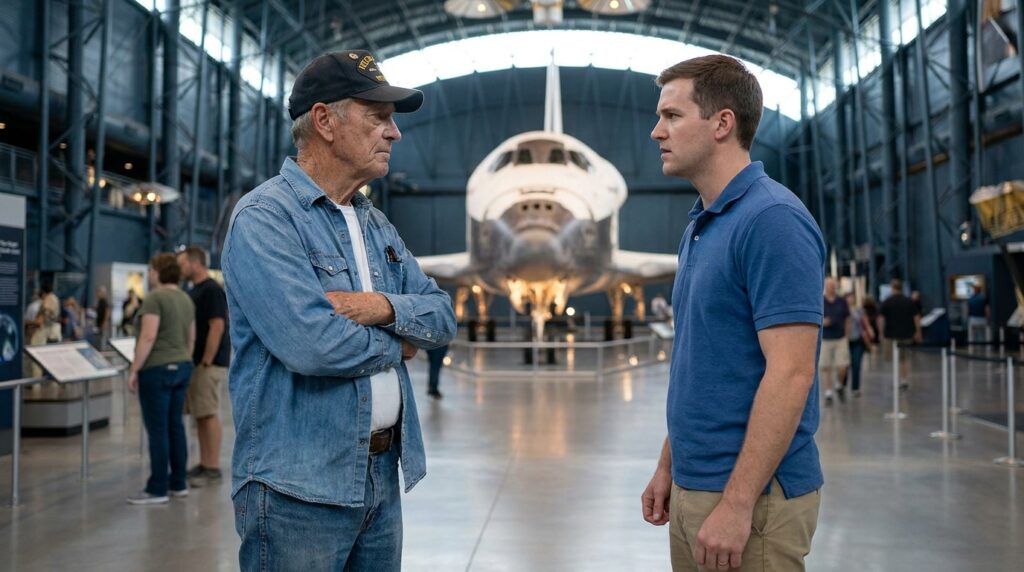
CHAPTER 8: THE COLD RUNWAY OF THE MINDS
The weight of the T-shaped manifold key dragged the right side of Frank’s jeans down until the coarse denim cuff scraped flat against the heel of his work boot. Every step out of the maintenance alcove was a lesson in ballast. The iron stem was ten inches of unyielding cold, pressing through his pocket liner into the dry skin of his thigh like a tire iron tucked into a bedroll.
He didn’t look back at the dark slot behind the metal lockers, and he didn’t check the open access panel beneath the space shuttle’s main gear strut. The hangar was empty now, its massive overhead mercury-vapor tubes clicking off one by one in a timed sequence that left the black thermal tiles of the underbelly swimming in a vast, subterranean blue twilight. The automated cleaning machine sat silent in the far corner, its dead batteries smelling faintly of boiled acid and lead.
Frank pushed through the heavy panic-bar of the administrative exit door. The seal broke with a soft, rubbery hiss that smelled of old vacuum grease, and then the winter air hit him.
It was five-fifteen. The sun had already dropped behind the limestone ridge that ran parallel to the state highway, leaving the parking lot spread out like a desaturated sheet of zinc. The macadam was cracked, its fissures filled with the gray salt crystal of the season’s first frost. Across the multi-lane blacktop, the red and neon-green canopy of the new corporate hotel flickered through the steam vents of a commercial laundry line, its bright, plastic presence an absolute contradiction to the forty feet of weapon-grade history sealed forty inches beneath his heels.
Frank walked toward his truck. It was an old eight-cylinder long-bed, the paint on the hood long ago bleached down to the gray primer coat by the sun of three different naval stations. He didn’t use the key fob; he turned the iron blade in the door lock manually, the internal cylinders dry and full of graphite dust that rasped against the brass teeth.
He sat on the cracked vinyl bench seat, the cold of the springs rising instantly through his denim trousers. He didn’t turn the ignition. He reached into his pocket and hauled the heavy iron manifold key out, setting it flat across the dashboard where the windshield defroster vents were clogged with dead pine needles. The white lead-paint stenciling—044-BUNK—glistened under the orange pulse of the highway lights.
His right hand stayed on the wheel, his thumb rolling the smaller brass nut against his palm. The metal was losing its heat now, returning to the ambient temperature of the cab, but the impression it had left in his flesh remained—a deep, hexagonal groove that wouldn’t clear for an hour.
Miller had been right about one thing: the registry didn’t matter anymore. The contractor who had taken the state money in ninety-two to bury the intake lines hadn’t been buying a retirement home; he’d been buying thirty years of silence from the municipal planning board. The whole aerospace museum wasn’t a monument to the sky; it was a three-million-dollar concrete cork driven into the neck of a forgotten cold-war bunker that the modern city had grown too large to acknowledge.
Frank leaned his head back against the glass of the rear window. The ache in his arthritic shoulder had settled into a dull, rhythmic thrum that matched the low, constant vibration of the interstate trucks passing a mile to the west. He thought about the kid in the blue polo shirt, whose uncle had helped pour the floor. The kid would go home with a bruised hip and a ruined pair of khakis, convinced he had simply crossed an old man with a short temper in a public museum. He would never know that his boot had been six inches from a high-pressure bleed valve that had been greased by hand before his mother had even been born.
The world out there—the one with the neon hotel signs, the timed core drills, and the corporate logistics schedules—moved with a frantic, shallow speed that assumed the past was just something you put behind a velvet rope. They thought they could drill three test holes through the center of a display lane because the computer map showed an empty drainage cistern. They didn’t understand that some things were built with an economy of force that required them to stay buried until the iron itself turned back into dust.
Frank reached out, his thick, calloused fingers wrapping around the crossbar of the iron T-key. He didn’t hide it in the glove box. He left it right there on the primer-gray dash, right where the morning sun would hit the white lead-paint when he came back through the gate at seven-thirty on Monday morning.
He turned the key in the ignition. The old eight-cylinder engine caught with a heavy, unshielded rumble that shook the rust flakes from the inside of the tailpipe, and as he shifted the long lever into reverse, Frank “Mac” MacAllister looked back through the mirror at the massive, silent shadow of the hangar canopy rising against the winter stars. He had two days before the drills arrived. It was more than enough time to reset the balance.








