
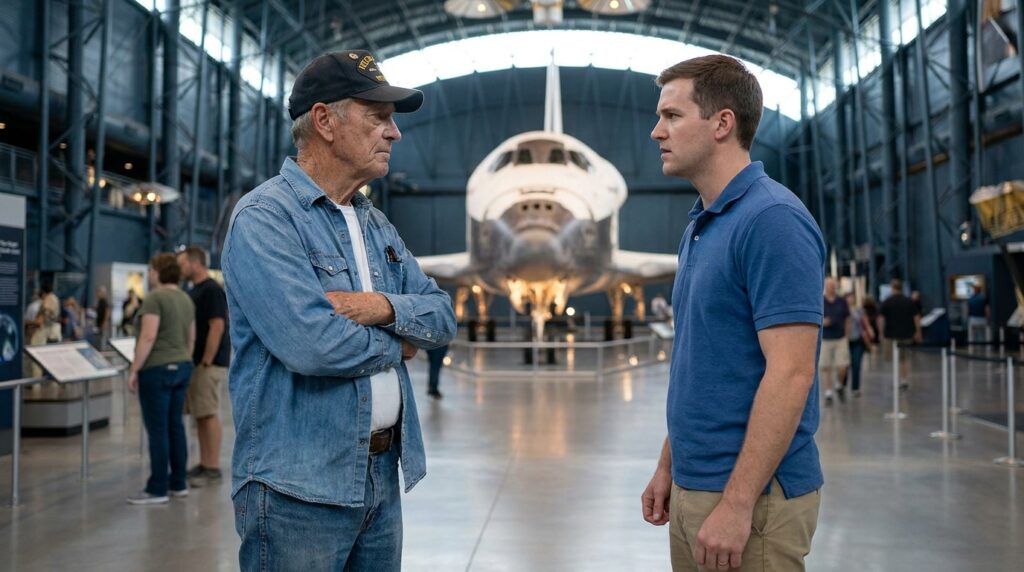
CHAPTER 6: THE RESPECT OF THE GUARD
The smell of Miller’s exhaust—stale battery acid and scorched copper—lingered in the corridor long after the red gleam of his cart’s tail-lamps cleared the far stanchions. Frank knelt. The movement was no longer mechanical; it was a slow calculation against the wet iron ache in his hip joint, his denim trousers stretching tight over his knee as he leaned down into the lime dust behind the stanchion’s base plate.
His fingers closed over the brass body of the sheared lock. It was heavier than the standard commercial models used to secure the facility’s display ropes—an old-pattern five-pin cylinder with a hardened steel shackle that had been severed cleanly by a portable hydraulic bite. The cut face was bright, entirely free of the brown oxide crust that covered the rest of the casing. Someone had used a silent, oil-cooled jaw to take this off, and they hadn’t done it from the floor level.
“MacAllister.”
The voice came from the dark lane between the administrative partition and the structural pillars of the wing. It wasn’t Miller. It was a leaner shadow, the footsteps clicking with the crisp, deliberate heel-and-toe strike of an active service uniform. Frank didn’t rise from his knee. He kept his left palm flat on the concrete, his thumb resting against the cold edge of the access panel while his right hand slipped the sheared brass body into his pocket next to the hexagonal nut.
A man stepped through the perimeter rope, his hand rising to touch the braided nylon with a familiarity that didn’t belong to a casual visitor. He wore the standard dark charcoal shirt of the senior facility staff, but his chest lacked the plastic name-tag and the laminated corporate barcode. Instead, three small, silver-plated screws held an antique ordnance inspector’s plate directly into the cloth above his pocket. His hair was cropped close to the scalp, the skin around his temples pale where a duty cap had rested until very recently.
“Miller said you were still hanging around the landing assembly,” the man said. He didn’t offer a name, but his eyes went straight to the gray grease smudges on Frank’s denim sleeve. “The tour buses left twenty minutes ago, Frank. The facility director wants the floor clear before the maintenance team brings the heavy rigging in for the western displays.”
“The rigging won’t hold if you set the outriggers on this section of the slab,” Frank said. He stood up slowly, using the thick aluminum stanchion to steady his weight until his boots were planted wide. “The steel underneath is hollowed out three feet past the main strut. You’ve got an eighteen-ton dead-load resting on an unreinforced cap, and someone’s already cleared the security pins from the lower valve guide.”
The man didn’t flinch. His face had the dry, desaturated texture of a career logistics officer who had spent twenty years reading cargo manifests in unheated warehouses. He stepped closer, his boots clicking once against the concrete before he stopped precisely two feet from Frank’s chest—the standard interpersonal distance of a formal inspection.
“The blueprints from ninety-two show a solid footer,” the man said, his voice dropping into a low, transactional cadence that didn’t carry past the shuttle’s tiled wing. “The city signed off on the structural density before the air force transferred the airframe. Whatever you think you remember about the old storage grid isn’t on the current registry, MacAllister.”
Frank reached into his shirt pocket. He didn’t pull the oil-soaked mimeograph sheet all the way out; he simply flicked the buttoned flap open with his thumb, allowing the man to see the purple ink lines and the hand-written grease-pencil signature at the bottom of the log.
The man’s gaze locked onto the scrap of paper. For three seconds, his jaw didn’t move. The shallow, rhythmic breathing of his chest slowed until his shoulders went rigid beneath the charcoal cloth, his eyes tracing the specific alphanumeric code—USAMC-ORD-44—stamped across the top margin.
“Where did you pull that from?” the man asked. His tone wasn’t administrative anymore; it had the sharp, hard ring of an officer who had just found a live primer in a scrap heap.
“Under the third bolt,” Frank said. He let the denim flap snap shut, his thumb returning to his lower pocket where the brass nut was warm against his thigh. “The grease on the threads is high-pressure tallow from seventy-four. The kind they used to seal the vent pipes on the ordnance vaults before they poured the public park over the top of the bunker. Your city engineers didn’t find a drainage cistern, son. They found the air cap for the lower chamber.”
The man looked down at Frank’s work boots, then back at the dark, narrow slit of the unsealed access panel. His right hand drifted toward his belt, his fingers hovering near a heavy ring of iron keys that hung from a brass clip, but he didn’t unhook them. He was calculating the cost of an exposure—not the public embarrassment of a museum dispute, but the systemic collapse of a logistical lie that had kept thirty feet of subterranean steel hidden beneath a layer of tourist concrete for three decades.
“The core drill is already scheduled for Tuesday morning,” the man said, his voice dropping so low it was almost lost beneath the distant, rhythmic thud of the main facility air compressors. “The work order came down from the state level. If I try to pull the clearance now, the regional office will send an investigative team to verify the structural variance.”
“Then you’ll have more than an old master-at-arms to worry about,” Frank said. He turned his back to the man, his eyes tracking the huge, dark shadow of the shuttle’s fuselage as it stretched toward the high glass walls of the hangar. “The secondary seal is brittle, Miller knows it, and you know it. If that drill bit hits the casing at thirty pounds of line pressure, the gas in that lower chamber won’t wait for the city to revise the map.”
The man didn’t move to stop him. He stood perfectly still under the towering canopy of the wing, his hands flat against his sides, his eyes fixed on the unsealed steel plate as if he could already see the old, rusted iron threads turning underneath the floor.
“We have two days,” the man said behind him.
Frank didn’t look back. He kept his feet moving toward the side corridor where the private benches were set near the old propeller engines, his leather soles catching the grit of the concrete with every slow, deliberate step.








