
CHAPTER 4: THE ACCESS CORE
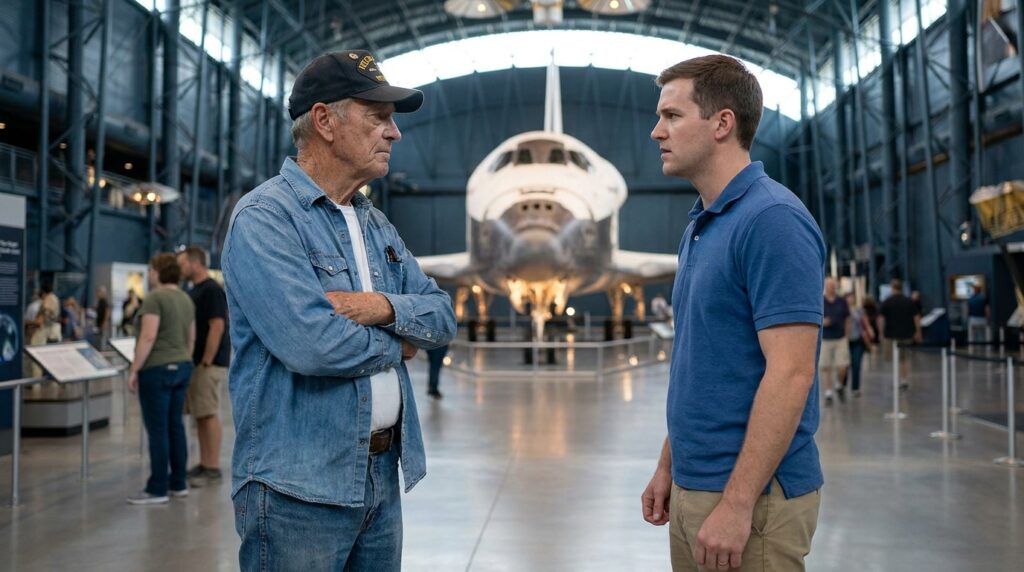
The fresh tallow smell was stronger when Frank dropped his hand from his belt loop. He didn’t bend his knees further; he simply let his weight settle lower into his boots, his gaze remaining fixed on the unsealed gap where the structural steel plate met the museum’s concrete floor. The kid stayed quiet, his shoulders rising and falling in irregular, shallow hitches against the aluminum railing, his hands flat on the stone like two dropped rags.
“You didn’t do this,” Frank said. His tongue felt thick, coated with the dry grit of the hangar’s air. He reached down, his blunt index finger tracing the edge of the unsealed steel plate. The metal was cold enough to stick to his skin, but the grease beneath it was fluid. It didn’t have the chalky texture of the commercial silicon lubricants the museum staff used on the display ropes. This was heavy-sulfur ordnance grease, designed to preserve structural threads against the corrosive moisture of deep storage bunkering.
“I told you,” the kid muttered. His voice was gaining a tight, thin edge of civilian indignation now that the physical shock was clearing his system. He wiped his palms down the sides of his dusty khakis, leaving two long, gray smudges across the front of his thighs. “I was just looking at the lower actuator arm. I saw the rope was down three inches on the western side. That’s all.”
Frank didn’t answer him. He slipped the brass nut back into his right pocket, letting it click against the small pocket knife he’d carried since his second tour in the Tonkin Gulf. His left hand worked into the narrow space behind the stanchion’s base. His fingers found the notched edge of a recessed service panel—an old inspection hatch that wasn’t marked on the public floor maps. The metal here was rougher, the factory paint flaking off in tiny, green scales that smelled of zinc chromate.
The small copper tag he’d heard snap earlier wasn’t a standard museum inventory label. As he turned it over in his calloused palm, the light from the shuttle’s high floodlights caught the stamped letters: USAMC-ORD-44. United States Army Materiel Command. Ordnance Division.
A low vibration passed through the concrete under his heels. It wasn’t the rhythmic thrum of the automated cleaning machine, which had moved toward the far end of the pavilion near the commercial airliner cockpits. This was a deeper, subterranean shudder, the kind that happened when heavy valves cycled through high-pressure lines three floors down. The tourists near the gift shop entrance didn’t notice it; their ears were tuned to the ambient chatter of the public address system and the soft chime of cash registers. But Frank’s boots had spent forty years on engine room gratings and steel decks. He knew the difference between a building’s air conditioning unit and the heavy mechanical breath of buried infrastructure.
“Get up,” Frank said. He didn’t look back to see if the kid obeyed. He kept his shoulder leaned against the shuttle’s main landing strut, using the bulk of his body to shield the open access panel from the three tourists who were still lingering near the perimeter ropes.
The kid scrambled to his feet, his joints popping with a dry, youthful snap that made Frank’s arthritic shoulder ache in sympathy. The boy stood three feet back, his athletic frame slightly crooked as he favored his left hip where it had taken the brunt of the concrete floor. His blue polo shirt was twisted at the collar, the fabric stained with grease from the stanchion rail.
“The security guard is coming,” the kid said. His eyes were darting toward the western corridor, where a small golf cart with a amber beacon was idling near the historic engine displays. “You need to tell him what happened. You can’t just throw people around in a public building.”
“The guard knows where the doors go,” Frank said. He pulled his hand back from the dark gap inside the panel. His fingers were slick with the gray tallow, and between his thumb and forefinger, he held a loose leaf of old, oil-soaked log paper. The edges were charred, the grid lines drawn with the purple ink of a military mimeograph machine from the late sixties. “You wanted to see the hydraulic schematics, son. Look at the bottom of the page.”
The kid hesitated, his short brown hair damp with sweat as he took a half-step closer. His gaze dropped to the stained scrap of paper in Frank’s hand. At the bottom of the log, beneath the column headings for pressure checks and fluid volumes, someone had hand-written a single line in thick grease-pencil: Vault 3-B secured under structural dead-load. Do not breach prior to decommissioning of carrier assets.
“What is that?” the kid asked. His voice had lost its defensive edge, dropping down into the same quiet register Frank used when the wind came off the runway. “This is a civilian museum. My uncle worked the procurement team when they brought the shuttle in from the air force base. He said the whole foundation was poured fresh in ninety-two.”
“Your uncle only saw the concrete they wanted him to pay for,” Frank said. He tucked the paper into his denim shirt pocket, buttoning the flap down until the brass snap clicked against his ribs. He turned his head slowly, his eyes locking onto the dark walkway that led beneath the shuttle’s tiled wing toward the administrative offices. “The foundation isn’t five feet deep. It’s an old roof.”
The yellow floor-cleaning machine near the emergency door gave a sudden, high-pitched whine as its brush assembly caught on a loose piece of wire, its red warning light spinning twice before the motor cut out entirely. The silence that followed was heavy, filled only with the cold, constant smell of old iron and the small, wet sound of the kid swallowing the blood from his lip.








