
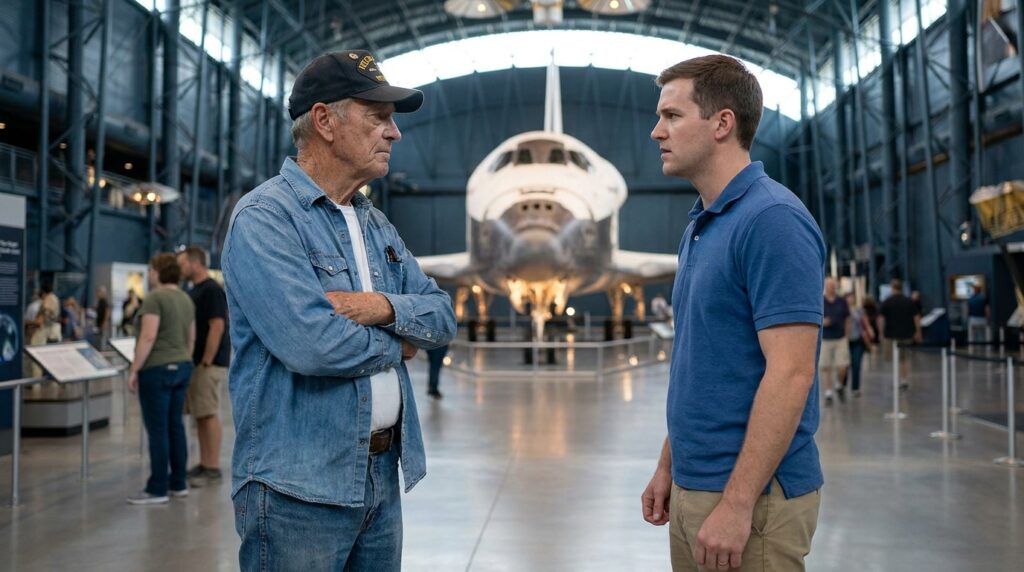
CHAPTER 2: THE ANGLE OF RESTRAINT
The copper wire’s snap was still expanding through the hangar’s rafters when the kid’s weight shifted forward. He didn’t know his balance was already gone. In the lexicon of the asphalt and the ready-room, a man who reached out with a stiff elbow was a man offering his ribs as a fulcrum.
Frank didn’t slide back. The worn rubber of his soles bit into the polished concrete, finding the gritty microscopic residue of old turbine oil and dust that never quite settled. His left hand—the skin thick and yellowed around the knuckles like old canvas—came up under the kid’s rising wrist. It wasn’t a blow. It was the simple application of iron against wood. He caught the sleeve of the blue polo, the fabric bunching beneath his fingers with a dry, heavy crunch, and stepped into the pocket of space the kid had left undefended.
“Hey—” the kid started, the syllable rising from his throat, sharp and thin.
The word never cleared his teeth. Frank rotated his hips precisely three inches to the left. It was the exact movement he had practiced on the wet decking of the USS Kitty Hawk while the sea threw spray over the catamarans, a mechanical repetition that stayed in the ligaments long after the names of the admirals had faded from memory. The kid’s own momentum became an anchor around his neck. Frank’s shoulder took the impact of the kid’s sternum—a dull, meat-and-bone thud that rattled the loose change in the kid’s khaki pockets.
Then came the floor.
The concrete didn’t give. When the kid hit, it wasn’t a clean slide; it was the flat, resonant slap of a hundred and eighty pounds of meat meeting five inches of reinforced slab. The impact went through the floorboards of the hangar, vibrating up through the rusted steel stanchions and into the safety rope, which whipped back and forth like a severed fuel line. A family three yards away—a man in a sunburned visor and two children holding plastic fighter jets—froze, their breath catching in a synchronous, small gasp that seemed to vacuum the air out of the immediate radius.
Frank didn’t look down. He dropped his center of gravity, his knees flexing into a low, triangular stance that kept his shadow spread wide across the floor. His breath came through his nose, rhythmic and cold, smelling of the stale tobacco and winter mints he kept in his shirt pocket. His right thumb remained hooked in his denim belt loop, his fingers steady against the brass nut. The metal was warm now, heated by the friction of his skin.
The kid lay on his side for two seconds, his short brown hair dusted with the white lime of the concrete. His eyes were wide, the pupils dilated until the dark centers swallowed the reflection of the shuttle’s overhead floodlights. His mouth worked silently, like an intake valve coughing on dry fuel, before he managed to drag a ragged chest of hangar air back into his lungs.
“Don’t,” Frank said. The word was small. It had the weight of an old lock clicking shut in an empty basement. “Don’t mistake the uniform for the man who wore it.”
The kid scrambled backward on his elbows, his neat khakis smearing against the gray floor, his boots kicking fruitlessly at the air until his spine met the square steel base of the space shuttle’s display stanchion. The aluminum rail groaned. A few more tourists had stopped now, their faces dark against the light of the entrance doors, their phones held low near their belts like small, square shields. Nobody spoke. In the American midwest, a public display of violence was an embarrassment that required silence before it required an officer; the crowd simply watched the geometry of the old man’s shoulders and waited for the kid to find his feet.
Frank kept his eyes on the kid’s hands. They were soft, the nails clipped clean, the fingers trembling as they dug into the concrete to find leverage. The arrogance had leaked out of the blue polo shirt the moment the hip met the floor, replaced by the sharp, metallic tang of adrenaline and public shame.
“I’m retired,” Frank said, his gravelly voice dropping down into the kid’s face, holding him against the steel base. “But my combat experience is still with me. Don’t mistake that.”
The kid didn’t answer with a curse. He looked at the faded lettering on Frank’s cap—VF-111 Sundowners—and then down at the wide, immovable placement of Frank’s work boots. His chest heaved once, twice, the fabric of his shirt stained with a dark patch of sweat between the shoulder blades. He was calculating now, but the math wasn’t corporate anymore; it was the basic arithmetic of a man who had just realized the old fence post he’d tried to kick over was actually a buried iron rail.
He took a slow, cautious half-step back along the floor, his knees pulling up toward his chin as if to decrease the target he presented. His mouth opened, closed, and then settled into a tight, thin line that tasted of gray dust.
“I understand,” the kid whispered, his voice cracking slightly before he caught the register. He didn’t look at the crowd watching him from the path. “I’ll back off.”
Frank didn’t move his boots. He stayed inside the triangular stance, his shadow locked over the younger man, while the loose copper wire on the landing gear above them continued its microscopic, rhythmic swing.








