
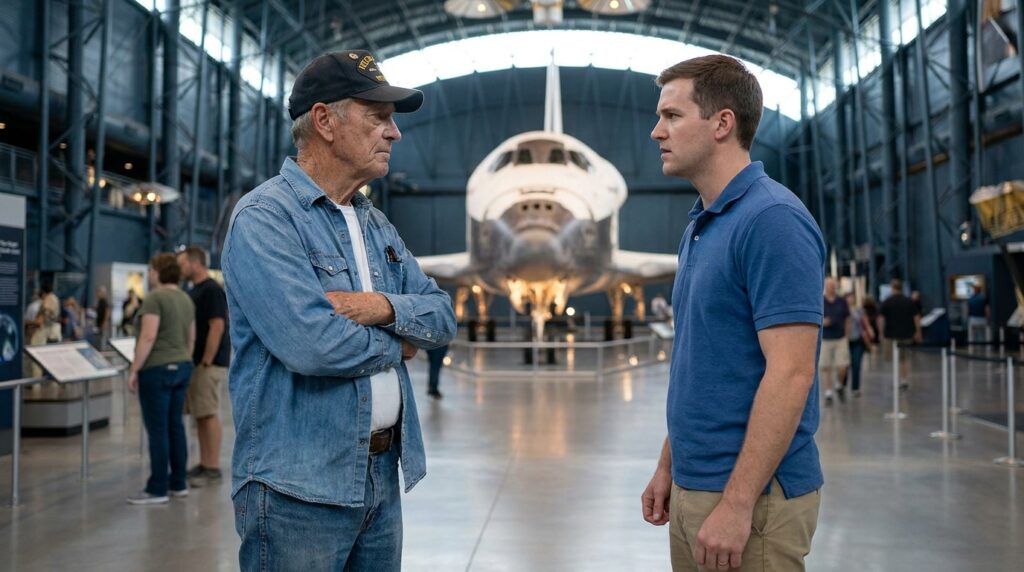
CHAPTER 3: THE COLD ANCHOR
The kid didn’t use the aluminum rail to stand. He slid flat against the square steel base plate, his heels scraping two pale, parallel tracks through the gray dust until his spine hit the vertical stanchion. The metal didn’t ring; it was too heavy, too thick with five decades of industrial lacquer to vibrate for a civilian. He kept his palms spread wide against the concrete, the white lime powder sticking to his sweat-slicked fingers like dry flour.
Frank didn’t look down at him. He kept his eyes fixed at a point three inches above the kid’s hairline, watching the jittery, erratic pulse in the boy’s carotid artery. The air between them remained thick with the smell of the winter mint Frank had chewed at ten o’clock and the sharp, chemical tang of modern laundry detergent from the polo shirt.
“Stay down until the air settles,” Frank said. His voice was old leather dragged over gravel, but it didn’t shake. The arthritic ache in his left shoulder blade was beginning to bloom now, a cold, familiar iron wedge driving itself beneath his collarbone, but he didn’t adjust his denim sleeve to hide it. “You rise too fast, your blood stays in your boots.”
The crowd twenty feet away had gone small. The family with the plastic fighter jets had drifted backward into the shadow of a twin-engine trainer display, the father’s hand wrapped tight around his son’s neck, pulling the boy’s face into his thigh. Nobody ran. In this part of the state, people didn’t scatter from an explosion of force; they watched it from the treeline, waiting to see if the secondary fire was coming. The only movement came from a small, yellow floor cleaning machine parked near the emergency exit, its battery charger humming a low, flat B-flat that vibrated through the soles of Frank’s work boots.
The kid pulled his right knee up toward his chest. His breathing had slowed from the frantic, shallow panting of a dropped animal to the rhythmic, heavy rasp of a man trying to convince himself his ribs weren’t cracked. His short brown hair was matted against his temple where it had caught the floor dust.
“You’re crazy,” the kid whispered. The slick, corporate grease was entirely gone from his tongue, replaced by the thin, metallic taste of a split inner lip. He didn’t look at the bystanders; his eyes stayed locked on the wide, greasy toes of Frank’s leather boots. “You could have killed me on this floor.”
“The floor didn’t move,” Frank said. He didn’t take his thumb out of his pocket. His thumb was still resting against the hexagonal flat of the brass nut, pressing the metal into his skin until the edge left a sharp, temporary groove in his flesh. “You’re the one who brought the speed. I just gave you an anchor to wrap it around.”
He shifted his weight by a fraction of an inch, his left boot pivoting on the concrete with a dry, gritty squeak. The movement made the kid flinch, his shoulders locking tight against the stanchion base. Frank saw the boy’s eyes drop to the aluminum display plate riveted into the steel—the one listing the weight, the fuel capacity, and the operational history of the hydraulic actuators beneath the shuttle’s main gear.
Right under the corner of that plate, where the heavy structural bolts met the floor, Frank noticed something he hadn’t seen during his seven-and-a-half-hour walkthrough the day before. The red wax inspector’s seal—the small, thumb-sized disc that federal logistics teams stamped over the access threads—was gone. In its place was a thin, oily smear of black grease that smelled faintly of high-pressure tallow, the kind they hadn’t used in the fleet since the winter of seventy-four.
The kid saw him look. Even with the white dust on his khakis and his breath rattling in his throat, the boy’s mind was still functional enough to recognize a shift in terrain. He stopped pulling his knees up. His gaze followed Frank’s eyes down to the dark gap between the steel plate and the concrete.
“I didn’t touch that,” the kid muttered, his hand twitching against the floor. “I was just looking at the lines. The rope was already slack.”
“The rope doesn’t matter,” Frank said. He turned his face back to the boy, his jaw tightening until the old scar beneath his ear—the one from the shattered canopy glass at Miramar—turned white against his weathered skin. “The grease is fresh. A man doesn’t get that kind of tallow on his fingers from a tourist brochure.”
The kid didn’t answer. He looked past Frank’s shoulder toward the bright glare of the museum lobby doors, where the modern glass panels reflected the silhouette of a state highway patrol vehicle parked out by the perimeter fence. His tongue came out, tasting the blood on his lip, his fingers curling into fists against the lime-dusted concrete. He wasn’t an impatient salesman anymore; he was a calculation that had run out of digits.
Frank stayed planted in the low, triangular stance, the cold steel of the shuttle’s landing strut rising behind him like an unyielding spine, while the yellow cleaning machine across the hangar clicked twice and began its second automated cycle.








