
CHAPTER 5: THE DUSTY RETREAT
The low, electric hum of the approaching security cart ground against the concrete, its amber beacon casting long, rhythmic slices of orange light across the black thermal tiles of the shuttle’s underbelly. The kid didn’t stay to argue. He didn’t wait for the guard to park the fiberglass vehicle or ask for a supervisor. He rose with a jerky, disjointed sequence of movements, his fingers catching the top rail of the aluminum stanchion to haul his weight upward, his boots leaving gray smears of lime dust across the polished floor.
He didn’t look at Frank. He looked at the floor, his head tucked into his shoulders as if trying to shrink the surface area of his blue polo shirt. The crowd of tourists—the small, silent circle that had formed near the cockpit replica—parted for him without a word. They didn’t ask if he was hurt; they didn’t offer a hand. In the vast, cold space of the hangar, an unmoored man who had just been dropped by an elder was a social contaminant. The boy bled back into the wide public corridor, his modern canvas shoes clicking with a rapid, uneven hitch until the bright glare of the exit foyer swallowed his shadow entirely.
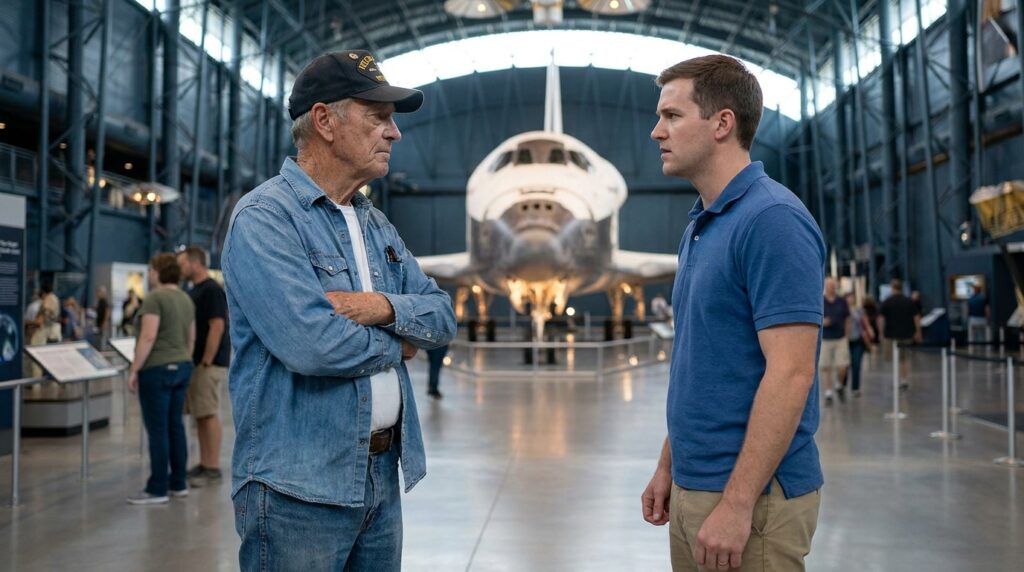
Frank remained standing in the shadow of the landing strut. The buttoned flap of his denim shirt felt tight against his ribs where the oil-soaked log paper rested. He didn’t adjust his cap. His right hand went back to his pocket, his fingertips finding the brass nut, but the cold wedge in his shoulder had spread down into his elbow now, a dull, throbbing ache that reminded him his marrow was as old as the airframe above him.
“MacAllister,” a voice called out from the golf cart. It wasn’t loud. It had the flat, tired cadence of a man who spent ten hours a day watching security monitors in a building that never changed.
The cart stopped three feet outside the boundary rope, its small tires squeaking against the concrete finish. The guard behind the wheel was a heavy-set man in his early sixties named Miller, his gray uniform shirt stretched tight over a stomach that had once been iron during his time with the military police in Frankfurt. He didn’t get out of the seat. He rested both thick forearms on the black plastic steering wheel, his eyes scanning the empty space where the kid had been, then drifting down to the open service panel behind Frank’s boot.
“The kid looked like he was carrying a short leg,” Miller said, his gaze settling on the gray dust patterns on the floor. “He hit hard?”
“He brought too much speed for the turn,” Frank said. He didn’t move his boot away from the open panel, but he tilted his shoulder back against the landing gear casing, hiding the loose copper wire with his torso. “He was leaning on the stanchion. The rope gave an inch.”
Miller looked at the stanchion. Then he looked at Frank’s right hand, which was still tucked into his denim pocket. He knew the look of an old master-at-arms; he knew that men who had spent thirty years on flight decks didn’t call for assistance when a civilian got loud. But he also knew the specific, unyielding geometry of the floor plates beneath the shuttle.
“The director’s been looking at the logbooks for the western wing, Frank,” Miller murmured, his voice dropping below the steady whine of the cart’s battery charger. He reached down to turn the key, cutting the ignition until the amber light stopped its rhythmic sweep across the tiles. The silence that rushed into the gap was sudden and cold, smelling of the damp earth that always managed to seep through the lower foundation seams during a frost. “The blueprint office in the city says we’re showing a variance in the load-bearing columns under this section. Three inches of drift since the frost in late November. They think the concrete is settling into an old drainage culvert.”
Frank’s fingers tightened around the brass nut in his pocket. “It’s not a culvert.”
“They’re bringing a core drill in on Tuesday,” Miller continued, ignoring the interruption with the stubborn patience of an old clerk. “They want to sink three test holes right through the center of this display lane. Right where you’re standing. They think the old municipal map from sixty-eight shows an empty cistern under the foundation.”
A cold draft passed over Frank’s ankles. It didn’t come from the main entrance doors, which were sealed against the winter wind, and it didn’t come from the overhead heating ducts. It was a thin, high-pressure whistle that smelled of old sulfur and rust, rising directly from the unsealed dark behind his heel.
Frank didn’t shift his boots, but his eyes dropped to the base of the stanchion where the kid’s weight had slammed into the steel plate. Tucked into the narrow, dark crevice between the iron riser and the concrete—hidden from Miller’s angle by the shadow of the tire—was a heavy, old-pattern Master Lock. The brass body was pitted with green corrosion, but the steel shackle hadn’t rusted through. It had been cleanly sheared by a hydraulic cutter, the bright, unoxidized silver of the internal steel face glistening like a small, cold tooth in the dust.
The decoy logbook in his pocket wasn’t the only thing that had been left behind. The layout anomalies weren’t structural failures from a settling foundation; someone had been down here with iron tools within the last forty-eight hours, and they hadn’t used the service stairs to get in.
“Tell the director the drill will crack the secondary casing,” Frank said. His voice was flat, devoid of the gravelly warmth he usually kept for the old guards. He looked Miller straight in the eyes, his jaw set until the scar near his ear pulled tight. “The concrete under this strut isn’t five feet deep. If they drop an air-hammer through that slab on Tuesday, they won’t find a cistern. They’ll find out why the city didn’t build an interstate through this valley.”
Miller stared at him for three seconds, his heavy hands remaining motionless on the plastic wheel. The tired, institutional indifference in his gray eyes flickered for a fraction of a second, replaced by the sharp, defensive calculation of a man who had seen the old manifests from the ordnance depots before the state turned them into public parks. He didn’t ask about the sheared lock. He didn’t look at the panel. He simply turned the key, the golf cart’s electric motor catching with a low, sullen click that shook the fiberglass frame.
“I don’t write the work orders, Mac,” Miller said, his voice rising to clear the noise of the engine as he shifted the lever into reverse. “I just check the badges at the gate.”
The cart backed away into the gray light of the central aisle, leaving Frank alone under the massive, silent weight of the tiles, the sheared brass padlock still waiting for him in the dust behind his boot.








