CHAPTER 8: THE SECURED LINE
“The pressure is down to zero across the entire bypass ring,” the radio on Officer Miller’s shoulder announced, its static sharp but short against the low, heavy idle of the municipal vacuum truck.
Arthur didn’t give a verbal reply. He kept his weight resting over the head of a massive, cold-rolled steel survey monument, his boots planted firmly on the wet, crushed limestone that the crew had just dumped into the washed-out cavity. The foul, oily odor of the ancient coal tar was slowly dissipating, replaced by the crisp, dry dust of fresh aggregate and the clean smell of turned earth. He raised his heavy ten-pound sledgehammer, his muscles burning with the deep, aching exhaustion of a full day’s labor, and brought the face down onto the steel pin with a flat, final clank that echoed down through the subgrade.
The monument sank its final two inches into the substrate, locking the municipal easement boundary into the county bedrock with an unyielding mechanical click.
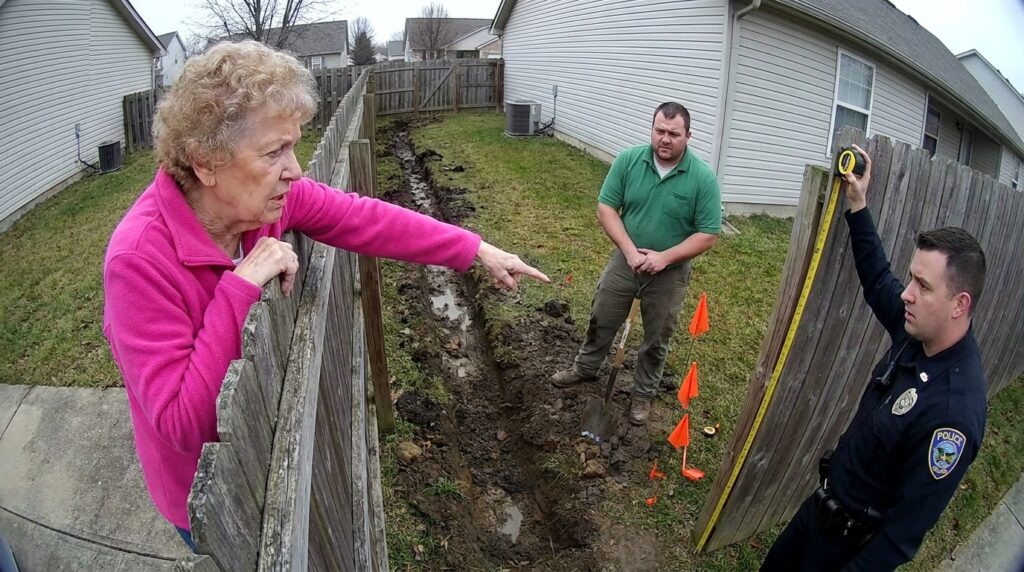
The side yard had changed its shape entirely. A four-foot section of the weathered cedar privacy fence hung crookedly, suspended by temporary steel cables anchored to the flatbed truck. The exposed concrete footer of the sunroom was no longer hidden behind matted crabgrass or thirty-year-old boxwood roots. It sat naked under the gray afternoon sky, its jagged three-inch structural fissure traced in orange chalk by the county building inspector who had arrived with the remediation crew.
Officer Miller walked slowly along the edge of the newly filled trench, his leather duty gear making a quiet, rhythmic scrape with each step. He checked the alignment of the new steel pin against his digital pad, his face settled into the stiff, dry neutrality of a man who had successfully transferred a neighborhood crisis into a matter of municipal record.
“The county surveyor just logged the amendment, Arthur,” Miller said, his thumb clicking the screen off as he stepped back onto the dry pavement. “The eight-foot easement is permanent now. No one’s moving this marker without a district court order.”
Arthur wiped his brow with the back of his muddy sleeve, leaving a dark gray smear across his forearm. He looked across the new boundary line. Marilyn was sitting on the low brick border of her ruined garden path. She had pulled the sleeves of her wet pink fleece jacket down over her hands, her shoulders hunched forward as she stared at the orange chalk line marking the unpermitted foundation of her home. The broad, authoritative silhouette she had maintained all morning had completely dissolved; she looked like any other resident facing the slow, indifferent machinery of a county citation.
“The structural engineers will issue the stabilization order by tomorrow morning, Marilyn,” Miller said, his voice dropping into a level, transactional register as he stood near the gate. “The county will require a full helical pier installation to underpin the sunroom before they can close the violation file. It’s going to have to be done from the interior.”
She didn’t look up at him. Her eyes remained fixed on the spot where the old forged iron spike had sheared off—the little circle of rusted scale that was already being covered by the gray limestone dust from the utility truck. “He told me it was done right,” she whispered, her voice carrying no heat, just the cold, flat weight of a realization thirty years delayed. “He said the city would never have a reason to look down there if we kept the surface clean.”
Arthur reached down, grabbed his sharpshooter spade from the grass, and tossed it into the open rack of the utility flatbed. The metal hit the iron frame with a sharp, familiar ring that signaled the end of the shift. He didn’t offer a word of comfort, and he didn’t look back at the crooked fence or the cracked foundation as he pulled on the heavy lever of the truck’s hydraulic hoist.
The new fiberglass conduit was already nesting deep in the limestone trench, a clean, smooth line of modern infrastructure running straight through the earth where the old secret used to sit.
“I’ll wait until you’re finished with the paperwork, Officer,” Arthur said, his voice low and flat as he climbed into the cab of the idling truck, his gloved fingers wrapping around the cold steering wheel. “We’ve got another three hundred feet of main to clear before the pool closes on Friday.”
Miller nodded once, his pen drawing the final cross-hatch on his grid paper as the vacuum truck began to coil its heavy hoses, its orange warning lights fading against the gray, unyielding lines of the suburban block.