CHAPTER 6: THE STRUCTURAL WEAVE
The gray mud sucked violently at Arthur’s heels as he rolled clear of the trench edge, his chest heaving against the cold grass. The dark, oily water continued to bubble from the sheared mouth of the old iron casing, its surface reflecting a distorted, rainbow sheen under the flat daylight. The foul stench of long-buried coal tar and septic gases expanded outward, a heavy, invisible wall that hit the back of his throat like wood smoke.
Officer Miller stepped back two full paces, his heavy leather duty boots crunching into the dry crushed limestone of the side path. He already had his radio microphone unclipped, his thumb driving down on the side toggle. “Dispatch, this is Unit Four. Upgrade my call at 114 Orchard Lane to a Code Three utility emergency. We have an active breach on an un-mapped commercial main. Contact the municipal environmental coordinator and tell the utility supervisor to pull the pressure logs for the old Orchard Vale loop.”
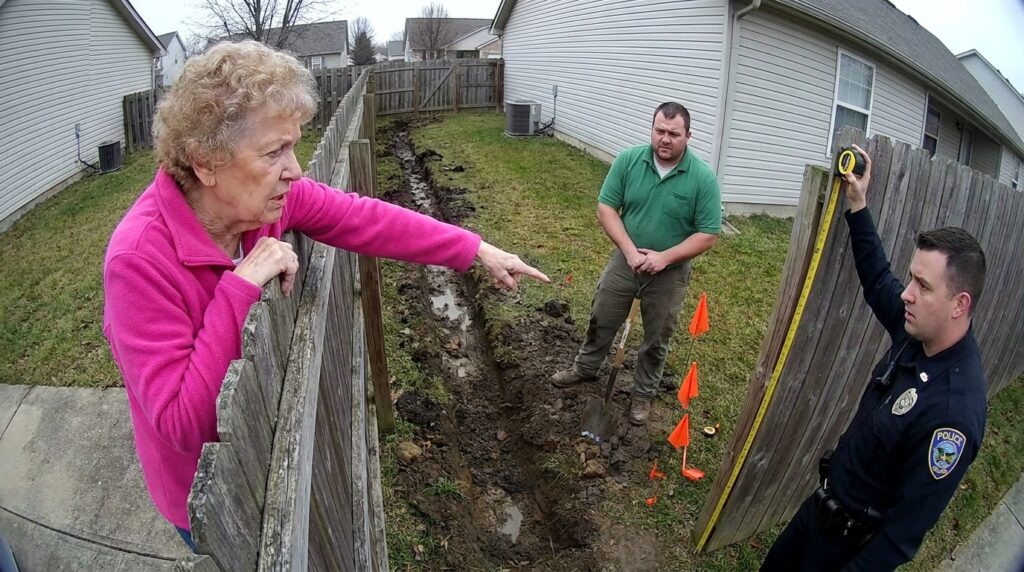
“Donald, look at the fence!” Marilyn’s voice cut through the static of the officer’s shoulder unit. She had abandoned the security of the gate, her boots sinking straight into the damp sod of her garden border as she scrambled toward the leaning cedar panels. The broad silhouette of her pink fleece jacket shook against the gray background of her house. “It’s dropping! The footer is dropping into that hole!”
Arthur pulled himself up onto his knees, wiping a thick smear of gray clay and pungent grease from his cheek with the sleeve of his polo shirt. The ground beneath the wooden fence posts was visibly groaning. The steady, wet hiss of the escaping fluid was carving out the loose gravel and the pulverized limestone backing that had held the old steel plate in place for thirty years. Deprived of its uncompacted ballast, a four-foot section of the cedar privacy wall began to settle into the trench, the panels twisting out of alignment with a loud, tearing splinter of wood.
“Stay back from that line, Marilyn,” Miller warned, his arm extending horizontally to bar her path as he watched the fence rail warp. “The whole substrate is washing out into Arthur’s cut. If that footer goes, the structural corner of your rear sunroom is sitting less than ten feet from the slide.”
“My husband laid that concrete himself,” she said, her voice fracturing as she watched the black fluid rise toward her ankles. Her hands remained curled into tight fists inside her fleece pockets. “He used four-inch commercial mesh. He told me it would hold anything. He said the city could never undermine the foundation if the iron pin stayed driven.”
Arthur gripped his spade, using the metal neck to stabilize his stance as he stood up on the slick grass strip. He wasn’t tracking her panic; he was looking at the way the dark water was channeling. It wasn’t rising evenly. It was erupting from a targeted void directly beneath the fence line, a cavity where the native clay had been completely replaced by an ancient, unpermitted timber retaining wall that was now rotted through.
“Officer,” Arthur said, his voice flat with the clarity of a man who worked with structural failure every day. “The pin wasn’t driven to mark a property line. Her husband used that iron spike to pin an illegal sleeve over a fractured section of the old bypass main. When they built the sunroom foundation in ninety-six, they poured the concrete directly onto the municipal easement’s safety shelf to hide the repair.”
Miller turned his head sharply, his flashlight beam slicing through the rising mist of petroleum vapor to find the cracked edge of the concrete footer now hanging exposed over the bubbling trench. “Marilyn, is that what happened? When the developer signed the covenant, did your husband bury the old junction box to keep the county from condemning the easement lane?”
The old woman didn’t reply. She stood perfectly still on the waterlogged turf, her face desaturated under the pale sun, her broad frame suddenly looking frail inside the bright pink fabric. She didn’t look at the officer, and she didn’t look at the neighbors who were now retreating down the sidewalk as the septic odor reached the curb. Her eyes were fixed entirely on the exposed, rusted steel plate—the false bottom of her entire estate—now slowly tilting into the municipal mud as the earth reclaimed its history.
“We couldn’t afford the remediation,” she whispered, her lips barely moving against the cold wind. “The developer said if the county found the cracked main under the line, they’d pull the building permits for the whole block. My husband did what he had to do to save our home.”
The sound of heavy diesel engines began to rattle the entrance of the subdivision as the first municipal vacuum truck turned onto Orchard Lane, its warning lights casting a pulsing, orange glow across the gray cedar fences.