CHAPTER 5: THE SUBTERRANEAN ANCHOR
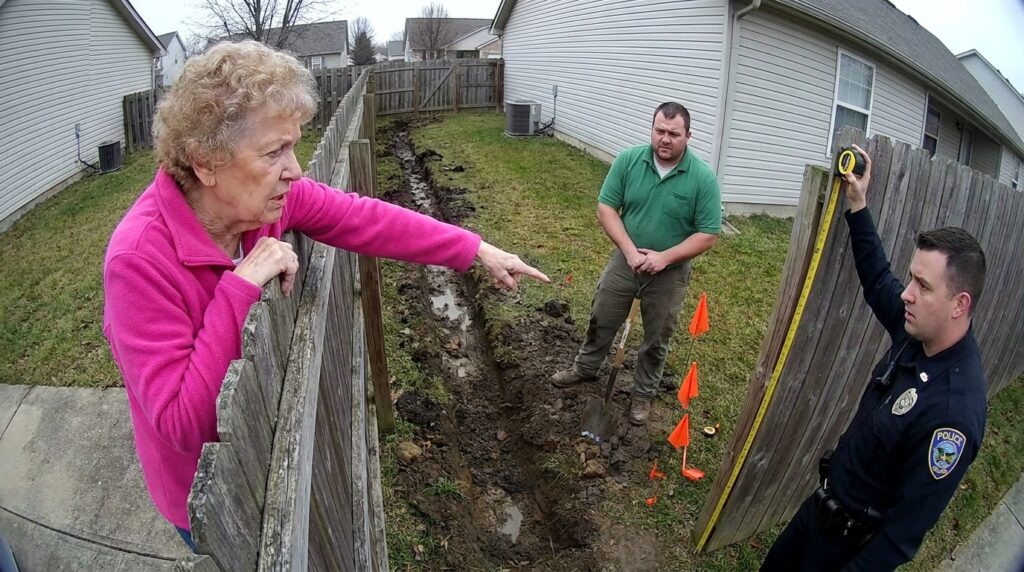
The yellow beam of Officer Miller’s flashlight wavered against the wet, gray walls of the ditch as Arthur shifted his weight, his mud-slicked fingers seeking a firmer grip on the cold ash wood of his shovel handle. The air inside the four-foot cut was growing colder, heavy with the sharp, sour odor of stagnant water and the unmistakable chemical tang of forty-year-old unrefined petroleum.
“Don’t wedge the blade underneath that lip, Arthur,” Miller said, his voice clipped as he leaned over the loose pile of dirt. The leather of his duty belt groaned against his hips. “If that’s an old water district isolation plate, the structural seal could be holding back whatever the developers buried when they cleared the orchard lane.”
Arthur didn’t pull back. He set the tip of the trenching tool against the flange of the steel plate, just three inches from where the ancient square iron pin pierced the metal eyelet. He applied single, deliberate pressure with his boot heel. The steel blade didn’t slice through the clay; instead, it hit the horizontal obstruction with a harsh, vibrating clink that rattled up through his shins and settled into the small of his back. The ground beneath his feet shifted slightly—a subtle, greasy slide of uncompacted gravel and crumbling chunks of black asphalt.
Across the cedar rail, Marilyn let out a sharp, shallow breath. Her knuckles had gone completely white against the gray wood, her broad frame leaning forward so far that the zipper of her pink fleece jacket rattled against the fence slats.
“I told you to leave it be,” she whispered. The heat had left her voice, replaced by a brittle, defensive precision that sounded like a warning. “Donald, tell him to get out of that hole. He’s going to ruin the grade. If he drops the drainage line any lower, my boxwoods won’t survive the winter runoff.”
“The grade isn’t the problem right now, Marilyn,” Miller said without looking at her. He clicked his notepad shut and shoved it into his rear pocket, his gaze locked on the small trickle of dark, iridescent fluid that had just begun to seep from the edge of the corroded steel plate. The fluid was thick, sluggish, and carried the pungent reek of old rust and coal tar. “Arthur, back off half a step. Let me get a look at the stamp on that casing.”
Arthur dropped his shoulder, scraping a heavy wedge of gray clay from the top face of the plate with his smaller hand trowel. The rough iron surface was severely pitted, covered in a thick layer of orange, flaky scale that fell away in brittle crusts under his touch. Beneath the rust, stamped into the iron in raised, blocky letters that had been deformed by decades of underground pressure, were the words: ORCHARD VALE UTILITY CORP — JUNCTION 4 — 1974.
Miller’s flashlight beam held steady on the text. The officer remained completely motionless for three seconds, the low hum of his idling cruiser the only baseline in the quiet suburban side yard.
“Orchard Vale went bankrupt before the county took over the district lines,” Miller murmured, his thumb rubbing the brass edge of his uniform buckle. “The whole system was supposed to be dug out and re-routed when they laid the foundations for this block in ninety-six. The developer’s report stated every single secondary main along this easement was clear and backfilled with standard aggregate.”
“They missed this one,” Arthur said. He knelt down further into the slick, gray mud, his work pants soaking through completely as he traced the perimeter of the plate with his gloved thumb. The metal extended deep into the bank, disappearing directly beneath the concrete footer of Marilyn’s privacy fence. The thick, square iron pin wasn’t an arbitrary boundary marker driven by her husband; it was an active structural locking pin, driven straight through the casing to anchor a massive, un-mapped junction box that was sitting exactly where the municipal contract required Arthur to lay the new six-inch fiberglass conduit.
“My husband didn’t miss anything,” Marilyn said. She stepped down from the garden brick, her boots crunching into the dry gravel of her side path as she walked toward the corner gate. Her face was tight, her oversized sunglasses pushed up into her short gray-blonde hair, revealing small, red-rimmed eyes that looked less angry now than completely exhausted. “He spent three thousand dollars out of his own pocket to keep the county from tearing up the yard when the kids were small. He did what he had to do to protect this house.”
“By driving a commercial anchor into an open variance line without an inspector’s signature, Marilyn?” Miller asked, his voice dropping into a hard, pragmatic register that brooked no neighborly deference. He stood up, his boots leaving two deep, watery imprints in the loose sod at the edge of the trench. “If this box is still connected to the old secondary main down on the bypass, we’re looking at an unpermitted structural bypass sitting directly on the municipal right-of-way.”
Arthur reached down to clear one more handful of the loose limestone backing from the base of the iron pin, but the moment his fingers brushed the rusted shaft, a sharp, hollow crack echoed from the bottom of the cut. The iron spike didn’t just shift; it sheared clean off at the collar, its heavily corroded core revealing a dark, dry void inside the metal.
Immediately, the sluggish trickle of coal tar turned into a steady, bubbling hiss. The dark, oily water began to rise around the toes of Arthur’s leather boots, the foul odor of ancient sewage and old petroleum gas expanding into the humid morning air with the force of an active ventilation leak.
“Get out of the hole, Arthur,” Miller commanded, reaching down to grab the collar of Arthur’s green polo shirt with one heavy, mud-stained hand. “Get out now.”
Arthur scrambled up the slick slope of the ditch, his boots losing traction twice against the wet gray clay before his fingers found purchase on the matted crabgrass roots at the edge. He pulled himself flat onto the sod just as a heavy, hollow thud rattled the bottom of the trench, the steel plate groaning as the internal pressure of the old utility main began to displace the uncompacted gravel beneath the fence.
Across the lawn, three neighbors who had been watching from their porches stepped down onto the asphalt, their phones held low but steady as the foul smell reached the street. Marilyn didn’t look at them. She stood by the cedar gate, her hands tucked deep into the pockets of her pink fleece jacket, watching the dark, oily fluid slowly fill the fresh utility cut until it touched the very bottom of her husband’s weathered cedar posts.