CHAPTER 4: THE TAUT STRAP
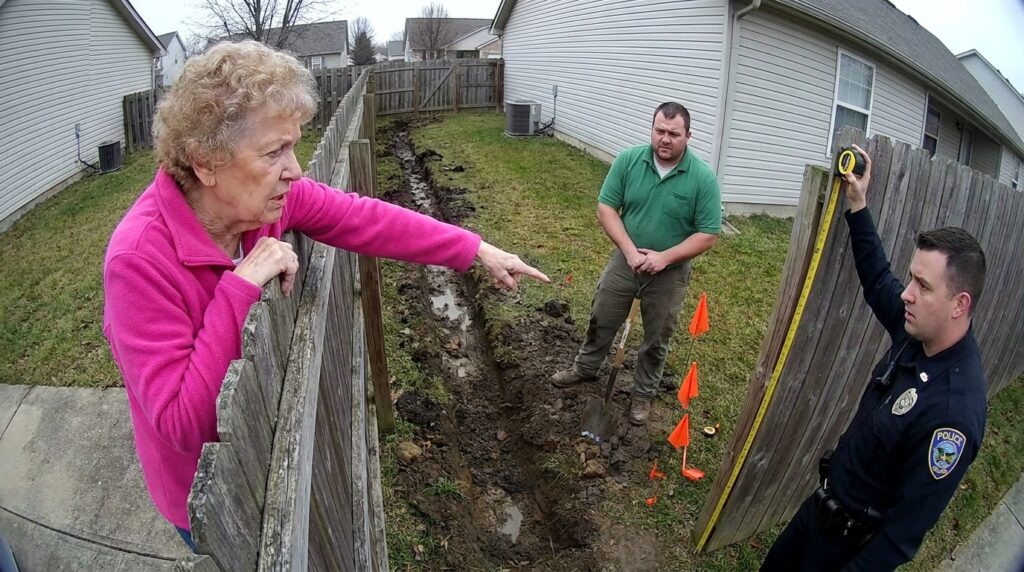
The radio inside Officer Miller’s distant cruiser barked with a burst of static, a dry, robotic voice echoing across the suburban pavement before dissolving into the hum of the neighborhood. Arthur didn’t move from his position in the trench. He kept his hands resting on the worn ash handle of his shovel, using the tool to anchor himself against the slick, sloping walls of gray clay. Across the top rail of the cedar fence, Marilyn remained fixed, her hands gripping the weathered wood so tightly that the white of her knuckles seemed permanently pressed against the grain.
The silence between them grew heavy, filled only with the sharp, rhythmic ticking of the utility truck’s cooling engine down the street. The air carried the cold, sour smell of turned earth mixed with the chemically sweet scent of fertilizer from Marilyn’s lawn borders.
“You think you’re smart, don’t you?” she said, her voice dropping into a low, raspy whisper that barely cleared the cedar slats. Her sunglasses caught the pale morning sun, twin mirrors reflecting Arthur’s mud-stained green polo shirt and the dark gash of the trench. “You think because Donald has to check his little computer in the car, you’ve won something here.”
“I’m not trying to win anything, ma’am,” Arthur said. He kept his eyes on the square head of the iron pin between his boots. The metal was heavily pitted, its rusted scale flaking off under the dampness of the clay to leave dark, greasy stains on his fingertips. “I just have three hundred feet of main line to lay before the county inspector locks the permit pool on Friday.”
“My husband spent thirty years keeping this patch clear,” she said, her chest rising sharply against the bright pink fleece of her jacket. She leaned further over the rail, her shadow stretching across the trench until it touched the blade of Arthur’s shovel. “He knew every line, every pipe, every tile beneath this sod. When the water district tried to run the old secondary main through the orchard lane in ninety-two, he stood right where you’re standing with a cold-rolled bar until they moved the flags. He didn’t let them cut then, and I’m not letting you cut now.”
Arthur didn’t answer. He had heard variations of the orchard lane story from three different residents since his crew entered this development, but none of them had mentioned an active redirection of the main. He knelt down again in the slick mud, the fabric of his work pants drawing in the cold moisture of the substrate. Using his smaller trenching trowel, he carefully scraped away the impacted gray clay surrounding the shaft of the mysterious iron pin.
The deeper he cleared, the more the ground changed. The native clay gave way entirely to a crude, packed layer of coarse gravel and chunks of ancient, broken asphalt that didn’t belong in a residential side yard. It was a localized backfill, poorly compacted and dense with the smell of stagnant water and old petroleum. Two inches below the level of the municipal survey flags, the blade of his trowel hit a flat, horizontal surface with a dull, hollow thud that didn’t sound like natural stone.
Marilyn’s breath hitched. Through the fence, Arthur heard the distinct, sharp rustle of her fleece jacket as she drew back half a step, her boots scraping against the brick border of her garden.
“Leave that alone,” she commanded, the volume returning to her voice, thin and brittle with an edge that wasn’t just anger. “I told you not to touch that iron until Donald got back.”
“I’m just clearing the shelf so the officer can see the base, ma’am,” Arthur said softly. He didn’t look up, but his fingers traced the edge of the horizontal obstruction he had just uncovered. It was an old steel plate, heavily corroded and slick with orange grease, running directly underneath the root ball of Marilyn’s prized boxwood. The iron pin wasn’t a property marker at all—it was a heavy structural stake driven through a pre-drilled eyelet in the plate, anchoring it down into the shifting substrate like a wedge.
Across the lawn, the door of the police cruiser slammed shut with a heavy, double-clicking thud. Officer Miller walked back toward the side yard, his leather duty gear creaking rhythmically with each stride. His notepad was tucked beneath his arm, and his face had settled into the stiff, guarded expression of a public servant who had just been given a bureaucratic headache.
He stopped at the edge of the trench, his eyes going straight to the widened hole Arthur had cleared around the iron head. He didn’t look at Marilyn until he had clicked his heavy flashlight back into its plastic ring on his belt.
“The recorder’s office doesn’t have a record of a private corner pin for this parcel, Marilyn,” Miller said, his voice level but dry. “But they do have an open variance flag from ninety-five that was never signed off by the engineering inspector. The original plat shows the municipal easement extends a full eight feet from the asphalt edge along this entire block because of an old utility junction that was listed as abandoned before the subdivision was platted.”
Marilyn’s fingers twitched on the top rail of the cedar fence. “The city gave up that right when they signed the developer’s covenant, Donald. You know that as well as I do.”
“The city didn’t give up anything,” Miller said, his thumb resting against the leather edge of his notepad. He turned to Arthur, his gaze dropping down to the exposed steel plate beneath the boxwood roots. “Arthur, what did you find down there?”
Arthur wiped his trowel against the grass, his eyes fixed on the point where the rusted iron pin pierced the plate. “It’s a non-municipal anchor, Officer. Someone drove a commercial isolation stake right through a structural cap. It’s sitting directly over the path of our new trench line, six inches deeper than the city flags.”
Miller knelt down, his uniform trousers straining as he leaned into the cut to shine his light onto the orange grease. The yellow beam illuminated the pitted, flaky texture of the steel cap, revealing the faint, stamped letters of an old industrial foundry that had closed before the turn of the century. The discrepancy was no longer a matter of maps or fence lines; it was a physical barrier buried in the gray clay, intentionally hidden beneath a layer of old asphalt and a forty-year-old boxwood hedge.
“Well,” Miller murmured, his pen tracing a sharp, heavy line across his grid paper. “That explains why the digital survey looked clean on the surface. Someone buried this line deep enough to clear the standard agricultural probes, then drove that stake to keep the whole works from shifting toward the house.”
He stood up, looking across the fence at Marilyn. The old woman hadn’t taken her eyes off the exposed steel plate. Her sunglasses had slipped further down her nose, revealing the small, deep-set lines of panic around her eyes that her pink fleece could no longer mask.