CHAPTER 2: THE RECONSTRUCTION OF BOUNDARIES
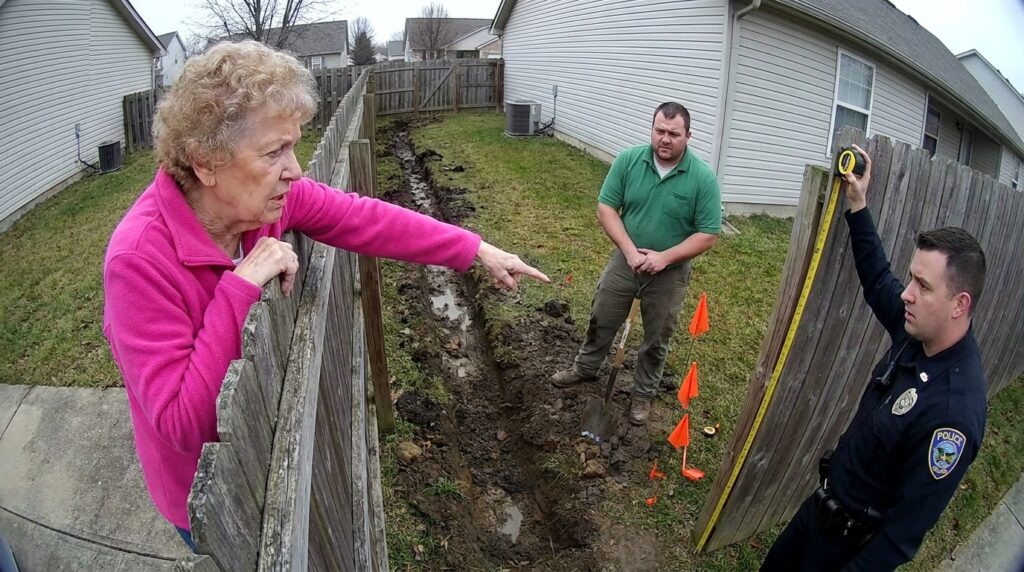
The screech of local police brakes over unswept road gravel cut the humid air before the engine fully died. Arthur didn’t drop the spade; he simply shifted his weight, his work boots sinking deeper into the soft, raw edge of the trench. The damp gray clay held the tread of his leather soles like a mold. Across the cedar rail, the old woman’s hand didn’t shake as she lowered the phone. Her face remained a hard, fixed mask of historical ownership, her bright pink fleece jacket a jarring stain against the muted, sun-bleached tones of the suburban development.
The cruiser door slammed with a heavy, metallic thud that resonated through the soles of Arthur’s feet. Officer Miller—his dark hair cropped short, his utility belt clicking with the rhythmic, plastic weight of institutional routine—stepped onto the grass strip. He didn’t look at the neighbor first, nor at Arthur. His eyes went straight to the bright orange flags, checking the alignment against the curb line before his boots met the edge of the newly turned sod.
“Marilyn,” Miller said, his tone flattened by years of the same domestic boundaries, the same shifting fence lines. “What are we doing out here?”
“He’s trenching my drainage easement, Donald,” she said, her voice dropping into a register that assumed compliance. She pointed a single, liver-spotted finger downward, her nail black with garden loam. “The county plat clearly states the property line terminates four inches out from the cedar posts. He’s already cut through the root ball of the boxwood my husband planted for the bicentennial. It’s willful destruction of private property.”
Arthur wiped his palm against his work pants, leaving a dark streak of mud across the green polo shirt. “The city infrastructure work order is pinned to the dashboard of the utility truck, Officer. Six-foot municipal easement from the asphalt edge. The flags were set by the surveyor on Tuesday morning.”
“The surveyors don’t live here,” Marilyn snapped, her chest rising against the pink fleece. “They don’t know where the old iron pins are. They look at a satellite screen in an office forty miles away and tell an ordinary boy with a shovel where he can dig.”
Miller stepped into the narrow lane between the fence and the open cut, his uniform pants brushing the unclipped weeds. He looked down into the trench, his gaze lingering on the single spade where it remained wedged into the gray clay. He didn’t take sides; he took out his notepad, the leather cover cracked and grayed around the corners from rain and dashboard sun.
“Arthur, right?” the officer asked, not looking up from his grid paper.
“Yes, sir. Municipal Utilities Group.”
“Pull the spade back a second.”
Arthur braced his arms, the muscles in his back tightening as he broke the suction of the heavy clay. The earth gave way with a wet, heavy sigh. As the steel blade cleared the trench, the edge scraped against the square head of the old iron pin Arthur had spotted moments before. The sound was a sharp, high-pitched metallic screech—iron on iron—that made Marilyn lean further over the rail, her sunglasses sliding down the bridge of her nose.
“What was that?” Miller asked, his pen pausing.
“An old marker,” Arthur said, his voice measured. He knelt down in the damp ditch, ignoring the mud that soaked through the knees of his trousers. With his gloved fingers, he cleared away the thick gray clods from the rusted iron head. It wasn’t a standard city survey peg. It was a massive, hand-forged piece of structural iron, thick as a railroad spike, driven deep into the substrate beneath the boxwood roots. It sat exactly six inches inward from where the orange flags ran, completely contradicting the city’s digital map.
Marilyn’s tight jaw loosened slightly, a small, grim smile forming at the corners of her mouth. “That’s the original corner pin from seventy-two. My husband drove it himself when the county re-zoned the orchard lane. That trench is on my land, Donald. You tell him to pack his truck.”
Miller looked from the rusted pin to the orange flags fluttering on their thin wire stems. The discrepancy was physical, tangible, and entirely irregular. He reached down to his utility belt, his fingers finding the brass clip of his heavy steel measuring tape.
“Nobody’s packing anything yet,” Miller said, his voice dropping into the pragmatic register of a man who trusted numbers more than memories. “Let’s verify the property line before anyone keeps digging here.”
Arthur stayed on his knees in the gray mud, his eyes fixed on the rusted iron head. There was something wrong with the clay directly beneath it. It wasn’t the uniform, hard-packed layer of the natural county line. It was loose, dark, and shot through with crumbling bits of decayed asphalt and old gravel, as if someone had dug here long after the orchard was gone, then buried the iron deep to keep the earth from settling.
The officer extended the tape, the silver metal snapping out with a harsh, rhythmic click against the cedar posts.