CHAPTER 1: THE RESISTANT EARTH
“Get that iron out of my dirt before I have the county marshal put you in a cell,” she said, her voice cutting through the humid morning grease before the spade could even clear its first three inches of sod.
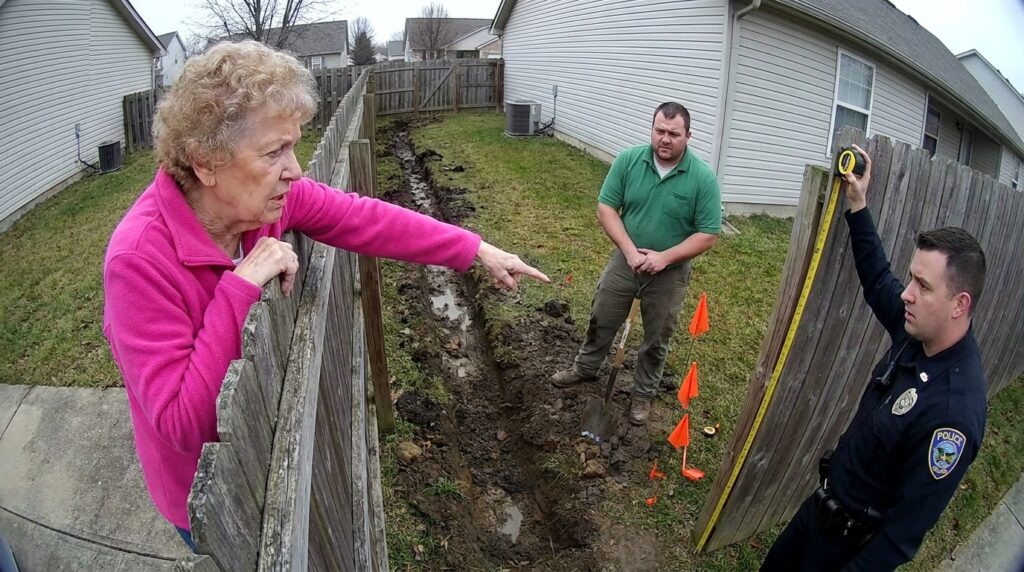
Arthur didn’t look up. He kept his weight centered over the T-handle of the sharpshooter spade, letting his work boots—caked in the gray, unyielding clay of the county line—sink the steel blade deeper into the turf. The soil here was thick with old gravel and matted crabgrass roots that resisted the edge with a dry, rhythmic tearing sound. He could see her shadow through the spaces in the cedar privacy fence: a broad, unmoving outline in a bright pink fleece jacket that seemed to absorb the dull, desaturated morning light.
“I’m just following the city survey lines, ma’am,” Arthur said. His voice was low, flat, and stripped of any heat that could be weaponized against him. He kept his eyes on the ground, tracing the path of the bright orange plastic flags that vibrated slightly in the exhaust of a utility truck idling three houses down.
“Those flags are a lie,” she spat back, her fingers locking onto the top rail of the cedar fence. The wood groaned under the sudden friction of her weight. Her skin was thin as parchment, spots of liver-brown standing out against the pale knuckles as she leaned over the boundary. “My husband set these posts forty years ago. The city doesn’t own a square inch past that ditch line, and you’re digging into my property. Look at me when I’m speaking to you, young man.”
Arthur didn’t turn his head. He knew the shape of her face without looking—the tight, outraged jaw, the oversized sunglasses reflecting the gravel driveway, the absolute certainty of an old resident who believed the earth itself conformed to her memory. Instead, he reached down, wiped a smear of damp, clay-heavy oil from the spade’s shaft with a rag from his back pocket, and stepped half a foot to the left to mark the next cut. The friction of the work polo against his neck was raw from the humidity. He could feel the weight of the neighborhood watching from the low porches across the asphalt strip—quiet, stationary figures waiting to see how much room an ordinary contractor would give a woman who owned the local history.
The air smelled of dry iron, diesel exhaust, and the sharp, sour tang of disturbed weeds.
“I have the county plat map right in the truck, ma’am,” Arthur said softly, his shovel clearing a clod of dark earth that fell away to reveal a glint of grey stone beneath the sod. “The easement allows six feet from the curb. We’re at four.”
“Call them,” she said, her voice dropping into a hard, transactional register that made Arthur’s thumb freeze against the wooden handle. She pulled a heavy white smartphone from her pocket, her thumb already striking the glass with a small, plastic click. “You think because you’ve got a green shirt and a state vest you can slice up a person’s life? We’ll see what the department says about an active trespass.”
Arthur stood perfectly still in the trench, his boots sunk two inches into the newly broken ground. Down in the narrow cut, tucked neatly against the root ball of an encroaching boxwood, something metallic caught the edge of his vision—not the copper tracer wire he was looking for, but a thick, square head of an ancient iron pin that shouldn’t have been there. It was buried deep, its surface pitted with decades of rust that looked exactly like old blood in the gray clay.
The sound of a distant siren began to rise from the bypass, growing louder as it turned into the subdivision.