CHAPTER 7: THE SUBSIDENCY CLASH
The heavy, dual-piston intake of the municipal vacuum truck hit the narrow side lane with a deafening hydraulic roar that drowned out the low static of Officer Miller’s shoulder radio. The warning beacons on the truck’s cab spun in aggressive, rhythmic orbits, casting long, mechanical slices of orange light across the gray siding of Marilyn’s house. Arthur stood on the trembling turf, his hands clamped tight around the wet handle of his spade, watching the high-pressure suction hose crawl toward the trench like a great, armored snake.
The air had grown intensely bitter, choked with a thick, atomized mist of old sewage, coal tar, and the sharp, hot reek of diesel exhaust.
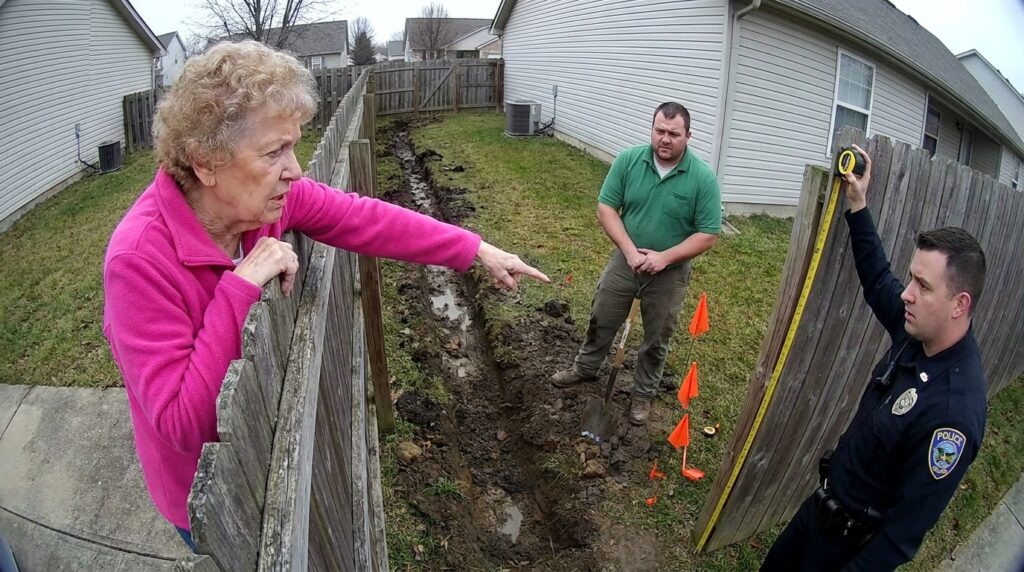
“Don’t let them drop that tube near the fence line, Donald!” Marilyn screamed. Her voice was thin, completely stripped of its old administrative weight, cracking against the mechanical din of the pumps. She had moved past the broken gate, her boots tracking thick ribbons of gray mud across her own aggregate walkway. The bright pink fleece of her jacket was soaked with the oily spray, turning a deep, bruised magenta under the orange strobe lights. “The concrete under the porch is cracking! I can hear the rebar tearing!”
Miller didn’t answer her. He was shouting commands to the operator in a yellow high-visibility vest who was maneuvering the massive boom arm over the open gash. “Keep the draw away from the footer! We just need to drop the surface pool before the vacuum undermines the primary utility shelf!”
Arthur stepped down onto the slick, uncompromised grass strip near the truck’s rear tires, his eyes locked on the vertical face of the excavation. It was too late for a surface drop. The dark, bubbling fluid had already dissolved the uncompacted limestone ballast three feet back into Marilyn’s lot. With the ancient structural plate now tilted forty-five degrees into the mud, the true bottom of the subdivision’s infrastructure error was fully exposed. The concrete footer of her sunroom—poured directly onto the municipal right-of-way to mask her late husband’s illegal patch—showed a long, jagged fissure that opened three inches wide with every pulse of the vacuum truck’s engine.
The friction of the subgrade was failing in real-time. A heavy block of gray clay, thick with the rotted roots of the boxwood hedge, slid into the bubbling pool with a wet, hollow thud.
“Arthur!” Miller yelled over the roar of the intake. “Get the trench shields from the utility flatbed! We need to wedge the plywood panels against that bank before the whole corner drops!”
Arthur dropped his shovel into the grass and turned toward the street, his boots slipping on the grease-smeared asphalt. He didn’t ask for help; he knew the crew down the block was still locking down the isolation valves on the main bypass. He grabbed the edge of a heavy, steel-rimmed shoring panel from the truck bed, the cold metal biting through his muddy leather gloves with a dull, abrasive ache. As he dragged the sixty-pound sheet back toward the fence line, his shoulders straining against the weight, he could see the neighbors through the gaps in the shifting panels—their faces pale behind their phone screens, documenting the exact moment the historic property line collapsed into a municipal violation.
Marilyn was on her knees now, right at the edge of the brick garden border. She wasn’t watching the neighbors, and she wasn’t watching the police officer. Her hands were sunk into the wet sod, her fingers clawing at the earth as if she could physically hold the concrete footer from dropping into the hole.
“He told me it would hold,” she whispered, her words lost to anyone but Arthur as he dragged the shoring panel past her. Her sunglasses had fallen into the mud, leaving her small, red-rimmed eyes completely unprotected from the glare of the strobe lights. “He said if we kept the city out, the house would outlive us both. He promised me, Arthur.”
Arthur didn’t give her a sympathetic look, but he set the edge of the steel-rimmed panel down right between her muddy fingers and the open trench. He jammed his boot against the frame, driving it deep into the gray clay to form a crude, temporary bulkhead against the sliding foundation. The metal groaned as the weight of her late husband’s unpermitted concrete footer slid forward another fraction of an inch, locking the panel into the earth with a final, unyielding snap of structural friction.
The hiss from the old main didn’t stop, but the rising fluid began to slow, the vacuum tube drawing the black slurry out in a heavy, rhythmic pulse that signaled the closing of the upstream municipal gates.