CHAPTER 3: THE CALIBRATION OF OUTRAGE
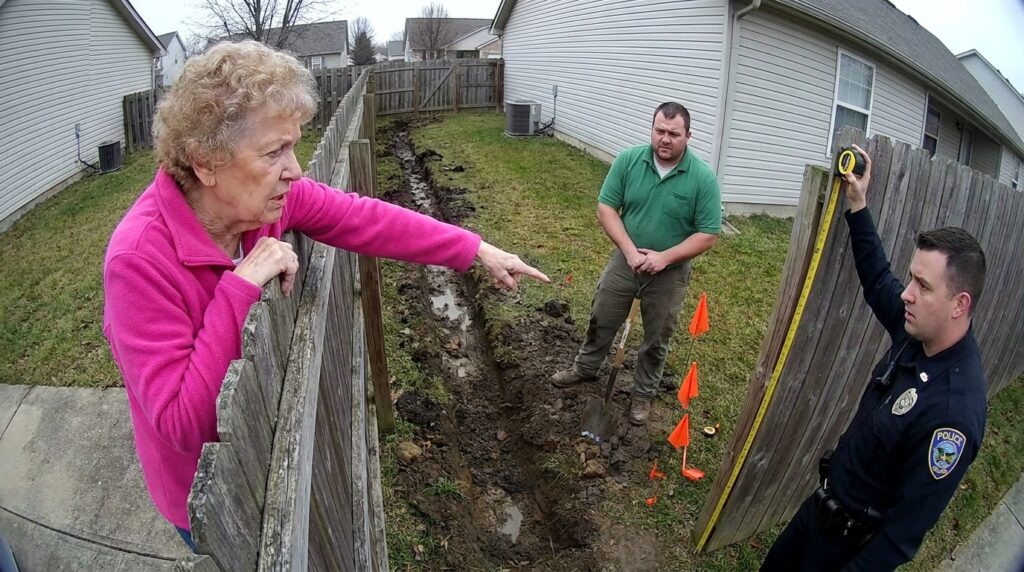
The metallic snap of the tape measure split the heavy morning silence like a small pistol shot. Officer Miller didn’t look back to see if Marilyn or Arthur were tracking the line; his focus was pinned to the yellow steel ribbon pressing against the base of the cedar post. The metal tape scraped over dry splinters, its numbers slightly faded by old sweat and utility belt grease.
“Hold that end flush against the cedar, Arthur,” Miller commanded, his voice tight with the dry authority of a county man who spent half his life separating neighbors over twelve inches of dirt.
Arthur didn’t hesitate. He shifted his weight on the slick incline of the trench, his work boots grinding into the newly turned clods. He pressed his gloved thumb against the hook of the tape, pinning it exactly where the weathered cedar post met the clay. The cold through his leather glove was a dull ache. Through the small gap between the slats, he could smell the faint, sour odor of Marilyn’s damp boxwoods and the stale floral perfume she wore like armor.
“Don’t you go pushing that tape into the soft wood, young man,” Marilyn warned. She had stepped down from the higher rail but remained balanced on the brick border of her garden bed, her broad silhouette blotting out the sun from the east. The pink fleece of her sleeve brushed the top wire. “Donald, make sure he’s checking the true face of the post, not the decorative molding. My husband paid for five-inch structural cedar, not the cheap slats they use in the new phase.”
“I know how to read a standard scale, Marilyn,” Miller murmured. He walked backward into the narrow lane, his boots sinking into the loose pile Arthur had shoveled out twenty minutes ago. The tape hummed as it extended, vibrating slightly under the tension. “Arthur, keep your fingers clear of the numbers. I want a clean sightline down to the flag.”
Arthur watched the yellow steel bridge the gap between the residential fence and the municipal excavation. The line was taut, an uncompromising bar of primary yellow cutting across the gray, desaturated landscape of the side yard. As the numbers crept past thirty-six, forty-eight, and sixty inches, the tip of Miller’s boot stopped exactly over the bright orange survey flag. The wire stem of the flag creaked against the silver grommet of the tape.
“Seventy-two inches,” Miller read aloud, his voice flat. He knelt down, his utility belt clicking as the plastic holsters pressed against his hip. “Exactly six feet from the face of the post to the center of the utility marker. The city flags are dead-on the easement boundary, Marilyn. This trench is entirely within the municipal sector.”
The old woman didn’t move. Her jaw remained locked, her reflection frozen in the wide lenses of her sunglasses. For three seconds, the only sound was the distant hum of the concrete mixer working on the cul-de-sac. Then, her fingers tightened on the cedar rail until the old wood gave a distinct, sharp crack.
“The digital maps are wrong,” she said, her voice dropped to a razor-thin whisper that had no age in it. “I told you, Donald. The orchard line was redrawn before you were out of grade school. That rusted iron pin down there—the one his shovel hit—that’s the true monument. The city surveyors never dug deep enough to find it. They just took the easy line.”
Miller sighed, his breath a short, heavy puff that stirred the dust on his notepad. He turned his head toward the trench, looking down at the massive, square head of the forged iron pin Arthur had uncovered beneath the boxwood roots. The iron was ancient, its corners rounded by decades of subterranean moisture, but it remained stubbornly planted in the substrate.
“Arthur,” Miller said, reaching for his flashlight. “Let me see that pin again.”
Arthur shifted back, grounding his shovel to clear a wider shelf in the clay. As he scraped the blade along the side of the ancient spike, more of the irregular substrate fell away. It wasn’t the natural, uniform layer of the local county line. The gray clay here was shot through with dark, oily streaks—bits of pulverized asphalt and a strange, crumbly white stone that looked like old limestone backing. It looked less like an undisturbed property boundary and more like the hasty patch of a deep trench that had been closed before the inspector could arrive.
The officer leaned over the edge, the bright beam of his flashlight cutting through the shadow of the boxwood leaves. He traced the line from the square iron head down to where it disappeared into the darker, loose soil below. His pen remained poised over the grid paper, but he didn’t write.
“That’s not a standard survey marker,” Miller muttered, his thumb tracing the worn leather edge of his notepad. “The head’s too broad. That looks like an old commercial isolation pin from the water district.”
“It’s the property pin,” Marilyn insisted, her voice rising again, reclaiming its volume. She leaned further over the fence, her pink sleeve dipping into the dirt Arthur had thrown up. “My husband had the deeds hand-checked by the registrar in ninety-four. If you let him break ground past that iron, Donald, you’re violating a recorded covenant. I’ll have the town clerk out here by noon.”
Miller stood up slowly, his joints popping. He looked at Arthur, then back at the old woman. The pragmatism in his eyes was being crowded out by the slow, exhausting realization that this wasn’t a standard boundary dispute. There was a history buried in the side yard that the city digital maps hadn’t accounted for—and the old iron pin was sitting right in the middle of it.
“Arthur,” Miller said quietly, adjusting the heavy belt around his waist. “Leave the spade in the dirt for five minutes. I need to call the county recorder’s office from the car. Don’t touch that iron until I get back.”
Arthur didn’t reply. He simply nodded, his palms resting on the worn wood of his shovel handle as the officer turned and walked back toward the idling cruiser, his boots leaving heavy, deep impressions in the raw clay. Through the fence, Arthur could hear Marilyn’s breath—fast, shallow, and ragged with a fear she was trying desperately to disguise as anger.