
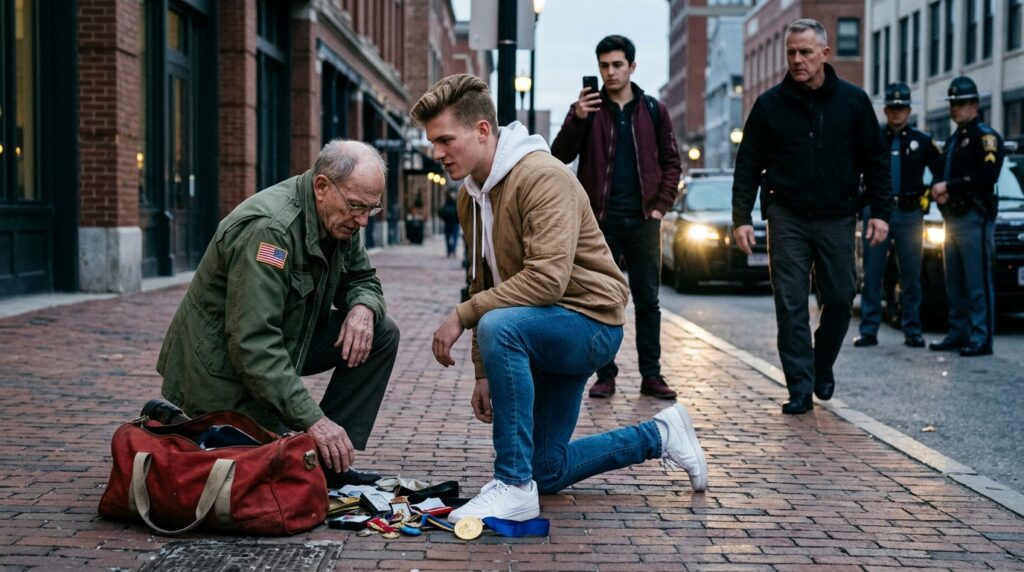
CHAPTER 6: THE VANISHING GRID
The cellar floor beneath the Fourth Street block didn’t feel like stone; it felt like frozen lard. For three decades, the moisture had dripped down the exposed structural iron pillars, leaving weeping trails of orange rust that smelled of sulfur and old tallow. Arthur stood by the ancient coal hopper, his left hand hooked into the torn strap of the red duffel, his right hand holding a heavy, iron-handled wrench he had pulled from the maintenance cage before the power died.
Above him, through forty inches of unreinforced masonry, the city was moving. It wasn’t the sound of traffic. It was the synchronized, rhythmic thudding of low-boy trailers backing onto the brick curb—the heavy, mechanical gait of thirty-ton hydraulic excavators taking up their positions before the light broke.
The air in the basement was thick with coal dust and the bitter tang of battery corrosion. Arthur walked toward the rear alcove, where the concrete wall met the foundation of the old boiler room. He didn’t use a flashlight. He knew the spacing of the floor beams by the way the damp cold changed against his forehead as he moved through the gloom.
A shadow broke the faint gray light spilling down the coal chute.
Arthur didn’t raise the wrench. He simply stood still, letting his body merge with the rusted framework of the hopper. The boots coming down the wooden stairs were light—too light for a demolition crew. They moved with the short, clipped cadence of someone who knew how to balance on slippery iron.
“The gate keepers are already signing the perimeter logs, Arthur.”
Captain Miller stepped into the light of the furnace opening. He wasn’t wearing his uniform cap, and his dark jacket was streaked with gray grease from the precinct garage. In his right hand, he carried a small, military-issue battery lamp, its beam hooded with black electrical tape until it was nothing but a narrow sliver of yellow slicing through the suspended soot.
“You’re outside your jurisdiction, Captain,” Arthur said, his voice a low rattle that barely carried across the coal bins.
“I don’t have a jurisdiction,” Miller said, setting the hooded lamp onto the rim of an empty oil drum. The light caught the brass eagle Arthur had left on the linoleum counter two hours ago. Miller had brought it back. He slid it across the rusted metal top of the drum until it rested against an old grease gun. “The administrative board filed the preliminary suspension at five-thirty. They’re running an audit on my logistics line right now. They want to know why a state transport detail was tracking a civilian resident on a city block.”
He walked toward the concrete foundation wall, his bare fingers tracing the long, jagged fracture line where the settlement had cracked the lime mortar. “The command car wasn’t in the yard when the registry was closed, Arthur. My father signed the demolition vouchers for the Third Battalion equipment in ’85. He was the regional supervisor for the ordnance depot.”
Arthur took a slow step out of the shadow, the red canvas bag heavy against his knee. The final layer of the structure wasn’t a corporate takeover or a municipal land grab; it was a familial ledger that had been balanced with institutional lies before the boy on the sidewalk had even been born.
“He didn’t sign the vouchers to save the holding firm, son,” Arthur said softly, his boot crunching into a layer of dried soot. “He signed them because your brother wasn’t inside that transport when it hit the line. He was inside this cellar. The battalion didn’t burn in the valley. They mutinied at the perimeter when the liquidation order came down from the logistics desk.”
Miller turned around slowly, his slate eyes catching the reflected yellow of the hooded lamp. The pale scar near his earlobe seemed to deepen, casting a small, hooked shadow across his jaw line. “My mother has a plot in the national cemetery with his name on the stone.”
“The stone is empty,” Arthur said. He reached down and kicked the bottom of the old wooden coal chute. The rotten pine splinters gave way with a dry crack, revealing the heavy, oil-streaked casting of an old cast-iron engine manifold tucked into the structural hollow behind the masonry. The serial number stamped into the metal was a perfect match for the eagle lying on the oil drum. “They buried the gear here because they couldn’t risk the scrap processors finding the internal damage from our own ordnance. Your father didn’t protect the state, Miller. He protected you from knowing what the line did to people who said no.”
A sudden, sharp vibration shook the ceiling joists. A shower of dried mortar dust dropped down, whitening the shoulders of Miller’s dark jacket like early frost. The excavator above had dropped its tooth-bucket onto the sidewalk, the iron teeth tearing through the very bricks where Arthur had knelt at dusk.
“They’re starting with the facade,” Miller said, his voice dropping into that flat, mechanical cadence that signaled the machine was running out of road. “The civil injunction doesn’t cover the emergency safety order the city inspectors issued twenty minutes ago. They claimed the foundation was failing.”
“The foundation is fine,” Arthur said, hoisting the red duffel onto his shoulder. The weight felt different now—no longer a burden of shame, but a hard, physical counter-weight to the gray grid outside. “But the paperwork says it’s gone, so it’s gone. That’s how the gray mask works.”
He walked toward the low drainage tunnel at the back of the boiler pit—the old overflow conduit that ran two miles south to the river mud beneath the abandoned rail yards. It was a dark, wet hole that smelled of river rot and old iron, but it was outside the cameras, outside the aggregate streams, and completely invisible to the zoning board’s ledger.
“What do you do with the book?” Miller asked, looking at the grease-stained logbook sticking out of the red nylon seam.
“I keep walking,” Arthur said. He reached out and picked up the brass eagle from the oil drum, dropping it into Miller’s palm. The metal was warm now, heated by the lamp bulb. “Give it back to your mother, Captain. Tell her the registry is closed.”
Miller’s fingers closed around the medal, his leather-less palm pressing the sharp serial number into his skin until his knuckles went white. He didn’t follow the veteran toward the tunnel mouth. He stood by the oil drum, a silent, dark shape under the vibration of the hydraulic shears above, watching the red duffel vanish into the gray horizontal silt of the city’s underbelly.
The first iron beam above them groaned, a long, acoustic scream of metal giving way to weight, but by the time the dust hit the floorboards, the cellar was empty of everything but the rust.








