
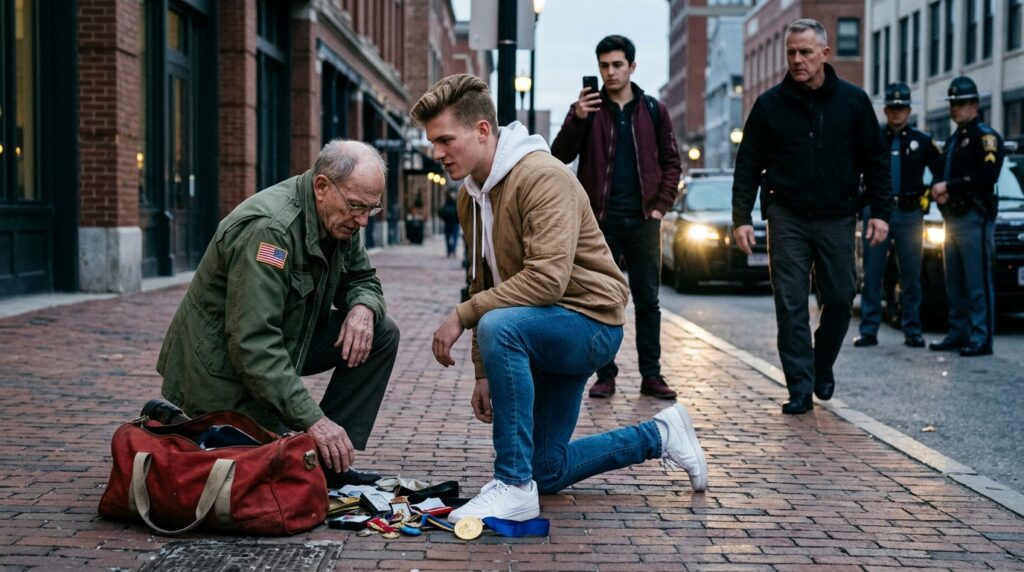
CHAPTER 3: THE PRECINCT CONTAINMENT
“You aren’t supposed to have that sequence, Arthur.”
The interior of the utility transport smelled of stale coffee, burnt wiring, and the bitter, chemical tang of industrial cleaner used to scrub down rubber floor mats. The vehicle bounced heavily over the city’s frost-heaved asphalt, a rhythmic shuddering that caused the loose metal mesh separating the front cab from the rear benches to rattle relentlessly.
Arthur leaned his shoulder against the reinforcement bar, his thumb pressed flat against his field jacket pocket, feeling the cold contour of the brass eagle through the lining. He didn’t look at Captain Miller, who sat across the narrow corridor, his dark jacket unzipped just enough to reveal a tarnished silver buckle beneath.
“A lot of things happen in forty years, Captain,” Arthur said, his voice flat, matching the vibration of the floorboards. “Medals get mixed up in lockers. Boxes get traded. The brass doesn’t look at the back of the star when they pass it down the line.”
“The Commonwealth doesn’t issue duplicates of that specific production run,” Miller said. He reached up, his leather glove rasped against the metal grab handle as the truck veered sharply left, entering the secure subterranean ramp of the county precinct. The light changed instantly from the bruised purple of city dusk to the harsh, vibrating hum of bare fluorescent tubes bouncing off unfinished concrete. “That run belonged to the Third Battalion. My brother’s unit. They went into the valley in ’84 and three of them didn’t come back out. The logistics office logged every citation as destroyed by fire.”
The truck ground to a halt, the pneumatic brakes releasing with a long, mechanical hiss that filled the confined bay.
“Maybe the logistics office lied,” Arthur muttered, keeping his hand deep in his pocket. He dragged his feet across the grated step as the trooper opened the rear door, his boots finding the wet, oil-slicked floor of the basement garage.
The two young men from the sidewalk were already being led toward the processing elevator. The boy in the tan bomber jacket had lost his swagger; his white sneakers were smeared with gray grease from the bay floor, and he kept his head down, avoiding the eyes of the two troopers flanking him. But the boy in the burgundy jacket—the one who had held the phone—wasn’t looking at the ground. He was watching the security cameras mounted in the corners of the concrete ceiling, his jaw set in a hard, calculating line that didn’t belong to a casual street instigator.
Miller intercepted the trooper holding the secured smartphone. “Get the tech unit down here. I want the transmission logs before we clear the intake log.”
“Already tried, Captain,” the trooper replied, his voice dropping into the low, transactional murmur of a precinct basement. He handed Miller a printed technical slip, the paper stiff and cold. “The device went dark thirty seconds after we closed the doors. It didn’t just stop recording. It executed a remote wipe sequence. But the data didn’t go to a local cloud.”
Miller squinted at the paper under the flickering fluorescent bulb. “Where did it route?”
“A secure proxy server registered to the Vanguard Development Trust,” the trooper said. He nodded toward the boy in the burgundy jacket. “The kid’s name is Julian Vance. His father sits on the regional zoning board. That trust has been trying to buy out the old veterans’ housing block on Fourth Street for eighteen months. The block where the sergeant here lives.”
Arthur froze, his hand tightening around the medal until the metal edges cut into his palm. The cold geometry of the room seemed to contract. The sidewalk confrontation hadn’t been an accident of youth or a random spark of modern arrogance. It was a calculated provocation, designed to create a public spectacle of institutional overreaction right on the border of a contested piece of real estate.
“They wanted the footage,” Arthur said, the realization settling into his chest like dry sediment. “They wanted your troopers to put hands on a civilian on camera. To make the precinct look like a hammer looking for a nail.”
Miller turned the paper over in his hand, the clean edge of his jaw tightening until a muscle pulsed near his scar. He looked at Julian Vance, then back at Arthur. For the first time, the machine-like certainty in the captain’s eyes flickered, replaced by the grim calculation of a man who realized he had walked into an ambush while trying to break up a fistfight.
“They wanted a witness, Arthur,” Miller said softly, his voice cutting through the damp chill of the garage. “But they didn’t count on you having that specific piece of brass in your bag. If that serial number gets into the public record, it doesn’t just damage a property deal. It reopens the registry for the valley.”
He stepped closer to Arthur, the smell of damp wool between them thick and suffocating. “My brother didn’t die in an accident, Sergeant. And you weren’t supposed to be the one carrying his tracking tag. Who gave you the red duffel?”
Arthur looked past Miller’s shoulder at the concrete wall, where the salt from the winter roads had dried into white, glittering crusts that looked like frost but never melted. The decoy was simple: a real estate play wrapped in a digital scandal. But the weight in his pocket was older, rooted in a deeper structure that Miller was blindly tearing toward.
“An old friend,” Arthur said, his voice dropping into the silent, guarded rhythm of a man who knew exactly how much weight a single beam could hold before the roof came down. “And he told me to keep it away from the family.”








