
CHAPTER 2: THE PERIMETER OF RUSTED IRON
The brass eagle felt like a shard of river ice pressed into Arthur’s palm. He slid it deep into the flannel lining of his field jacket pocket, his thumb dragging across the sharp, raised edges of the engraved serial number. It wasn’t his number. The weight of that difference felt heavier than the metal itself, a small, jagged lie hidden in a pocket full of fraying history.
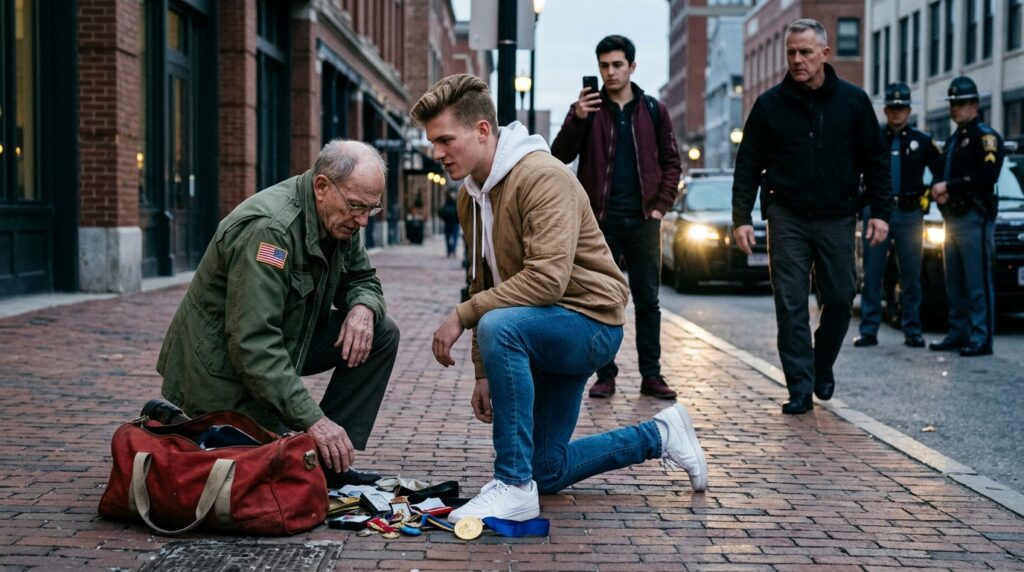
Around them, the city street had grown small. The four state troopers didn’t push the gathering crowd back with loud commands; they simply widened their stance, their heavy boots grinding the salt and grit against the frozen brick sidewalk. Their presence was a wall of gray wool and dull leather that smelled of gun oil and wet pavement. The idling engines of the utility vehicles rumbled in the background, a low-frequency vibration that rattled the loose glass in the storefronts and vibrated through the soles of Arthur’s boots.
Captain Miller remained motionless, a silhouette carved from the oncoming glare of the high beams. His eyes didn’t follow the young man in the tan bomber jacket, who was now stepping backward, his clean white sneakers scuffing the dirtied curb. Miller’s gaze stayed fixed on Arthur’s hand—or rather, the pocket where the medal had vanished.
“Sir,” Miller said, his voice dropping into a register meant only for the space between them. “The bag.”
Arthur didn’t answer immediately. He reached down to gather the split nylon handles of the red duffel. The cheap material groaned under the strain, the torn seam widening to reveal the corner of a grease-stained logbook and three bundles of letters tied with rotting green twine. The friction of the coarse canvas rasped against his calloused skin, leaving thin, white tracks on his knuckles. He didn’t want the state’s help. He didn’t want this clean-shaven officer looking into the grease and iron of a life that had been dismantled thirty years ago.
“I can carry my own gear,” Arthur muttered. He braced his weight against the iron lamp post, the cold metal biting through his sleeve as he hoisted himself up. His knees clicked—a dry, acoustic reminder of rain-soaked trenches and concrete floors.
The young man in the tan jacket had reached the edge of the trooper line, his casual arrogance souring into something sharper as he realized the crowd wasn’t backing him up. The boy in the burgundy jacket was still there, his hands steady as the smartphone screen flickered, capturing the precise geometry of the encounter: the stooped veteran, the unyielding captain, the blue-and-red strobes painting the brickwork in shades of emergency.
“Hey,” the tan jacket barked, his voice cracking slightly against the cold air. “He was blocking the path. We’ve got rights to the walkway. You can’t just park three rigs on a city curb because some old guy dropped his groceries.”
One of the troopers shifted his weight, his shoulder turning just enough to block the boy’s view of Miller. The movement was silent, practiced, and absolute.
Miller didn’t look back. He took half a step forward, his boot coming down on a discarded metal bottle cap, crushing it into the grit with a dry crunch. “Get him into the transport,” he told the trooper nearest to him. He wasn’t referring to Arthur. He was looking at the boy with the phone.
“Whoa, hold on,” the recording bystander said, his hands dropping an inch as the shadow of a trooper fell over his screen. “This is public space. I’m allowed to film.”
“You are,” Miller said, his tone perfectly flat, devoid of anger or empathy. It was the voice of a machine that had been running on the same gears for thirty years. “And the Commonwealth is allowed to secure evidence of an administrative obstruction during a transit detail. Take the device.”
The transition was fast—no shouting, no cinematic struggle, just the heavy lever-action of authority. A trooper’s hand closed over the top of the phone. The boy in the burgundy jacket pulled back, but his boots slipped on the wet brick. For a second, the scene was nothing but the sound of hard plastic scraping against leather gloves and the low hiss of the truck exhaust.
Arthur watched from the shadow of the lamp post, his hand still clamped over the medal in his pocket. He knew that look on Miller’s face. It wasn’t the look of a man enforcing a city ordinance. It was the look of a hunter who had found a familiar footprint in the mud. Miller wasn’t looking at a random street hassle; he was looking at an ignition point.
“Captain,” Arthur said, his voice thin but clear enough to cut through the idle of the diesels. “Let the kids go. It’s just an old sack. It happens every winter.”
Miller finally turned his head. The blue strobe light caught the side of his face, highlighting a small, pale scar near his earlobe—the kind left by flying glass or an old piece of wire. His eyes were entirely desaturated, the color of wet slate.
“The bag isn’t the problem, Sergeant,” Miller said, using a rank Arthur hadn’t heard applied to himself since the helicopters stopped running. “The problem is where that video is going before the screen even goes dark.”
Miller turned back toward the lead utility vehicle, his fingers hooking into the front of his jacket. “Bring them both to the barracks. Not the local precinct. The county line.”
The trooper pushed the two young men toward the rear doors of the second truck. The tan jacket was silent now, his jaw clenched, his eyes darting toward the side streets as if calculating the distance between the curb and the dark alleyways between the brick tenements. But the perimeter was locked. The gray wool uniforms closed the gaps, and the heavy iron latches of the transport door dropped into place with a sound that signaled the end of the street and the beginning of the grid.
Arthur didn’t move as the trooper held the door of the lead vehicle open for him. He looked down at his shoes, then back at the sidewalk where the red duffel had ruptured. A single brass washer lay there in the dirt, missed in the scramble. It was rusted around the rim, turning the brick beneath it a faint, bleeding orange. He left it there, stepped up into the cab, and let the smell of old vinyl and stale coffee swallow him whole.








