
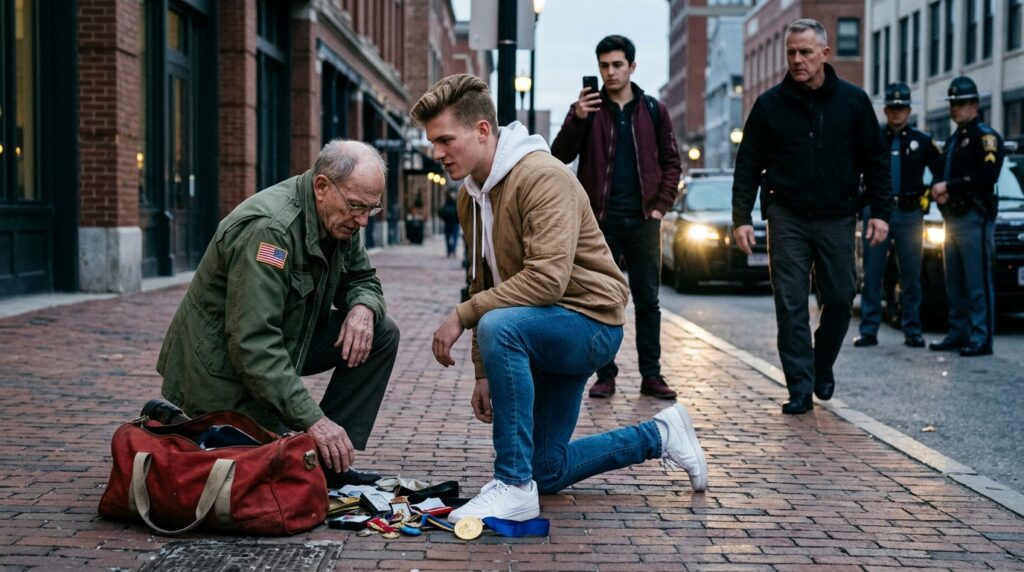
CHAPTER 4: THE VIRAL NET
The metal table in the center of the briefing room had a long, rusted scratch slicing diagonally across its gray enamel surface. Miller threw the printout onto that scratch. The paper slid, its edge catching on a loose rivet before coming to rest under the pale glare of the overhead lights. Outside the narrow window, the subterranean exhaust fans of the precinct hummed with a heavy, vibrating drone that felt like a low fever behind Arthur’s temples.
“It’s already live,” Miller said. He didn’t sit down. His hands braced against the rim of the table, his knuckles turning the color of dry tallow. “The remote wipe on the boy’s device didn’t delete the file. It verified the upload protocol. Six regional news aggregates picked up the stream twenty minutes ago. They aren’t running it as a sidewalk dispute, Arthur. They’re running it as state troopers executing an illegal asset seizure against a resident of the Fourth Street block.”
Arthur sat on the low iron stool, his knees locked to keep from shaking. His field jacket felt stiff, the heavy red duffel bag resting between his boots like a dead weight. The smell of the damp canvas was different now—warmer, sourer, mixing with the sharp copper scent of the rusted table hinges.
“The trust,” Arthur muttered, his thumb tracing the brass star still tucked into his pocket. “They didn’t want the land. They wanted the noise.”
“They wanted a federal civil injunction to freeze the precinct’s jurisdictional clearance over the Fourth Street district,” Miller said, his teeth clicking together on the final syllable. He leaned across the table, his slate-gray eyes boring into Arthur’s wrinkled face. “With my units tied up in an internal affairs review over that footage, the state compliance team can’t enforce the structural preservation order on your building. The demolition crews can roll in at dawn, and by the time the courts sort out the video, your housing block is nothing but crushed concrete and iron rebar.”
Arthur didn’t look away from the rusted scratch on the table. He reached down, his fingers catching the rough zipper of the red duffel. Slowly, without asking for permission, he pulled the split material further apart. The grease-stained logbook he had shielded on the sidewalk lay inside, its cardboard cover frayed into soft, gray pulp at the corners.
“They aren’t tearing down that block because of the real estate, Captain,” Arthur said softly. He pulled the logbook out, the spine dropping copper dust onto the gray enamel table. “They’re tearing it down because thirty years ago, the logistics office wasn’t the only thing that handled the files from the valley.”
Miller’s hands didn’t move from the table, but his posture changed, going entirely rigid, like a guard dog catching an unfamiliar scent in the dark. “What is that?”
“It’s the ledger from the maintenance depot at the perimeter,” Arthur said. His voice was steady now, the low, mechanical rhythm of a man who had spent his life watching parts wear down until they snapped. “Every vehicle that came back out of the valley had to clear the wash rack here. Every piece of salvaged iron. Every personal effect that didn’t burn. Your brother’s unit didn’t get caught in an accidental ordnance cook-off, Miller. The registry says their transport was logged back into the yard three days after the logistics office issued the casualty notices.”
The room went completely silent, save for the heavy, industrial thudding of the ventilation shaft three floors above.
Miller reached out, his leather glove off now, his bare hand trembling slightly as his fingers touched the stained edge of the logbook. The skin of his palm rasped against the old paper with a dry, papery hiss. He turned the first three pages, his eyes tracking the faded purple ink of the old military stamps. His face didn’t pale; it seemed to harden, the small scar near his earlobe turning a dull, angry red against his skin.
“The serial number on that star,” Miller whispered, his eyes still fixed on the ledger. “The one you picked up off the brick.”
“It matches the frame assembly number of the command car that came back into the yard,” Arthur said. He didn’t take the medal out. He didn’t need to. The truth was already sitting on the table between them, a cold, rusted wedge that split the decoy secret wide open. The real estate trust wasn’t a bunch of greedy developers looking for a cheap urban flip; they were a front organization funded by the same legacy holding firm that had signed off on the valley liquidation vouchers in ’84. They needed the Fourth Street block gone because the old storage cellar beneath the boiler room held the unwashed engine blocks of the Third Battalion—the physical proof that the fire had never happened.
The heavy iron door of the briefing room clicked. A trooper stood in the frame, his face shadowed by the dim corridor light behind him.
“Captain,” the trooper said, his voice clipped and dry. “Counsel for the Vance family just cleared the security gate. They brought a county magistrate with an expedited release order for Julian. And they brought an administrative suspension notice for your detail.”
Miller didn’t look up from the logbook. He carefully closed the frayed cardboard cover, his hand resting flat on top of the grease stains as if he could keep the history from leaking out through the seams.
“Tell them to wait,” Miller said.
“The magistrate isn’t waiting, sir,” the trooper replied, his eyes shifting toward Arthur and the red bag. “They have a media crew from the aggregate site sitting in a van right outside the exit ramp. If we don’t turn over the device and the civilians in five minutes, they’re going live with a secondary feed from the precinct steps.”
Arthur stood up, the old canvas bag heavy in his grip. The consequence loop was closing around them, driven not by the arrogant boys on the street, but by an old system that used digital algorithms and legal leverage with the same cold precision it had once used to bury an infantry platoon. He looked at Miller, the clean-shaven captain who was now caught between the memory of his brother and the rigid weight of the uniform he had spent his life maintaining.
“You can’t keep them here, Captain,” Arthur said, his voice dropping into the quiet pragmatism of the dusty gray. “And you can’t keep me here either. If that media crew sees an old man with a torn red bag coming out of your basement, the story stays exactly where they want it.”
Miller looked up, his slate eyes empty of everything but the hard, dark calculation of a survivor. “The demolition crews have a permit for six hundred hours, Arthur. If you go back to that block, you’re sitting on top of a grave.”
“I’ve been sitting on one for thirty years, son,” Arthur said, turning toward the secondary exit that led to the utility tunnels. “The only difference is now I know whose name is on the marker.”








