
CHAPTER 5: THE SCALE OF LEVERAGE
“The suspension order is signed by the administrative judge, Captain. It took effect twenty minutes ago when the video crossed forty thousand views.”
The representative for the Vance family didn’t look like a lawyer from the central district. He wore a heavy wool overcoat that smelled of wet asphalt and tobacco, and his briefcase was scuffed down to the gray fiberboard at the corners. He stood behind the scuffed linoleum counter of the secure intake area, his palm resting flat over a single sheet of paper. Behind him, Julian Vance stood under the flicker of the precinct lights, his hands deep in his pockets, his chin lifted just enough to catch the attention of the media van visible through the heavy glass doors of the garage ramp.
Miller didn’t take the pen. He stood on the opposite side of the counter, his shoulders square, his dark zip jacket pulled taut over his chest. His right hand remained near his belt, not out of aggression, but with the steady, heavy stillness of a gatepost that had settled into the earth over decades.
“The video was routed through a server owned by your client’s development group,” Miller said. His voice was too quiet for the wide room, but it carried the low, mechanical rattle of a heavy engine idling down. “That isn’t a civil recording. That’s an orchestrated disruption of a state convoy.”
“The court doesn’t look at routing logs when a uniformed officer is seen confiscating civilian property without an inventory voucher,” the representative said. He didn’t raise his voice; he spoke with the flat, professional indifference of a clerk reading a tax roll. “The injunction covers the Fourth Street perimeter. Any state presence within three blocks of that housing facility is a violation of the civil liberty complaint filed by the Vance Trust. Your troopers are done there, Miller. If you step onto that brick before the administrative review board convenes on Monday, you’re acting without color of law.”
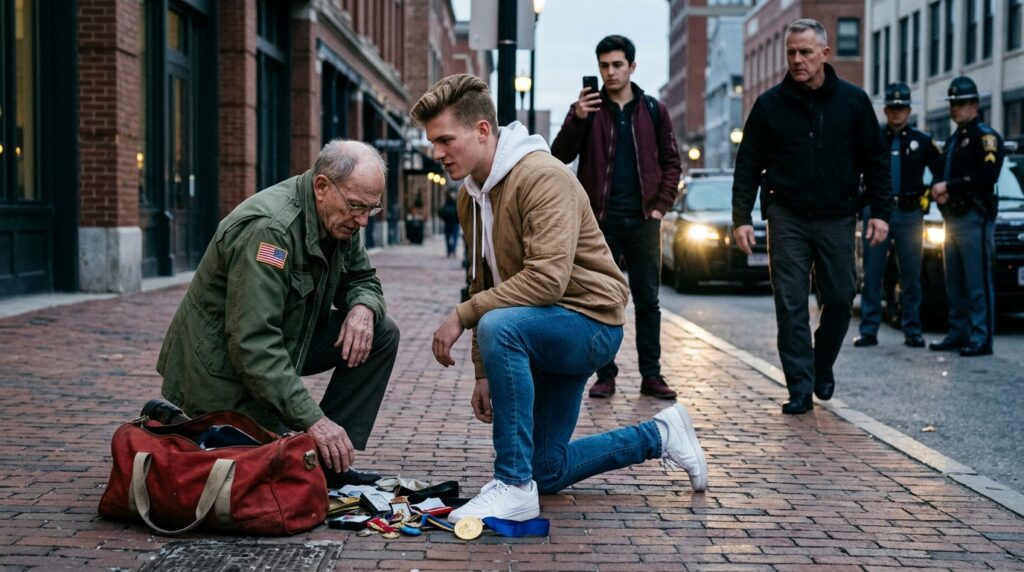
Arthur watched from the shadow of the utility alcove, his fingers pressed against the canvas strap of the red duffel. The cold air from the open garage bay rolled across his boots, bringing with it the smell of diesel and damp soot. The logic of the room was simple, efficient, and entirely desaturated of anything resembling human value. The young man on the sidewalk hadn’t been acting out of simple malice; he had been an asset deployed to a specific grid coordinate to force a specific institutional counter-move.
“And the old man?” Miller asked, his eyes moving toward the alcove where Arthur stood. “The duffel was dropped on a public walkway. The contents are part of a pending registry identification.”
“The old man isn’t our concern,” the lawyer replied, snapping the latch of his briefcase with a sound like a small pistol shot. “He can take his rags wherever he likes. But if any of those objects are listed on a state evidence locker receipt before Monday, we add a tampering charge to the federal filing. The boy goes out the front door, Captain. Now.”
Julian Vance grinned then—a sharp, quick flash of teeth that didn’t reach his eyes. He didn’t look at Miller; he looked at the glass partition where the blue strobe lights of the idling transports were dying out one by one as the troopers shut down the engines. He knew the machine had worked. The algorithm had met the state’s rigid protocol and ground it to a halt in less than an hour.
“Move out,” Miller told the trooper at the gate.
The iron latch clicked open. The lawyer turned toward the exit, his heavy overcoat swinging against the linoleum. Julian followed three paces behind, his white sneakers squeaking against the wet stone of the ramp as they headed toward the waiting media van.
Miller didn’t move until the heavy glass doors rumbled shut behind them. The room seemed to grow larger then, colder, the clanking of a rusted iron radiator in the corner the only sound left in the administrative hub. He turned his head slowly toward the shadow where Arthur stood.
“They’re going to clear that basement by midnight, Arthur,” Miller said. His jaw was set so tight the skin around his scar looked translucent. “The administrative order takes away my authority, but it doesn’t change the schedule for the local code enforcement crew. They don’t need troopers to pull a structural lever. They have their own paper.”
Arthur pulled the red bag out of the shadow, the frayed strap dropping over his forearm like a length of old rope. He reached into his pocket and took out the brass eagle, setting it down on the linoleum counter between them. Under the bare fluorescent bulb, the unmatching serial number on the reverse looked deep, the metal around the engraving gray with ancient grease.
“This belonged to your brother, Captain,” Arthur said, his voice flat, stripped of the fatigue that had been building since dusk. “He didn’t give it to me. I found it in the grease trap under the maintenance rack three days after they cleared his car out of the yard. The logistics office didn’t burn his files. They just changed the name on the box so the pension board wouldn’t have to look at the frame damage.”
Miller looked down at the star, but he didn’t reach for it. His hand stayed clamped on the edge of the linoleum, his fingers digging into the old plastic trim until it groaned. “Why keep it in the bag? Why bring it out now?”
“Because the man who told me to watch the boiler room under the Fourth Street block died last week,” Arthur said, turning his face toward the dark secondary exit that led to the utility tunnels beneath the city grid. “He said if the trust ever came for the foundation, it wouldn’t be for the brick. It’d be for what’s under the floorboards. I was bringing it to your sector because I thought you were the only one left who’d recognize the stamp.”
He didn’t wait for Miller to answer. He picked up the heavy red duffel, the canvas dragging against his trousers with a dry, coarse rasp, and stepped into the dark mouth of the service corridor before the captain could call for a trooper to open the gate.








