
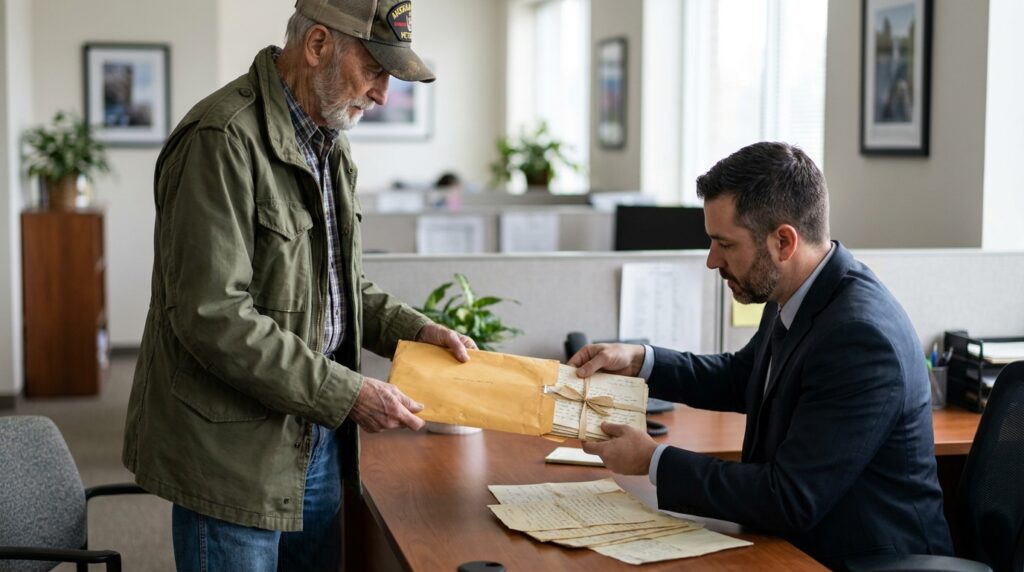
CHAPTER 6: THE PERMANENT RECORD
“The data is already in the transfer buffer, Jerry,” David Miller said, his voice dropping into a quiet, unwavering stillness that completely bypassed the supervisor’s looming shadow. He didn’t look up to meet Thomas’s furious gaze. Instead, his fingers, still lightly smeared with the dried reddish dust from the paper sleeve, shifted back to the keyboard, executing a short sequence of command-line overrides he hadn’t used since his entry-level training days. “If I force a manual purge of an active verification folder during a live public presentation, the automated transaction logs will tag this terminal for internal state audit. It’s a permanent cloud record. It doesn’t wash out.”
Jerry Thomas froze, his massive hands remaining anchored to the desk partition like heavy stone blocks. The blotchy crimson color on his neck turned a dark, bruised violet under the flat light tubes. For three full seconds, the office felt entirely devoid of movement, the air thick with the smell of old cedar boxes and the dry, metallic odor of overheating processor cooling fans. The compliance officers behind Thomas shifted their weight, their leather equipment belts letting out a rhythmic, hollow creak that sounded like a ship’s timbers pulling apart under immense pressure.
Arthur Vance did not move. He stood on the opposite side of the counter glass, his lean, upright frame catching the long, horizontal shafts of late-afternoon sunlight that had begun to pierce the high window blinds. The golden light caught the frayed threads of his olive field jacket and turned the gold embroidery on his veteran cap into a brief, brilliant flash of fire. He looked at David, his flint-colored eyes softening slightly, recognizing the subtle, painful cracking of an institutional soul finding its proper human shape.
“Miller,” Thomas muttered, his baritone rumble dropping into a low, menacing hiss that barely vibrated the speaking grate. “You don’t understand the scope of what you’re touching here. The county needs that logistics park. The funding lines are already secured through the state treasury. You are throwing a wrench into a thirty-million-dollar infrastructure plat because of an unindexed military marker.”
“It’s not unindexed, Thomas,” David said softly. He reached down and carefully picked up the fifth sheet of the bundle, the paper raspy and brittle against his skin. He tilted the page toward the window, allowing the low-angled amber sunlight to pass directly through the fibers. Underneath the faded purple mimeograph print, visible only when the bright natural light cut across the weave, was an official county surveyor stamp from October of nineteen-seventy-four. At the bottom of that old county land grant, scrawled in the exact same looping, left-leaning cursive as the field logistics orders from the Mekong Delta, was a single authorizing name: Gerald Thomas, Senior Planner.
The silence in the county administrative lobby became absolute. The typing at Window 2 stopped instantly, the young clerk lowering her hands to her lap as she stared across the partition. Behind the velvet security rope, the local contractor let out a low, slow whistle, his heavy arms tightening across his chest as he fixed his gaze on Thomas’s rigid back. The younger veteran in the utility jacket simply reached up and pulled his shoulders back, his posture locking into an unwritten code of alignment that spanned generations.
Jerry Thomas didn’t reach for the papers again. The reveal didn’t trigger a shouting match or a dramatic denial; it triggered a slow, deflating collapse of his posture, his shoulders dropping two inches as he looked through the glass at the quiet old man he had spent half a century trying to hide under a mountain of land titles and zoning codes. He had known the name Vance since he was a twenty-four-year-old assistant draftsman, hired to erase a forgotten tactical coordinate so a local development company could build its first gravel pit.
“It was an old war, Arthur,” Thomas said, his voice suddenly losing its institutional power, sounding dry, thin, and infinitely tired. He didn’t use his supervisor’s title anymore. He spoke through the grate like a man looking across a fence at an old boundary line. “The Pentagon said the unit didn’t exist on the active rosters. They gave us the clearance letters. We had to grow the county. We had to build something here.”
“You built it over them, Jerry,” Arthur said, his voice carrying no venom, only the immense, heartbreaking clarity of a man who had carried the names of twenty-eight missing boys in his pocket for fifty years. He pointed his large, thick-knuckled finger at the duplicate silver tag that still sat between the logs on David’s desk. “The records weren’t void because the company failed. The records were void because someone didn’t want to pay for the recovery. You knew where the bunker was when you signed the road plat in seventy-four.”
David Miller didn’t wait for his supervisor’s permission. With a series of steady, intentional strokes on his keyboard, he routed the entire scanned document packet into the permanent, un-redactable federal archival mirror, bypassing the county’s local server entirely. He printed a heavy, three-page digital receipt, the laser printer behind his station letting out a high-pitched, rhythmic whistle as it spat the crisp white sheets into the tray.
He took the sheets, stamped them with the blue steel validation seal of the County Registrar, and slid them through the lower counter slot into Arthur Vance’s waiting hands.
“Your records are logged into the permanent system registry, Mr. Vance,” David said, his voice steady, warm, and thoroughly humbled as he looked up into the old man’s weathered face. He reached through the window and gently slid the dark blue cap back toward the veteran, his hand brushing against the gold lettering. “The files are public now. The state archeological division has already received the automatically triggered site coordinates. The excavation at the railway spur will be flagged for an emergency forensic hold within fifteen minutes.”
Arthur Vance accepted the white receipt sheets, folding them once with his large, steady hands before slipping them safely into the deep interior pocket of his frayed olive field jacket. He took his veteran cap, turned it over once in his fingers to check the peak, and placed it back onto his head, pulling the brim down low over his gray, flinty eyes.
He didn’t say another word to Jerry Thomas. He didn’t offer a final speech of victory or look for an apology from the broken bureaucrat who stood beside the desk organizer. He simply turned back toward the crowded lobby, his lean, upright frame moving with the quiet, unbroken discipline of an officer who had held his section of the line against all odds.
As Arthur stepped across the yellow vinyl tape and moved toward the glass exit doors, the younger veteran in the utility jacket stepped directly into his path, his feet snapping together on the hard linoleum. He brought his right hand up to his brow, his fingers straight and locked in a perfect, razor-sharp salute that held the entire room in a state of breathless reverence. Behind him, the old contractor took off his work hat, holding it over his chest, while the young mother pulled her child close, her eyes damp with an ancient, unspoken understanding.
Arthur stopped, looked at the young soldier through the golden afternoon light, and brought his own worn hand up to the brim of his cap in a mutual, quiet acknowledgment of a duty finally discharged.
The glass doors slid open with a soft, heavy sigh, and the old commanding officer walked out into the bright, unclouded American sun, leaving the record finally, completely clean.








