
CHAPTER 2: THE REJECTED TETHER
The word coordinates fell into the space between them like a lead weight hitting stagnant water. David Miller’s fingers remained frozen over his mechanical keyboard, the small blue light from his computer monitor casting a pale, unnatural sheen across his high cheekbones. For three seconds, the only sound in the administration office was the high-frequency hum of the ballast directly above the service window and the heavy, rhythmic sigh of the old contractor behind Arthur in the queue.
David cleared his throat, his posture straightening further as he forced a professional smile that didn’t reach his eyes. “Mr. Vance, I appreciate that you have historical materials. But as I said, we are a repository for current county records. Unless these documents pertain to a filed property deed or a pending local estate inside the Douglas County limits, I cannot legally catalog them. The system doesn’t have a code for…” He glanced down at the blue cap with its faded gold lettering. “…for military tactical maps.”
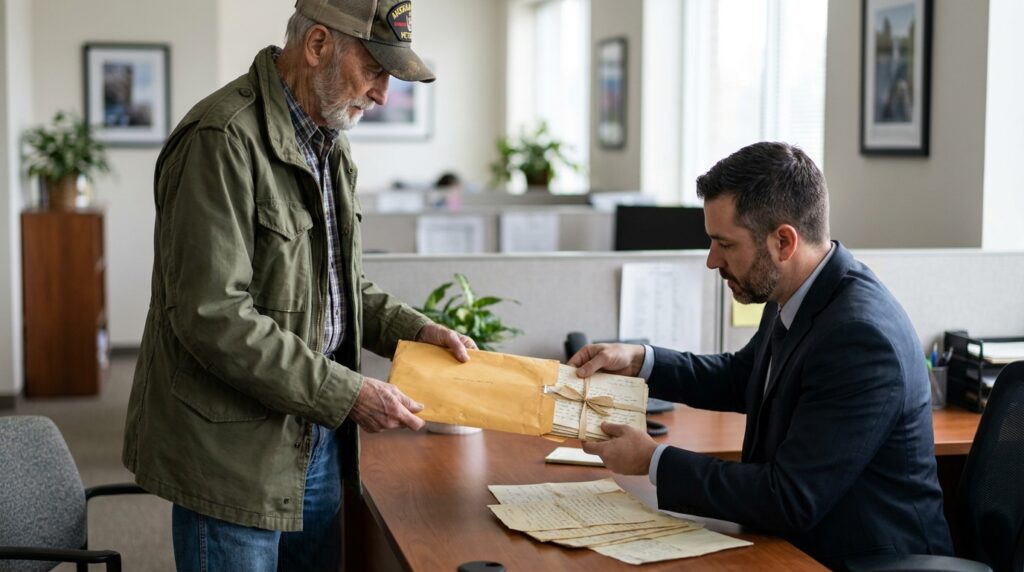
Arthur did not blink. His eyes, the color of winter flint, remained anchored on the clerk’s face. He didn’t raise his voice, but his large, worn hands shifted, pressing flat against the oak counter with the quiet solidarity of an old stone foundation. “The county line changed in seventy-four, son. The valley where the old railway spur intersects the eastern marsh—the land your office re-zoned for the industrial park last Tuesday—that used to be state territory. It holds the records you’re looking for. You just don’t know it yet.”
David’s smile vanished. The mention of the Tuesday zoning meeting—a closed-session vote that had barely made the legal notices section of the local paper—sharpened the atmosphere instantly. His eyes narrowed, his gaze dropping to the thick manila envelope. The paper was weathered, its edges slightly furry from decades of friction, but it was solid. And protruding from the bottom corner of the envelope, visible only now that it sat under the flat glare of the county lights, was a tiny loop of black typewriter ribbon, frayed and stained with old violet ink. It was a detail David’s bureaucratic eye caught immediately—the hallmark of an old government filing system that hadn’t existed since the Nixon administration.
Behind the security rope, the silence deepened. The young mother stopped bouncing her toddler; the child’s wail subsided into a wet, curious sniffle. The younger veteran in the utility jacket stepped out of the strict alignment of the queue, his eyes fixed on the olive-drab canvas of Arthur’s sleeve. The room was no longer a line of citizens waiting to pay fees; it had become an audience.
“Look, sir,” David said, his voice dropping into a tense, hushed register as he leaned toward the glass partition, his silver smartwatch clicking against the metal frame. “I don’t know where you got your information about the zoning board, but I have a queue of thirty-five people behind you. If you refuse to step back behind the security rope, I will have to call the floor supervisor. We have procedures for a reason.”
“Procedure didn’t build that valley, David,” Arthur said softly. He used the clerk’s name without checking the plastic badge pinned to the suit jacket; his eyes had already read the cursive font during the first thirty seconds of the exchange. “And procedure isn’t what’s keeping those pages together.”
With a slow, deliberate movement that carried the absolute certainty of a command briefing, Arthur’s right hand moved to the brass fasteners. He didn’t pull the envelope away from the clerk; instead, he pushed it an inch closer, until the worn paper touched the base of David’s desk organizer. His ancient fingers caught the prongs of the brass clip, straightening them with a dry, metallic snap that echoed off the glass.
David reached out instinctively, his palm flat as if to push the packet back across the counter, but his hand stopped three inches away. The scent of old cedar, dry dust, and the faint, unmistakable tang of degraded machine oil wafted through the speaking grate. It was the smell of an old vault. As the brass prongs parted, the heavy bundle inside expanded slightly, revealing a flash of pale yellow paper and a dark green cloth binding stick at the spine.
“Just open it,” a voice called out from the back of the line. It was the contractor, his blueprint tube tucked under his thick arm like a club. “Let the man show you what he came for, Miller. It’s eighty-five degrees in here.”
David’s face flushed a deep, blotchy crimson beneath his trimmed beard. He looked from the contractor back to Arthur, whose face remained as unreadable as an old mountain trail. The public pressure was a physical force now, thick and unyielding under the white tube lights. David’s jaw tightened. He knew the protocol for uncooperative visitors, but he also knew that calling security over an eighty-year-old man holding a handful of old papers would look like a failure of management on his monthly evaluation.
His fingers reached out, hesitant, before grasping the upper edge of the manila flap. He pulled.
The bundle slid out onto the polished oak with a soft, heavy thud. The top sheet was not a letter. It was a mimeographed operational log sheet, dated August 14, 1969, the letters stamped in a crude, purple typeface that had bled into the fiber of the paper over fifty seasons. Across the header, two heavy black lines had been drawn with a marker that had since faded to a sickly greenish-gray, trying to obscure the words Company C, 3rd Battalion, 12th Infantry.
David’s eyes scanned the first three lines of the log. His technical training in document validation kicked in automatically, his gaze tracking the official stamp format at the margin. But as his eyes moved lower, past the time stamps and the fuel consumption numbers, they hit a large, red ink impression that made his hand twitch away from the page as if the paper were hot.
Stamped across the entire lower half of the first manifest, over the signatures of the logistics officer and the supply sergeant, were five clean, unsmudged words: UNIT DISSOLVED — RECORDS VOID BY ORDER.
David looked up, the administrative coldness in his eyes fracturing to reveal a sudden, sharp confusion. He looked at the paper, then at the old man’s face. The date on the stamp was two full weeks before the legendary defense of Firebase Ryder had even begun according to the county’s own historical monuments plaque in the square.
“This…” David began, his voice losing its smooth, transactional rhythm, replaced by something thin and uneven. “This says the unit didn’t exist when these logs were written, Mr. Vance. This isn’t a legal record. According to this stamp, this paperwork was cancelled before it was even finished.”
Arthur looked at the purple ink beneath the glass, his thumb tracing the small piece of grease pencil inside his jacket pocket. “That’s what the clerk in Saigon thought, too,” Arthur murmured. “But the mud didn’t care about the stamp.”








