
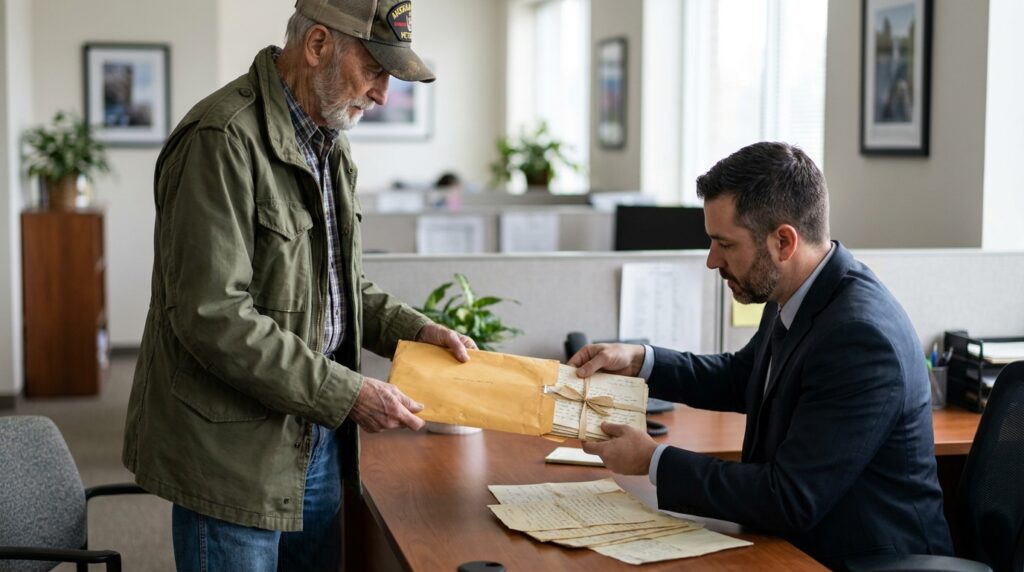
CHAPTER 5: THE RIPPLED REFLECTION
The heavy, laminated security door swung backward against its hydraulic arm with a hollow hiss. Jerry Thomas stepped onto the gray linoleum of the service floor, his presence immediately shifting the air like an onshore wind before a rainstorm. He was a large man in his late fifties, his charcoal suit stretched tight across a broad chest, his hair a stiff, brush-cut wedge of iron-gray. Behind him stood two uniformed county compliance officers, their heavy leather utility belts creaking in unison as they stepped inside the counter enclosure.
“Miller,” Thomas said, his voice a low baritone rumble that cut through the background typing of the other service windows. He didn’t look at David. His eyes were already locked on Arthur Vance’s straight, unmoving spine on the other side of the partition. “Where are the documents?”
David pointed a trembling hand toward the oak desk, where the yellowed pages lay spread beneath the fluorescent light tubes. The small silver identifier tag gleamed darkly between the sheets, its rusted edge casting a tiny, sharp shadow onto the county planning watermark below it. “Right here, Jerry. Look at the lower margins. The interlocking diamonds match our internal pre-development logs, but the text… the text is stamped as a non-entity.”
Thomas strode down the narrow aisle behind the counters, his polished wingtips squeaking softly on the floor. He leaned over David’s shoulder, his heavy hands pressing flat onto the desktop workspace with an aggressive, territorial finality. He didn’t look at Arthur. He picked up the top log sheet with thick fingers, squinting at the faded purple mimeograph ink and the bold black lines that covered the unit designation headers.
“This material is unverified,” Thomas said loudly, his voice directed toward the compliance officers rather than the window. He was speaking for the benefit of the lobby, trying to re-impose a professional, structural frame on the room’s mounting tension. “These pages are the property of the state archival division under a protective custody hold. They should never have left the lower vault. Mr. Vance, you are in possession of restricted municipal surveys.”
Arthur didn’t pull his hands back from the oak ledge. He stood his ground against the glass, his flint-colored eyes reflecting the cold glare of the lights above. “The survey didn’t come from your vault, Thomas. It came from my footlocker. The copy you have downstairs is the one my logistics sergeant sent to the state capital before the company was written off the books.”
Thomas let out a short, dry laugh that had no warmth in it. He dropped the paper back onto the stack with a dry rasp. “It doesn’t matter where it sat for fifty years, sir. Right now, this land plat is subject to a certified commercial transition. The zoning board signed the variance on Tuesday night. The construction teams are already clearing the old railway spur. Any claims regarding historical boundary disputes had to be filed sixty days before the public hearing.”
“This isn’t a boundary dispute,” Arthur said, his voice dropping into that quiet, commanding resonance that seemed to slow the breath of every person standing behind the security rope. He reached down and picked up the blunt piece of black grease pencil, his large fingers holding it with the precise, deliberate grip of an officer who had spent years drawing fire sectors on maps. He tapped the glass directly in front of Thomas’s face. “Look at the coordinates on page twelve, Jerry. Cross-reference them with the excavation grid your engineers laid out yesterday morning. Your machines are digging into the old medical bunker of the Third Battalion.”
The words seemed to freeze the mechanical hum of the room. David Miller looked from the silver tag up to his supervisor’s face. He saw Thomas’s jaw tighten, a small muscle twitching beneath the older man’s ear. Thomas didn’t look down at page twelve. He didn’t have to. The precise location of the excavation trenches was something he had reviewed every morning for three months; the knowledge was already sitting behind his eyes, heavy and compromised.
“We are digging a retention basin for an industrial logistics hub, Mr. Vance,” Thomas said, his tone dropping to a hard, unyielding whisper as he leaned closer to the glass speaking grate. “The state site assessment came back clean. There are no registered markers in that valley. The history of that unit was settled before I took this job.”
“The history was erased, son,” Arthur said softly. He laid the grease pencil down beside his cap. “And you’re about to pour six inches of concrete over the only evidence left.”
Behind the velvet security rope, the younger veteran in the utility jacket stepped forward, his hand resting on the metal stanchion with enough force to make the chrome tube rattle. “He just told you there are men down there, Thomas. You can’t just run an excavator through a field support site because the paperwork was redacted in sixty-nine. That’s a violation of federal burial law.”
“The line is closed,” Thomas snapped, turning his head toward the compliance officers and pointing a finger at the counter slot. “Clear the window. Sweep these files back into the security sleeve and log them as non-conforming municipal waste. We are done here.”
One of the uniformed officers stepped forward, his hand reaching for the manila envelope on David’s desk, his heavy frame crowding the narrow workstation.
But David Miller didn’t move his chair back to give the officer room. He sat entirely still, his hand hovering over the silver tag with its stained aluminum edge. His fingers brushed the cold, notched surface, feeling the small white ridge where the metal had been struck by a machine stamp decades ago. He looked at the watermark, then at the bold black mark that tried to declare Arthur Vance’s entire life a legal fiction. The system he had defended for twenty years—the neat, metric-driven world of clean digital registers and balanced processing times—seemed to fracture under his hand like dry porcelain.
“Jerry,” David said, his voice thin but clear enough to stop the compliance officer’s hand an inch from the paper. “I can’t log this as waste. The signature on the primary unit citation matches the applicant’s identification card. If I falsify a historical record handoff at a certified public window, the county is liable for civil erasure.”
Thomas turned on him, his face darkening to an ugly, mottled purple. “Miller, wrap those files now or I’ll have your security credentials pulled before the building closes.”
Arthur Vance didn’t move. He watched the breakdown of the administrative hierarchy behind the glass with a quiet, sorrowful pity. The trap had sprung, but it hadn’t caught him; it had caught the men who had spent their lives believing the record was identical to the truth.








