
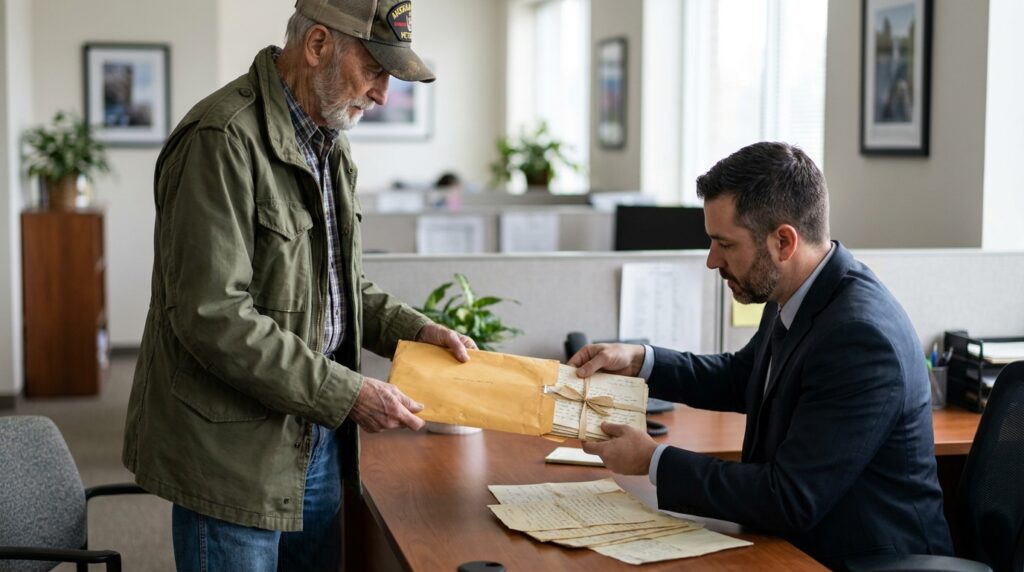
CHAPTER 3: THE STRATIFIED SHADOWS
“The mud didn’t care about the stamp,” Arthur said, his voice remaining low, level, and entirely empty of anger.
David Miller looked away from the old man’s face, his eyes dropping back to the sharp purple ink that branded the historical papers as an administrative phantom. His hand, still hovering near the desk organizer, twitched. He felt a cold sweat prickling the back of his neck beneath his stiff collar. This was the midpoint of his Friday shift, the hour where numbers usually balanced and the waiting room slowly emptied into the weekend. Instead, the sterile air of Window 3 had grown dense, thick with the scent of unventilated history and the rising murmurs of thirty citizens who had stopped looking at their own paperwork.
“Mr. Vance,” David said, his fingers tracing the edge of his laminated desktop partition as he tried to re-establish the familiar boundary of his authority. “If a unit was dissolved on paper, its operations are no longer part of our active verification matrix. We can’t log documents from an entity that legally ceased to exist two weeks before the events took place. The county archival database will literally reject the file structure if I try to enter the registry keys.”
Arthur leaned forward slightly, the worn canvas of his olive jacket whispering against the oak counter. “The men who were holding the eastern ridge on the twenty-eighth didn’t check the registry keys, son. They stayed because the radio told them help was coming. They stayed because they trusted the line.”
From three spaces back in the queue, the younger veteran in the modern utility jacket moved closer to the security rope. His boots made no sound on the thin carpet, but his eyes were sharp, scanning the top page of the bundle that lay exposed under the fluorescent lights. “Let me see that header,” he said, his voice cutting through the low hum of the ceiling ballasts.
David didn’t answer him. He was looking at something else—a small, pale watermark embedded in the lower margin of the third sheet down, where the paper had frayed away from the heavy green binding stick. It wasn’t an army seal. It was a modern, geometric crest consisting of three interlocking diamonds—the exact corporate insignia of the Vanguard Development Group, the very conglomerate that had secured the commercial excavation rights for the eastern marshland during Tuesday’s closed-door zoning session.
The discovery hit David with a cold, mechanical click. These historical records hadn’t been pulled from a random military vault; they had been cross-referenced with modern local land surveys. The physical paper in front of him carried a dual identity—a bridge between a thirty-year-old erasure in the jungle and the concrete foundations being poured four miles away near the old railway spur.
“This watermark,” David whispered, his voice cracking slightly as he used his index finger to lift the edge of the second log sheet, keeping the movement small so the crowd behind the rope couldn’t see the interlocking diamonds. “This is from our local planning archive. Someone accessed these grid maps from the county basement four days ago. The signature on the digital log-out sheet was under an administrative override.”
Arthur watched the clerk’s fingers handle the yellowed fiber. His expression didn’t change, but his large hands slowly closed into quiet, still fists on the wood. “A lot of things get buried under administrative overrides, David. Sometimes it’s an old supply ledger. Sometimes it’s a valley full of iron.”
Behind the partition, the inner office doors remained closed, but the rhythm of the room had broken completely. The young clerk at Window 2 had stopped processing a title transfer; she was leaning back in her chair, her eyes darting between David’s tense shoulders and the old man’s steady posture. The waiting queue had pressed entirely against the velvet security rope, their faces illuminated by the harsh, flat glow of the overhead tubes.
David felt the cage of his metrics tightening. If he accepted these files, he was entering non-conforming data into a system monitored by the state archive board; if he pushed them back through the slot, he was doing so under the watchful eyes of a room full of voters who were already recording the interaction on their phones. His smartwatch vibrated again—a sharp, rhythmic buzz reminding him that his average handling time per citizen had passed twenty-two minutes.
“Sir,” David said, his voice hardening as he reached for the black telephone receiver mounted to the side of his monitor bracket. “I’m calling the chief registrar down here. This isn’t just an indexing issue anymore. If these documents carry our corporate planning seals from the basement vaults, they fall under a non-disclosure hold until the zoning board certifies the land plats next month.”
Arthur didn’t pull the envelope back. He didn’t look at the phone. He simply reached into his jacket pocket, his thick knuckles catching on the frayed lining as he pulled out the short, blunt piece of black grease pencil he had carried across the state line. He laid it gently beside his blue veteran cap, the tip pointing directly toward the clerk’s computer screen.
“Call him,” Arthur said softly. “Tell him the man from the ridge is here. And tell him the water in the eastern marsh is already turning red.”








