
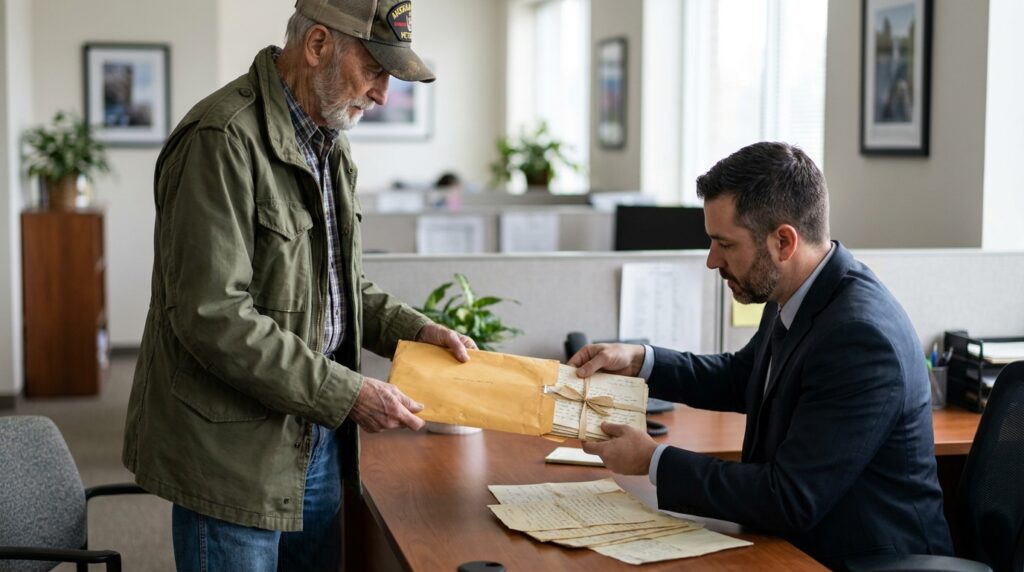
CHAPTER 1: THE WEIGHT OF THE LINE
The air inside the Douglas County Administration Building smelled faintly of industrial lemon bleach and the heavy, sour dampness of forty citizens waiting in a room with a failing air conditioning unit. Arthur Vance adjusted his grip on the manila envelope. The paper was thick, compressed fiber, heavy enough to hold eighty-four pages of carbon-copied tactical logs and three hand-drawn topographical overlays, but against his ribs, it felt like cold sheet iron. He kept his thumb hooked over the bent brass prongs of the fastener. The metal was dull, scratched white at the curves from thirty years of sitting in a cedar footlocker beneath his winter blankets.
Behind him, a child let out a thin, persistent wail that scraped against the low hum of the fluorescent light ballasts overhead. Arthur didn’t turn around. His boots, an old pair of black leather issue with soles worn down to smooth, flat discs, stayed perfectly parallel to the yellow vinyl tape stuck to the industrial carpet. To his left, the beige wall was covered in framed portraits of county commissioners whose eyes had been bleached out by three seasons of unshaded morning sun.
“Number forty-two,” a flat, synthesized voice chimed from a small plastic speaker near the ceiling.
Arthur looked down at his right hand. The skin across his knuckles was thin as parchment, dotted with dark liver spots, but the fingers were steady. He wasn’t holding a ticket. He hadn’t taken one from the red dispenser by the security door because his hands had been full, and because forty years ago, a man didn’t need a slip of thermal paper to speak to someone behind a desk. His thumb pressed deeper into the manila paper, feeling the distinct, hard ridge of a small chunk of black grease pencil rolling around at the bottom of the sleeve. It was the exact same pencil he had used to mark the parameters of Fire Support Base Ryder when the monsoon had turned the red dirt into soup.
Two paces ahead of him, the line shifted. A young man wearing a neon utility vest and muddy work boots stepped away from Window 3, grumbling into a glowing smartphone.
Arthur took three slow, deliberate steps forward, the rubber of his heels clicking against the exposed metal transition strip at the edge of the carpet. He stopped exactly two inches from the high oak counter. The wood was old, its dark varnish worn completely away at the center where thousands of forearms had rested while waiting for titles, deeds, and death certificates.
Behind the glass, David Miller didn’t look up. He was forty, maybe forty-two, his dark hair cut short enough to show the neat, pale contour of his scalp above his ears. His charcoal suit jacket was draped over the back of an ergonomic mesh chair, leaving his white dress shirt crisp and free of wrinkles despite the midday heat. He clicked a mouse twice, his eyes tracking something across a dual-monitor display with the rapid, rhythmic twitching of a man who measured his life in transactions per hour.
“Next,” David said. His voice was smooth, institutional, completely devoid of friction. He reached for a stack of white printing paper without breaking his gaze from the blue light of the screen.
Arthur didn’t reach for the handout. He took his dark blue cap off his head, revealing a fringe of silver-gray hair that stayed pressed flat against his skull, and placed it neatly on the right side of the oak counter, the gold embroidered lettering facing the glass. Then, using both hands, he laid the heavy manila envelope down between them. The dull scratch of the paper against the wood was loud enough to make the woman at the adjacent window pause her typing.
“I brought these records,” Arthur said. His voice wasn’t loud, but it possessed a strange, dry resonance that seemed to drop the ceiling by six feet. “Because they deserve to be seen and remembered.”
David’s hand hovered over the white paper stack for a fraction of a second. He slowly turned his head, his gaze sliding down from the fluorescent light reflection on the glass, past the gold letters on the blue cap, until it settled on the thick, unyielding block of the envelope. His brow furrowed slightly, a sharp crease appearing between his trimmed dark eyebrows. He didn’t touch the paper. He simply leaned back into his mesh chair, his silver smartwatch flashing a green notification as his wrist hit the armrest.
“Sir,” David said, his tone dropping into the careful, measured pitch reserved for citizens who had wandered into the wrong department. “If this is a historical donation or a personal veterans’ claim, you’re on the wrong floor. We handle municipal land records and probate filings. You need the federal archives branch over on Fourth Street.”
Arthur didn’t pull the envelope back. He left his large, thick-knuckled hands flat on either side of the paper, his thumbs bracketing the brass clasp like a pair of sight alignment markers. Through the glass, he could see the tiny reflection of his own olive field jacket, a small patch of green canvas fraying at the pocket seam where an old combat infantryman badge had once been pinned.
“Fourth Street is closed, son,” Arthur said softly. “And these aren’t claims. These are coordinates.”








