
CHAPTER 4: THE HARDENED CORE
The telephone receiver made a sharp, clattering impact against David Miller’s ear. He didn’t look at the queue as his thumb stabbed the three-digit extension for the administrative floor supervisor. His pulse thrummed behind his teeth, matching the relentless, tiny flicker of a malfunctioning screen pixel at the lower edge of his workstation monitor.
“Supervisor’s desk, this is Thomas,” a gravelly voice rasped through the plastic grate of the earpiece.
“Jerry, it’s David down at Window 3,” David said, his voice dropped to a forced, trembling whisper that barely carried past the glass speaker holes. He kept his shoulder turned away from the glass, his eyes pinned to the small piece of black grease pencil Arthur had left lying on the oak counter like an unexploded shell. “I have an applicant here… an elderly gentleman. He’s presenting historical documents regarding the eastern marshland sector. Jerry, the paper carries our archive’s internal watermark from the closed repository downstairs, but the sheets are stamped with obsolete federal headers. And the top log sheet is marked Unit Dissolved.”
There was a long, dry silence on the other end of the line. Through the receiver, David could hear the distinct, faint sound of a heavy metal filing drawer rolling shut three floors below.
“Did you say the eastern marsh?” Thomas’s voice lost its standard bureaucratic fatigue, instantly sharpening into something rigid and flat. “What’s the applicant’s name, Miller?”
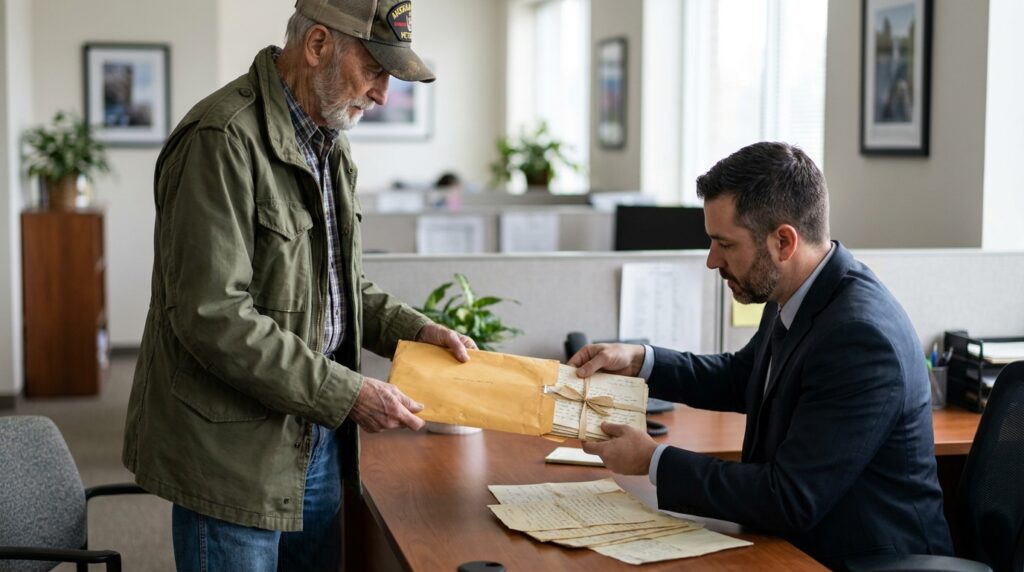
David shifted his gaze. Arthur Vance stood entirely motionless, his large hands resting on the oak counter with the same patient, unyielding weight as a stone pier enduring a rising tide. His faded cap with its gold embroidered lettering sat precisely where he had placed it, a silent anchor amidst the sterile plastics of the service desk.
“Vance,” David murmured into the plastic mouthpiece. “Arthur Vance. The paperwork contains operational field records from August of sixty-nine.”
“Hold him there,” Thomas ordered. The voice didn’t hesitate. “Do not register those files into the system queue. Do not hand them back to him. I’m coming down with security.”
The line clicked dead. David slowly lowered the receiver back onto its plastic cradle, the mechanical chime of the hook sounding like a heavy latch dropping into place. He looked up at Arthur through the grease-smeared glass partition. The air in the service stall felt thin, hot, and restricted, smelling more of old dust and failing air conditioning than it had ten minutes ago.
“They’re coming down,” David said, his voice flat as he tried to look back at his computer screen to avoid the veteran’s flint-colored eyes. “They’re going to verify the security chain on these basement watermarks. If these files were removed from the non-disclosure vault without an authorized signature, it’s a Class E administrative violation, sir. I can’t let you leave the counter with them.”
Arthur didn’t pull his hands back. His thumbs remained bracketed around the worn manila sleeve, his posture straight as an old iron rod under the modern fluorescent tubes. “I didn’t come here to leave with them, David. I came here to give them to you because the county records are incomplete without them. Every name that’s missing from your database is written on page twelve.”
From behind the velvet security rope, the younger veteran in the utility jacket stepped forward, his heavy boots making a clear, solid thud against the floor transition strip. “Hey, friend,” the younger man said, addressing David with a quiet but dangerous intensity that made the clerk’s hands freeze over his keyboard. “The man said those are operational logs. If those are original battalion documents, they don’t belong under an administrative hold by a county clerk. That’s federal record.”
“Step back behind the rope, sir,” David snapped, his administrative facade fracturing completely as the pressure from the room pressed closer against the counter. “This window is currently handling an active verification protocol. If you disrupt the line, I’ll have the guard clear the lobby.”
The young mother in the queue pulled her toddler against her side, her eyes darting between Arthur’s quiet, lined face and the thick bundle of yellowed paper spread across the desk organizer. The contractor with the blueprint tube simply stood his ground, his arms crossed over his chest like a wall, his silence carrying more weight than a protest.
Arthur didn’t turn his head to acknowledge the support of the line. He kept his eyes locked onto David’s face, his voice dropping into that low, dry resonance that seemed to freeze the mechanical clicking of the keyboards around them. “He’s right, son. The records don’t belong to the county. They don’t belong to the Vanguard Group either. They belong to the families who think their boys just went missing in the grass.”
David reached out with a trembling hand to slide the document stack back inside the manila sleeve, but as he moved the second page, his finger caught on a hard, sharp edge hidden beneath a rusted iron staple at the upper spine. He pulled his hand back, a small bead of dark blood forming on his index finger where the skin had snagged against something rigid.
Peeking out from between the yellowed carbon pages was a small, notched piece of silver metal, dull and heavily tarnished by decades of oil and marsh water. It wasn’t an archive clip. It was a duplicate identifier tag, its stamped letters partially obscured by a dark, reddish-brown stain that had eaten into the aluminum thirty years ago.
David stared at the silver notched metal, his breath catching in his throat as his eyes tracked the name stamped into the tarnished surface: VANCE, A.
The door behind the service counter clicked open with a sharp, heavy jar, and the sound of polished dress shoes on linoleum cut through the room’s silence.








