
CHAPTER 8: THE SUNK POSTS
Inspector Miller didn’t wait around for the twilight to settle over the cul-de-sac. He snapped his canvas binder shut, climbed back into the white county pickup, and started the engine. The amber light bar flashed once against the side of Sandra’s house before the truck backed down the gravel lane and turned onto the main asphalt, its tail lights fading into the warm July dusk.
The street didn’t empty right away. Old Mr. Henderson remained standing near his porch steps, his hands resting in his pockets, watching the dust settle back onto the limestone driveway. Dan Kowalski picked up the yellowed carbon complaint form from the hood of my truck, folded it with heavy, calloused fingers, and tucked it gently under my windshield wiper before walking back toward his lawn without saying a word.
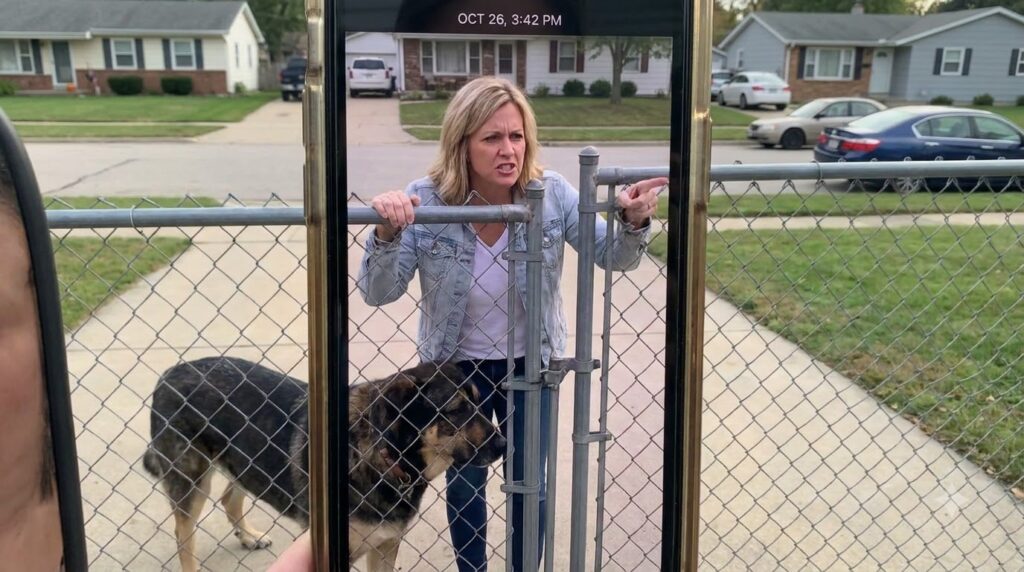
Sandra remained standing by her open chain-link gate. Her dark-and-tan dog had laid down across the walkway, its chin resting on its paws, its dark eyes watching her every movement.
I didn’t go inside to eat. I didn’t change out of my work clothes.
I reached into the bed of my Ford, grabbed a heavy iron digging bar, and stepped over to the corner post of her fence—the one set two feet inside my legal property line. I drove the wedge end of the bar deep into the packed clay beside the galvanized steel pipe. The metallic thunk of iron hitting dry earth rang out through the quiet neighborhood, echoing off the brick walls of the two houses.
“What are you doing?” Sandra asked. Her voice wasn’t sharp anymore. It was thin, tired, and stripped of the cold authority she had carried for six months.
“The fourteen-day clock started the minute Miller handed you that citation,” I said, putting my weight on the leverage bar. The dry ground cracked around the concrete footing with a dull, hollow pop. “If we wait for a private fencing crew, Public Works will show up with a backhoe and tear the whole line out. I’m pulling the corner pipe tonight so we can set the new corner first thing tomorrow.”
She stood there for a long moment, watching the dust rise from around the loosened post base. Then she reached into her jacket pocket, pulled out the worn brass key ring holding the three identical keys, and knelt in the gravel. She didn’t use the keys; she simply laid the metal ring on the dry flagstone by her gate, leaving it beside the exposed brass survey cap that gleamed faintly in the failing light.
“My father bought those keys when he set the gate,” she said, her hands resting flat on her knees. “He told me he kept three copies because Arthur Vance was forgetful. He said Arthur would always lock himself out of the lane.”
“Arthur didn’t lock himself out,” I said, working the digging bar in a slow, steady circle to widen the hole. “Arthur was trying to keep the gate open.”
She looked down at the key ring, her fingers brushing a fleck of dry mud from the brass. She didn’t argue. The weight of thirty years of misunderstanding—of holding a grudge passed down like a family inheritance—seemed to settle into the soil around her.
I pulled the steel corner post straight up out of the earth. The old concrete collar came with it, heavy, jagged, and caked in dark red clay. I set the metal pipe down on my side of the gravel, then picked up a spade and stepped two feet back, right along the string line Inspector Miller had pulled from the brass curb monument.
I drove the spade into the untouched earth. The blade sliced through the turf with a clean, satisfying crunch.
“Hold the string,” I said quietly, without looking up.
Sandra paused. She looked at her dog, then at her own hands, dusty and gray from the fence wire. Slowly, she stepped across the old gate line—across the space her father had claimed thirty years ago—and knelt at the edge of the true boundary. She took the end of the bright yellow mason’s line from my tool bag and held it pinned firmly against the brass cap in the curb.
We worked for an hour in the fading light, driven not by anger or vindication, but by the quiet, methodical rhythm of labor that should have happened thirty years ago. I dug three post holes along the true parcel line, two feet deeper into the yard, clearing away the old roots and the matted crabgrass that had covered the truth for a generation.
When the third hole was dug, I carried a six-by-six cedar post from the truck bed and lowered it into the pit. The rough-sawn wood smelled of fresh resin, deep forest, and dry rain. I dropped a spirit level against the square face, watching the green bubble float perfectly between the two black lines.
“Hold it plumb,” I told her.
Sandra reached out, her pale, dirt-stained hands resting against the rough cedar grain. She held the heavy post upright, her arms steady, while I dumped two bags of dry gravel and concrete mix around the base, tamping it down with the flat end of the iron bar.
The street was entirely dark now, illuminated only by the warm yellow glow of my truck’s running lights and the distant porch lamp over Mr. Henderson’s door. The neighborhood was quiet, the air cooling as a faint evening breeze rustled the leaves of the oak trees along the ditch line.
I poured a bucket of water over the dry concrete mix, watching the gray liquid soak into the soil, binding the stone, the clay, and the cedar post together in the dark earth.
Sandra let go of the post. It stood completely straight, solid and unyielding, rooted two feet inside her former fence line—marking the exact place where her land ended and mine began.
She looked at the post, then down at the string line stretching cleanly to the curb. She didn’t look like a woman who had lost a war. She looked like someone who had finally laid down a heavy load she was never meant to carry.
“I’m going to leave the gate unlocked tonight,” she said quietly, wiping her hands on her jeans as she turned toward her porch.
“I know,” I said, leaning my spade against the bed of my truck. “I’ll see you at seven, Sandra.”
She walked up her walkway without looking back, her dog following close at her heel. The screen door opened and closed with a soft, familiar click that carried through the quiet night air.
I stood in the driveway for a few minutes, listening to the gentle ticking of the Ford’s cooling engine and the soft rustle of the wind through the cedar posts in the truck bed. I reached down, picked up the old brass key ring from the flagstone, and set it carefully on Sandra’s porch railing where she could find it in the morning.
Then I stepped back onto my gravel lane, walked around to the driver’s side of my truck, and quietly turned off the lights.








