
CHAPTER 7: THE UNCOVERED MARKER
The silence in the alley stretched thin, pulled taut between the white parish pickup truck and the sun-bleached galvanized wire of Sandra’s gate.
Sandra didn’t move. Her fingers remained hooked over the top rail of the fence, her knuckle joints white against the zinc coating. Her gaze moved slowly from my face down to the yellowed carbon complaint form resting on the hood of my truck, then back to Inspector Miller, who was already writing the parish case number across the margin of his official log.
“You’re a contractor,” she said, her voice barely carrying over the dry rustle of the oak leaves along the ditch line. “You build things for money. You don’t reset thirty feet of pipe-set chain-link out of neighborly charity.”
“I build things to last,” I said, stepping back toward the rear bumper of my Ford. I unlatched the tailgate. The heavy steel fell with a deep, echoing thunk that shook the bed, revealing the stack of rough-sawn cedar posts, the bags of quick-set concrete, and the heavy iron post-hole digger resting against the wheel well. “And I don’t leave bad foundations sitting in the dirt to rot.”
Inspector Miller clipped his pen back into his collar pocket. He walked over to the curb edge where the gravel met the cracked parish asphalt. Kneeling in the dust, he pulled a small mason’s trowel from his side holster and began scraping away thirty years of packed red clay, dry pine needles, and dead grass roots right at the property corner.
Dan Kowalski stepped closer, his heavy work boots crunching on the loose stone as he stood over Miller’s shoulder. Across the street, Mr. Henderson slowly descended his porch steps, his watering can forgotten as he walked out to the edge of the road, drawn by the rhythmic scraping of the steel blade against the buried stone.
“Here it is,” Miller said quietly.
The trowel blade struck metal with a clean, high-pitched ping.
Miller brushed the dry silt away with his gloved palm, exposing a solid brass survey cap set flush into the concrete curb header. The metal was dark and oxidized to a deep olive-brown, but the deep, chiseled cross-hair in the center was as sharp as the day the parish crew had driven it into the ground in 1968.
Miller unreeled his yellow fiberglass measuring tape, hooking the brass end directly into the center notch of the brass cap. He walked thirty feet straight down the property line, pulling the tape taut along the gravel. The black inch-markings crossed the yellow line of Sandra’s fence two full feet inside her gate.
“The brass cap doesn’t lie, Mrs. Vance-Giles,” Miller said, looking up from the tape reel. “This is the legal, recorded origin point for parcel 4A and 4B. Everything inside this line belongs to parcel 4A. Everything outside it is parish access right-of-way.”
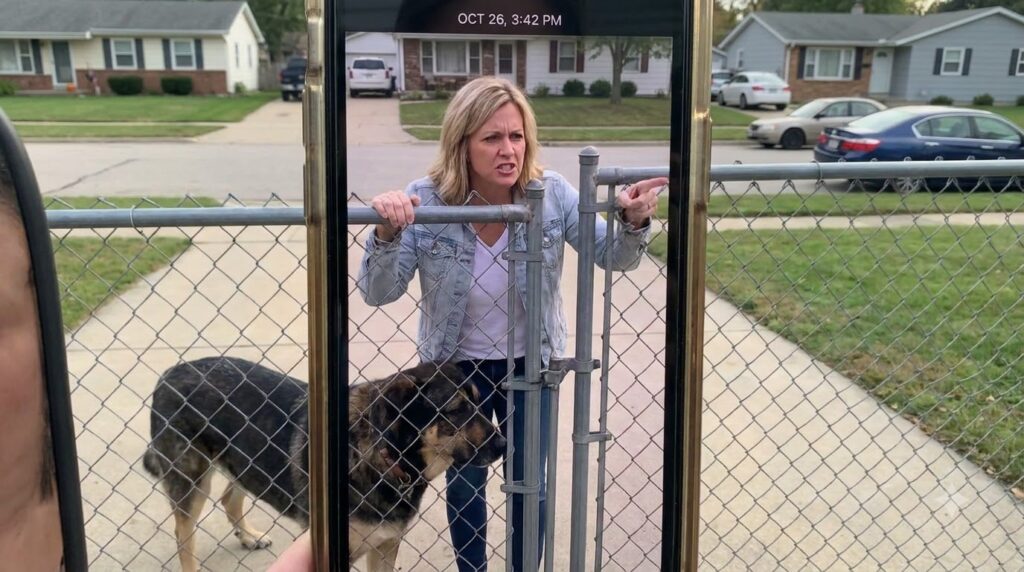
Sandra’s hand slowly loosened on the gate latch. The dark-and-tan shepherd mix beside her let out a low, mournful huff, sitting back on its haunches as the gate swung open an inch under its own weight, the rusted hinges groaning in the still afternoon air.
She looked at the brass cap gleaming faintly in the low, golden light of the late afternoon sun. The paper she held—the yellowed field sketch her father had handed her thirty years ago—seemed small and weightless in her hand, its red-ink line rendered completely meaningless by the permanent brass monument anchored into the earth below.
“He told me it was ours,” she whispered, her eyes fixed on the oxidized metal ring at the curb. “He told me he fixed the drain and saved the yard.”
“He fixed the drain,” I said softly, stepping up to the fence line with my tape measure in hand. “But he left you carrying a debt that wasn’t yours to pay.”
I reached through the open gap in the chain-link gate and pulled the orange citation slip off the latch handle. I didn’t tear it up—it was a matter of official parish record now—but I folded it neatly and placed it on the hood of my truck next to Arthur Vance’s old complaint form.
“We start at seven tomorrow morning,” I said, meeting her eyes through the wire grid. “We pull the steel corner posts, dig two feet back along the brass line, and reset the chain-link where it belongs. The cedar posts in my truck are going on my side of the line to frame a proper utility lane.”
Sandra stood frozen for a long moment, the breeze catching the loose strands of her shoulder-length blonde hair. The authoritative, unyielding posture that had defined her for six months had completely vanished, leaving behind the tired, quiet outline of a woman who had spent decades defending a lie she hadn’t created.
“Why?” she asked, her voice crackling like dry paper.
I looked down at the brass survey cap at the curb, then back at the rough cedar posts resting in my truck bed.
“Because next time someone points at my truck,” I said, “I want to make sure both of us are standing on our own land.”








