CHAPTER 3: THE DRIFT OF WITNESSES
“The drain was cleared thirty years ago, Sandra,” I said, but the gate latch had already clicked shut.
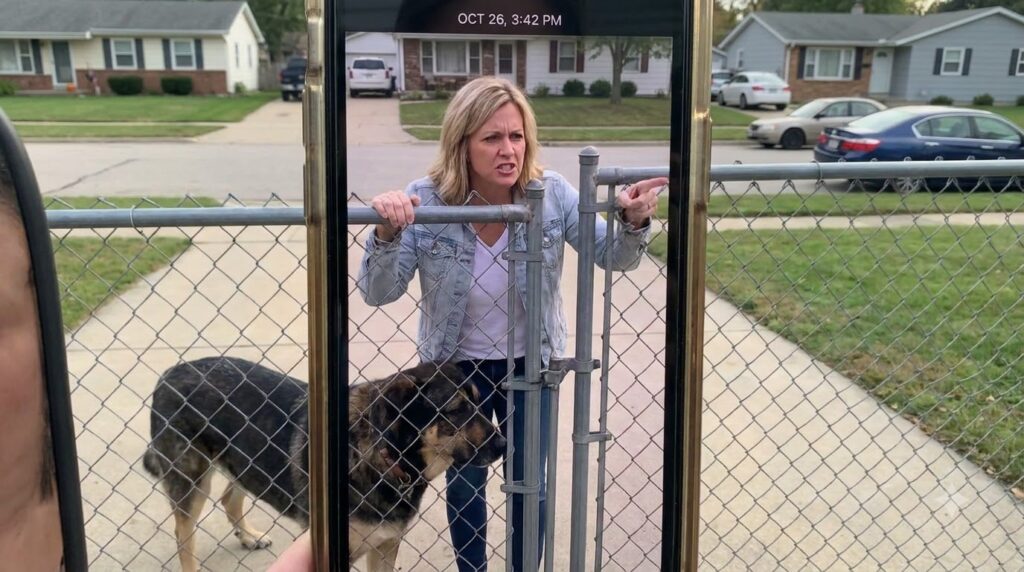
She didn’t look back as she walked toward her rear porch, her light denim jacket stiff against her spine, the dark-and-tan shepherd mix pacing at her heel. Her white canvas shoes left faint, dusty ovals on the dry flagstones. The screen door slammed behind her with a tinny, double-rebound slap that echoed off the brick facing of my garage.
I stayed on the driver-side running board for three slow seconds, my fingers hooked into the top loop of my utility belt. The heat radiating off the gravel was dry and heavy, smelling of baked dust and old crankcase oil.
Across the street, old Mr. Henderson hadn’t gone back inside. He had set his plastic watering can down on the second step of his porch, his hands resting flat on his thighs as he watched me. A few houses down, near the corner where the street sign tilted slightly in the sandy soil, two more neighbors had drifted onto their front lawns—Dan Kowalski from 412, holding a half-empty mug of coffee, and young Mrs. Miller, who remained behind her screen door with her face pressed against the wire mesh.
They weren’t coming over. They were doing what people in this development had done for fifteen years: keeping their distance, measuring the dispute by the angle of the trucks parked in the alley and the frequency of the shouting.
I stepped down off the running board, the gravel grinding under my boots. Instead of unlatching the tailgate to get to the cedar posts, I walked slowly around the rear bumper, my eyes fixed on the narrow green strip between my concrete shed footing and her chain-link fence.
The space was barely eighteen inches wide. Crabgrass and wild clover grew thick and rank in the shade of the fence, choked with drifted oak leaves from two autumns ago. I knelt in the dirt, the canvas knees of my work pants soaking up the stale, trapped heat of the ground.
My fingers brushed through the dry grass, tracing the edge of the shed’s concrete pad. The slab had been poured six inches thick, reinforced with steel mesh—a sturdy, honest piece of work I’d finished my second month here. But right where the concrete met the chain-link barrier, buried under three inches of matted roots and yellowed pine needles, my knuckles struck something hard and metallic.
It wasn’t a rock. It was a round, cast-iron valve cover, five inches across, rusted to a deep, flakey orange.
I picked up a flathead screwdriver from my belt holster and scraped at the top of the iron disk. The letters came through slowly, filled with packed red clay: PARISH DRAINAGE – DO NOT COVER.
A cold, quiet knot tightened in my chest.
Arthur Vance hadn’t built the shed over a ditch; he had poured the concrete pad within three inches of a buried parish overflow line. If Sandra’s father had dug that culvert by hand in ninety-four, he hadn’t just helped Arthur save his foundation. He had run a private line right into a municipal storm drain—one that didn’t show up on any standard residential property plat I’d been handed at closing.
“She’s been keeping that paper in her kitchen drawer since May,” a voice called out from the street.
I turned my head without standing up. Dan Kowalski had walked across the asphalt, his work boots stopping at the edge of my gravel apron. He was wearing an old flannel shirt with the sleeves cut off, his forearms sunburned and scarred from forty years as a auto mechanic.
“Dan,” I said, wiping my dusty thumb on my thigh.
“She showed it to the postal driver last week,” Dan said, squinting through the heat shimmer at Sandra’s darkened kitchen window. “Told him if he tire-tracked her side of the driveway again, she was going to have his route reassigned. Man was just trying to deliver a certified letter.”
“She thinks Arthur gave her the easement,” I said, standing up and brushing the dry dirt from my knees.
Dan let out a short, dry sound that wasn’t quite a laugh. “Arthur was a good builder, but when his wife passed in ninety-two, he stopped paying attention to deeds and permits. He let her dad dig whatever he wanted back there just to keep the peace. But Sandra… Sandra doesn’t want peace, kid. She wants the street to look the way it did when her mother was still alive to tend those hydrangeas.”
He nodded toward the buried iron valve cover hiding under the crabgrass.
“If the county inspector comes out here with a rod and a metal locator, he’s not just going to look at the fence,” Dan added, his voice dropping an octave as he glanced toward Sandra’s house. “He’s going to ask why there’s a six-inch iron riser resting two inches from your foundation. You know what happens if they declare that an active drainage easement?”
“They pull the concrete,” I said softly.
“They pull the concrete,” Dan agreed. “And they bill the owner of the parcel for the excavation.”
Behind us, the low, mechanical whine of a heavy engine turned off the main avenue and entered the cul-de-sac. A white county pickup truck with an amber light bar on the roof slowed as it passed Mr. Henderson’s house, its tires crunching onto the loose gravel of the shared lane.