
CHAPTER 6: THE MEASURING TAPE AND THE BINDER
The orange citation slip fluttered slightly in Inspector Miller’s fingers, the carbon paper underneath leaving a dark smudge along his thumb.
“Fourteen days, ma’am,” Miller repeated, his voice carrying no malice, only the hollow, unyielding weight of parish regulation. He stepped up to the chain-link gate and pressed the official notice through the wire diamonds, resting it on top of the latch handle.
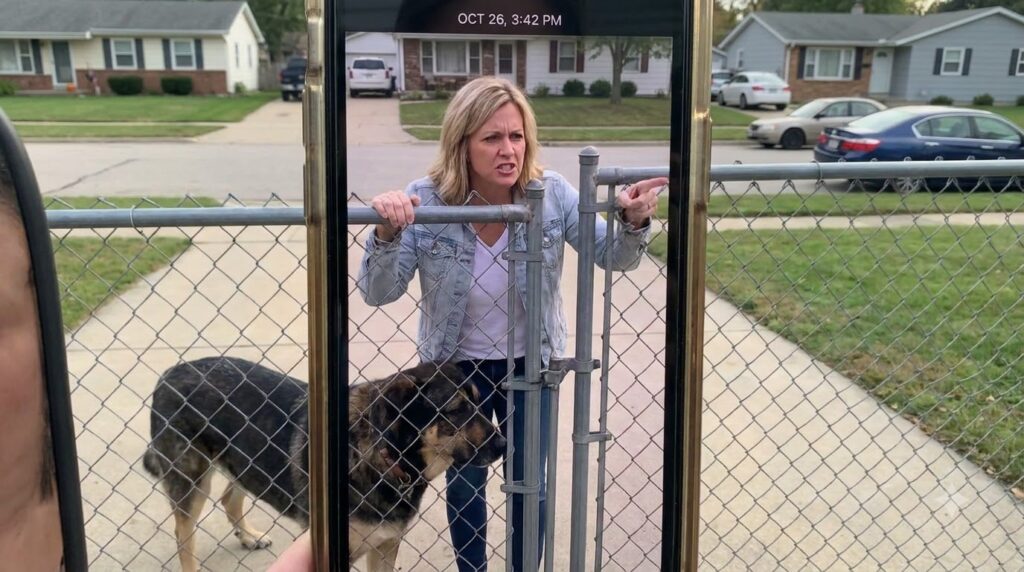
Sandra didn’t take the paper. She stared at it as if it were a burning coal, her fingers curling tighter into the pockets of her light denim jacket. “You can’t just write a citation on a thirty-year-old fence. My father built this town’s first firehouse. He worked for the parish board!”
“And he left a non-conforming encroachment across a municipal utility corridor, Mrs. Vance-Giles,” Miller said. He snapped his leather binder shut with a dry, heavy thud that sounded like a door locking in an empty room. “I don’t have discretion over active storm lines. When the parish GIS flags an illegal barrier on an easement, the notice goes out automatically.”
I lowered my phone screen, my thumb finally stopping the video recording. The lens had captured it all—the rusted valve, the exposed steel surveyor pin, the bright yellow flag vibrating in the red clay, and the orange citation wedged into her gate. I had every piece of legal proof I’d spent six months wishing for. I had the county’s backing, the surveyor’s mark, and a recorded video that would crush any legal challenge she tried to bring to civil court.
Yet as I looked at Sandra standing behind that wire grid, her shoulders hunched against the late-afternoon sun, the victory felt heavy and jagged in my hands.
“Inspector,” I said, stepping closer to Miller’s shoulder. “What happens if she can’t get a contractor out here in fourteen days? It’s peak building season. No fence company is taking a thirty-foot reset job on a two-week notice.”
Miller turned his head, his gray eyes assessing me over the rims of his reading glasses. “If the fence isn’t relocated or removed by the deadline, parish Public Works sends a backhoe team to cut the posts at ground level. They clear the corridor, haul the scrap to the municipal yard, and place a lien on parcel 4B for the labor costs.”
A sharp gasp escaped Sandra’s throat. “Cut the posts? My father welded those corner anchors himself!”
“Then I suggest you hire a private crew before the fourteenth, ma’am,” Miller replied calmly. He turned back toward his canvas binder, unbuckling the brass strap to log his field notes.
As he flipped through the worn plastic sleeves of his binder, a yellowed, folded receipt slipped out from behind a blue parcel map, fluttering down onto the hood of my truck.
I reached down and caught the paper before the wind could blow it into the dust. It wasn’t a modern computer printout. It was an old three-part carbon form from the 1994 Parish Public Works department—the original field complaint filed by Arthur Vance thirty years ago, the day after Sandra’s father dug the ditch.
My eyes scanned the faded blue impact-typewriter text: COMPLAINT LOG #94-882. Complainant: Arthur Vance. Subject: Illegal boundary fence and forced drainage diversion.
Beneath the log entry, in Arthur’s tight, slanted handwriting, was a note that hadn’t appeared on Sandra’s field sketch: Neighbor set fence under threat of blocking south runoff. Signed sketch under duress to prevent flooding of my subfloor. Never ratified.
The final piece of the truth locked into place like a deadbolt falling into a iron strike plate.
Arthur Vance hadn’t given the land away out of neighborly generosity, nor had he forgotten to file the paper out of old age. Sandra’s father had used the threat of the August floodwaters to force the old man into signing a paper on his kitchen table, using the water as a lever to carve out two feet of Arthur’s yard. Arthur had filed a formal protest with the parish the very next morning, but the parish had shelved the file when the floodwaters receded, leaving the secret buried in a metal cabinet for thirty years.
I held the yellowed carbon receipt in my hand, feeling the dry, brittle texture of the paper against my calloused thumb.
Across the fence, Sandra was watching me. She didn’t know what was written on the carbon paper, but she saw the change in my face—she saw the moment I realized her family’s legacy wasn’t built on a peaceful promise, but on a silent, forced surrender.
“David,” Dan Kowalski called out from the edge of his lawn, his voice quiet. “Leave it be, kid. The county gave her the notice. You got your lane back.”
I looked at Dan, then down at the yellow flag in the clay, and finally at Sandra, whose pale hand had finally reached out to touch the orange citation resting on her gate handle.
“Inspector,” I said, my voice cutting through the quiet heat of the alley. “If the fence is moved two feet to the true boundary line, does the parish still require the drainage easement to remain completely bare?”
Miller paused, his silver pen hovering over his logbook. “If the barrier is on the legal parcel line and doesn’t obstruct the iron valve cover, the parish doesn’t care if you put up a new fence, a garden bed, or a stone wall. The utility access stays open, but the boundary is yours.”
I looked at Sandra through the chain-link grid. “I have three hundred pounds of cedar posts in the back of my truck,” I said softly. “And I’m a licensed contractor.”








