
CHAPTER 4: THE LENS AND THE RECORD
I reached into my pocket before the truck’s driver-side door even opened.
My thumb swiped the glass screen awake, switching straight to video recording. I held the smartphone steady at chest height, framing the gravel corridor, Sandra’s chain-link gate, and the white Ford Ranger with the official county seal painted on its door panel.
Dan Kowalski took two steps back onto his own grass, folding his scarred forearms across his chest. He didn’t leave, but he gave the county truck a wide berth, his jaw working silently on a piece of tobacco. Across the street, old Mr. Henderson leaned over his porch railing, his eyes wide and fixed on the vehicle’s amber light bar.
The truck door creaked open, and a man in a crisp khaki short-sleeve shirt stepped down into the dust. He wore a heavy leather gear belt laden with a brass tape reel, a digital distance meter, and a thick canvas binder jammed with rolled blueprint sheets. He looked to be in his early fifties, his skin weathered to the color of dried cedar, a silver pen tucked behind his right ear.
“Afternoon,” he said, adjusting his cap. The stitched logo above the brim read PARISH CODE ENFORCEMENT & PUBLIC WORKS. “Either of you the property owner for 408?”
“I am,” I said, stepping forward but keeping my boots on my side of the gravel rut. “David Miller. And this is my shared access lane.”
“Name’s Miller,” he repeated, flipping open a clipboard and running a thumb down a printed daily log. “Got a dispute call logged two hours ago regarding an unpermitted obstruction and a blocked drainage easement. Called in by a Mrs. Sandra Vance-Giles.”
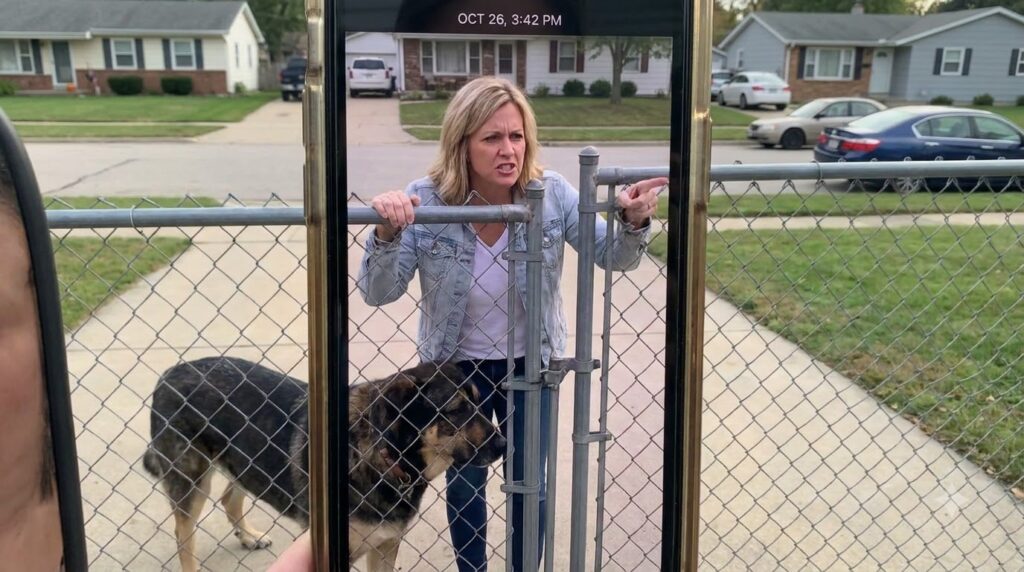
Before I could answer, the latch on the adjacent house rattled. Sandra came down her walkway with sharp, rhythmic strides, her light denim jacket open now, revealing the white shirt beneath. She held her folded yellow paper in her left hand, her knuckles tight. The dark-and-tan shepherd mix trotted behind her, stopping right at the chain-link gate line without a sound.
“I’m Sandra Vance-Giles,” she said, her voice carrying clear and hard across the gravel. “He’s had his commercial vehicle parked in the access corridor for forty-five minutes. He’s sitting right on top of my family’s drainage line, and he’s refusing to move.”
The officer—whose name tag read V. MILLER, no relation—didn’t rush. He looked at Sandra, looked at my Ford diesel idling twenty feet back, and then looked down at the gravel strip between our houses.
“Ma’am, is the truck currently blocking your personal vehicle from leaving?” Officer Miller asked, his tone flat, bureaucratic, and entirely void of drama.
“He’s on my land,” Sandra insisted, thrusting the folded paper toward the wire mesh. “He’s violating a written agreement signed by the original owner of that property. He has no right to park a work rig on this gravel.”
“I’m recording this, Sandra,” I said, keeping my voice level as I stepped closer, angling the phone camera so it captured both her face through the chain-link grid and the paper in her hand. “You’re claiming this entire lane is private property. State for the camera that you’re denying access to a recorded parish easement.”
“I am denying you permission to destroy my boundary!” she snapped, leaning over the gate rail. Her eyes flared, flashing toward my camera lens before snapping back to the inspector. “Look at the document, Officer! Look at Arthur Vance’s signature!”
Officer Miller sighed, a long, tired exhale that smelled faintly of stale gas-station coffee. He walked over to the fence, taking off his sunglasses and hanging them from his collar. “May I see the paper, ma’am?”
Sandra handed it over through the diamonds of the wire mesh with a triumphant glance in my direction.
I kept the phone recording, zooming in on Officer Miller’s weathered fingers as he unfolded the fragile, yellowed sheet. The late-afternoon sun hit the paper, illuminating the hand-drawn grid, the dark cursive of Arthur Vance, and the thick, torn streak of red ballpoint ink outlining the surrendered drainage corridor.
Officer Miller studied it for a long, silent minute. He turned the paper over.
On the reverse side, hidden in the bottom corner beneath thirty years of paper yellowing, was a faint blue-ink rubber stamp. It wasn’t a county clerk’s seal. It was a receipt stamp from a private surveying firm that had gone out of business in ninety-eight—a stamp that read: PRELIMINARY FIELD SKETCH – NOT RECORDED – SUBJECT TO FINAL PLAT APPROVAL.
The decoy secret hung there in the open air, clear and stark under the summer sun.
Arthur Vance hadn’t legally ceded the land to Sandra’s father. He had drawn up a preliminary proposal for a private drainage compromise during the August flood of ninety-four, paid for a field sketch, and then… nothing. The paper had never been filed at the courthouse. It had never been approved by the parish. It was an unexecuted draft, a historical ghost that Sandra had guarded for three decades believing it was the law of the land.
Officer Miller looked up from the paper, his eyes shifting from Sandra’s tense, expectant face to the chain-link fence beneath her hands.
“Ma’am,” Miller said softly, his thumb resting on the blue stamp. “This isn’t a recorded deed modification. This is a private field draft from thirty years ago. It has zero legal standing with the parish.”
Sandra’s face went completely pale, the color draining from her cheeks like water pulled down a dry pipe. “What are you talking about? It has his signature! He signed it!”
“He signed a sketch, ma’am,” Miller replied, handing the paper back through the wire grid. “He never recorded it. Which means the original 1968 parcel plat is the only legal document governing this property.”
He turned away from her, walking toward the rear of my utility truck with his measuring tape already unclipped from his belt.
“And according to the parish GIS database,” Miller added, his eyes scanning the overgrown crabgrass near my shed, “the 1968 plat shows something else entirely.”
Sandra stood frozen behind her gate, the yellow paper trembling in her hand, as Miller knelt right where I had been five minutes ago, pulling back the thick weeds to expose the rusted iron valve cover.








