CHAPTER 2: THE PAPER BOUNDARY
“Look at it,” Sandra repeated, her voice dropping into a rasp that cut straight through the low thrum of my idling engine. “Look at what your predecessor signed before you ever stepped foot in this county.”
I didn’t reach through the chain-link grid to take the paper. I knew better than to break the plane of her fence, even by an inch. Instead, I cut the Ford’s ignition. The sudden silence settled over the driveway like wet wool, leaving only the metallic ticking of the cooling manifold and the distant, rhythmic snip of Mr. Henderson’s hedge shears across the street.
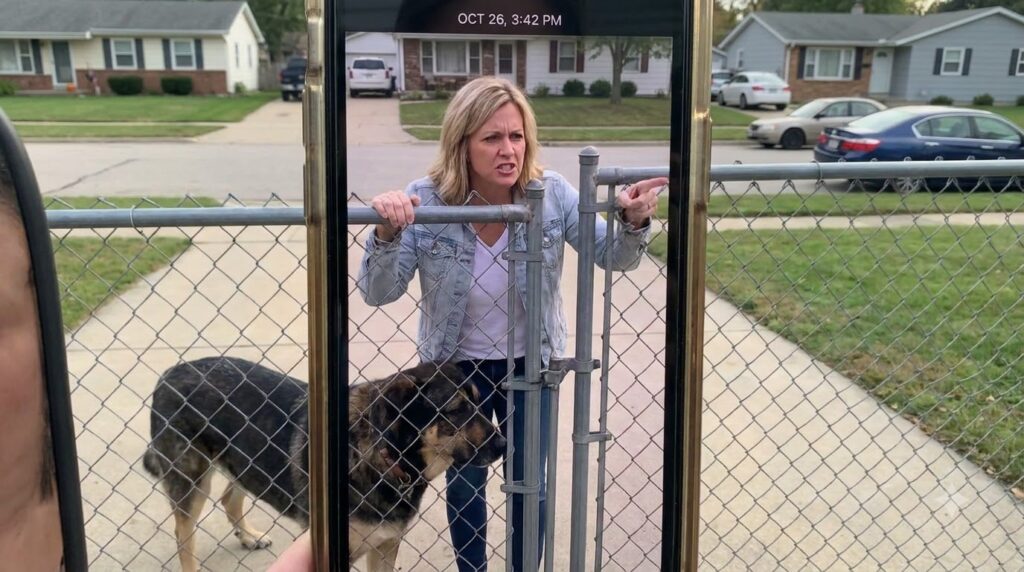
“Show it to the lens, Sandra,” I said, lifting my phone until the black glass of the camera lens aligned with the rusted wire diamonds. “If it’s a legal deed modification, it’s got a county clerk’s stamp on the margin. Let me see the seal.”
Her face tightened, the skin around her eyes crinkling into fine, sun-cured lines. She held the yellowed sheet against the fence, her thumb deliberately obscuring the bottom right corner where a notary’s crest ought to sit. The paper was fragile, the edges yellowed and frayed like dry corn husks, marked with a hand-drawn grid in faded black ink. A thick, bleeding streak of red ballpoint lined the gravel corridor, drawn with a heavy hand that had torn small, feathered splits into the grain of the paper.
In the upper margin, the handwriting was distinct—the tight, slanted cursive of Arthur Vance, the old carpenter who had built my house in sixty-eight and lived in it until his heart gave out on the back porch three winters ago.
Surrendered for drainage access, the annotation read, dated August 14th, 1994. Lane control reverts to parcel 4B upon completion of south ditching.
My thumb hovered over the screen, zooming the digital lens until the red ink filled the display. The line didn’t follow the current fence. It pulled three feet inward, slicing directly through the edge of my utility shed’s concrete footing.
“Arthur wrote that thirty years ago,” I said softly, the hum of the air conditioning fading as the cab rapidly warmed in the afternoon sun. “Sandra, Arthur was seventy-two in ninety-four. He didn’t have the legal authority to cede a county access easement with a ballpoint pen on a piece of scrap drafting paper.”
“He owned the dirt!” She slammed her free palm against the top rail, making the steel chain-link vibrate with a harsh, metallic clatter. The shepherd mix beside her didn’t bark; it simply shifted its weight, its claws clicking against the dry flagstones of her walkway. “He knew what was fair! My father dug the drainage ditch with his own tractor when the county refused to run culverts after the flood. Arthur gave him the lane because my father saved his foundation from caving in! You bought a foreclosed shell from a bank that didn’t care about the history, and now you think you can drive a six-ton work rig over my family’s sweat!”
The anger in her voice was thick, aged, and sour—not the flash-fire rage of a bad neighbor, but the deep, calcified grief of someone who felt every passing year had stolen another square foot of her childhood. Behind her, through the wire mesh, I could see the overgrown garden beds where her mother’s hydrangeas had dried into gray, papery skeletons.
“If it was a legal conveyance, it would be filed in the parish register,” I said, my voice steady, though I could feel the dull, familiar ache beginning at the base of my neck—the weight of three hundred pounds of cedar waiting in the bed, the sun dipping lower toward the treeline. “A private note in a desk drawer doesn’t rewrite a parcel plat.”
“It’s not a private note,” she whispered, leaning so close to the fence that her breath fogged a small circle on the cold galvanized wire. “It’s a promise. And around here, before people like you showed up with utility belts and city permits, a promise meant the ground stayed where it was put.”
She folded the paper along its ancient, tearing creases with meticulous, trembling care, tucking it back into the pocket of her denim jacket. As she pulled her hand away, her fingers brushed against a small, rusted iron key ring hanging from her belt loop—a ring holding three identical brass keys, none of which belonged to any lock on the chain-link gate.
Across the drive, the front door of the Miller house clicked open. Young Mrs. Miller stepped out onto her porch, holding a sleeping infant against her shoulder, her eyes darting nervously between my truck and Sandra’s gate before she quietly retreated behind her screen door.
“I’m not moving the truck, Sandra,” I said, setting my boots back on the gravel with a crunch that sounded loud in the quiet lane. “I’m unloading the cedar. If you want to call code enforcement, the number is on the county sign at the corner.”
She didn’t reach for her phone. Instead, she took half a step backward, her hand resting on the head of the dark-and-tan dog.
“I don’t need to call code enforcement,” she said, her voice dropping into a flat, terrifying calm. “I called the parish surveyor two weeks ago. He’s already on his way out here to mark the drain.”
She smiled then—a thin, colorless line that held no warmth at all.
“And when he looks at the south corner, he’s not going to be looking at your truck. He’s going to be looking at what you built over Arthur’s drain.”