
Chapter 8: The Work Nobody Applauded
Karen expected community service to be humiliating.
She imagined people recognizing her, whispering behind her back, and treating her like a criminal.
Instead, she was assigned to assist a nonprofit organization that supported emergency preparedness and older residents in remote Alaskan communities.
The work was ordinary.
She sorted donated blankets.
She assembled emergency supply kits.
She labeled boxes of batteries, flashlights, and first-aid materials.
She helped prepare informational packets for residents who lived far from hospitals.
No one applauded.
No one asked about her social media account.
Most volunteers barely knew who she was.
Her supervisor, a sixty-seven-year-old retired paramedic named Helen Brooks, treated her exactly like everyone else.
Helen had short white hair, sturdy walking shoes, and a voice that could carry across a crowded room without sounding angry.
She had spent more than thirty years responding to medical emergencies.
She knew that people often remembered dramatic rescues.
They rarely remembered the quiet preparation that made those rescues possible.
One afternoon, Karen complained about spending hours packing emergency kits.
Helen asked whether she knew why the organization included reflective blankets.
Karen guessed they were for comfort.
Helen explained that exposure could become dangerous quickly in remote environments, especially for injured or older people who could not move easily.
She described patients who had survived because rescuers arrived with the right supplies.
Then she showed Karen a photograph of a winter rescue.
An elderly woman sat wrapped in a reflective blanket while volunteers prepared a snowmobile evacuation.
The woman looked exhausted.
But she was alive.
Helen explained that the patient had been stranded after a vehicle breakdown.
Her rescue had required coordination among several agencies and volunteers.
Every piece of equipment had mattered.
Karen studied the photograph.
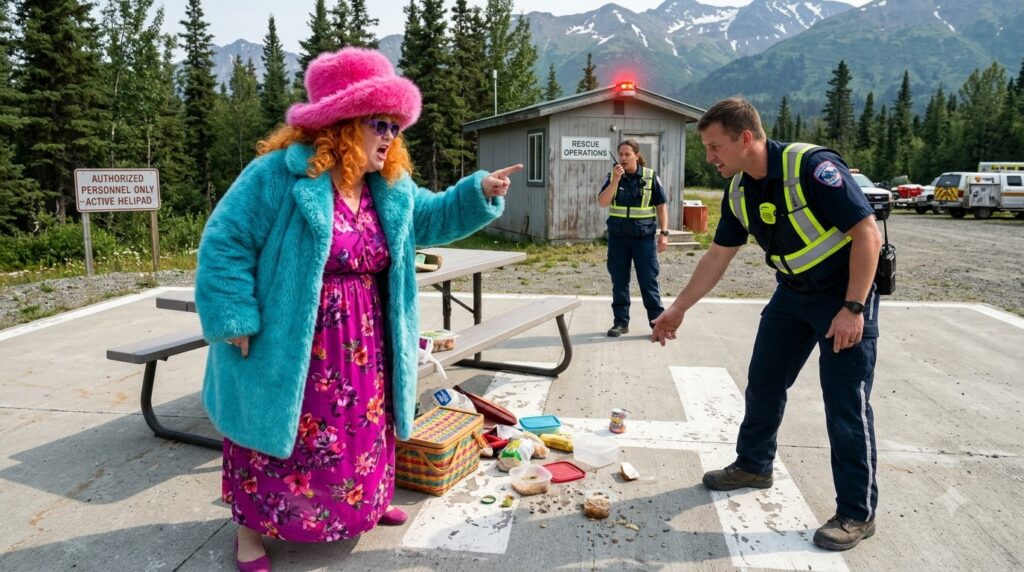
She thought about the picnic basket she had kicked across the helipad.
At the time, it had seemed like a harmless expression of anger.
Now she understood that emergency workers did not have the luxury of treating loose objects, blocked access lanes, or wasted minutes as harmless.
Their work depended on preparation.
And preparation depended on cooperation.
Over the following weeks, Karen began arriving early.
She stopped complaining about the repetitive tasks.
She learned to check supply lists carefully.
She helped an elderly volunteer carry boxes without being asked.
These were modest changes.
They did not erase what she had done.
But they mattered because they required Karen to think about someone else’s needs before her own.
Meanwhile, Daniel Mercer returned to his regular duties at Raven Creek.
The incident had brought unwanted attention to the station.
Reporters called.
Visitors asked questions.
Administrators reviewed access procedures.
The open service gate that had allowed Karen to enter was replaced with a controlled-entry system.
Additional signs were installed.
Staff received updated guidance on documenting unauthorized access without allowing confrontations to distract from rescue operations.
Daniel welcomed the improvements.
But he disliked the public attention.
He had not become a rescue worker to appear in viral videos.
He wanted to do his job.
One afternoon, Sarah found him reading a letter from Thomas Hayes.
The letter thanked the Raven Creek team for their professionalism.
Thomas wrote that he was recovering at home and looking forward to attending his granddaughter’s high school graduation.
He also said he hoped the incident would remind people to respect those who worked in emergency services.
Daniel read the letter twice.
Then he placed it in a drawer beside several other notes from families whose loved ones had been rescued.
Those letters meant more to him than public praise.
They reminded him why the work mattered.
Weeks later, Karen’s community service supervisor mentioned that the rescue station had received a letter from the Hayes family.
Karen asked whether Thomas was doing well.
Helen told her that he was recovering.
Karen felt relief.
Then she felt something less comfortable.
She realized that she had spent more time worrying about her reputation than about the man whose rescue she had disrupted.
That evening, she sat alone at her cabin table and began writing a letter.
For once, she did not begin by explaining why she had been angry.
She began with an apology.








