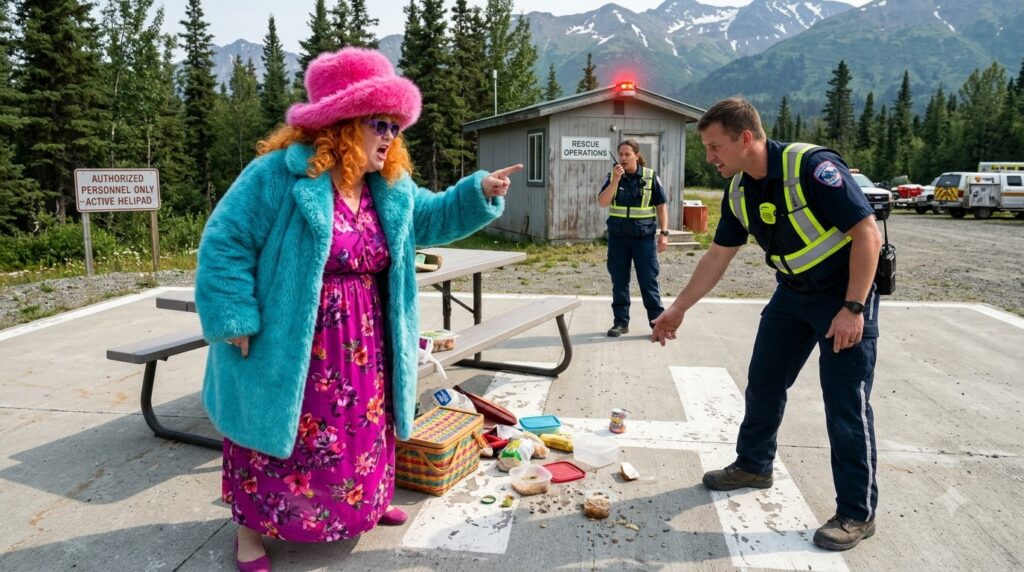
Chapter 5: A Video That Told the Wrong Story
Karen Whitcomb returned to her rented vacation cabin convinced that she had been humiliated.
She was not accustomed to losing public confrontations.
Back home in suburban Arizona, she had built a reputation for filing complaints.
She had argued with neighborhood association boards, disputed restaurant bills, and once demanded that a grocery store manager dismiss a cashier who refused to honor an expired coupon.
Karen considered herself a woman who stood up for her rights.
Other people described her differently.
Her younger sister, Linda, had stopped inviting her to family gatherings after Karen publicly embarrassed a waitress at their mother’s eightieth birthday dinner.
Her adult son, Eric, called less frequently than he once had.
And her former husband had told her, shortly before their divorce, that every ordinary disagreement seemed to become a contest she needed to win.
Karen dismissed these judgments.
She believed people resented strong women.
At the cabin, she uploaded an edited version of her confrontation.
The video began with Daniel pulling the picnic table away.
It omitted Karen’s earlier decision to destabilize the table.
It showed Sarah blocking the operations building entrance.
It did not show Karen trying to push past her.
The caption accused federal rescue workers of bullying a senior citizen during a harmless picnic.
For several hours, the post attracted sympathy.
People who saw only the edited footage questioned whether the employees had been unnecessarily harsh.
Karen responded enthusiastically.
She described herself as a retired businesswoman who had traveled thousands of miles to enjoy Alaska’s natural beauty.
She claimed the workers had deliberately ruined her vacation.
Then someone posted a photograph of the warning sign at Raven Creek.
Another person identified the large white H as an active helicopter landing marking.
A former rescue pilot commented that the facility appeared to be an operational landing zone, not a public recreation area.
Questions began multiplying.
Karen deleted several comments.
Then she blocked the people asking them.
The next morning, a local news outlet published a short report confirming that federal authorities were reviewing an incident involving unauthorized access to an active rescue facility.
The report did not name Karen.
It also did not identify the medical patient.
But it confirmed that emergency operations had been underway.
Karen became furious.
She contacted the station and demanded that the report be corrected.
Sarah referred her to the appropriate public affairs office.
Karen interpreted the referral as another insult.
She then contacted an attorney in Anchorage, hoping to file a lawsuit for harassment and emotional distress.
The attorney, Margaret Ellis, agreed to review the available information.
Margaret was sixty-one and had practiced law for more than three decades.
She had represented people who were genuinely mistreated by public agencies.
She also knew that not every unpleasant encounter with a government employee amounted to a legal violation.
Karen sent her the edited video.
Margaret watched it carefully.
Then she asked for the unedited recording.
Karen said it was unnecessary.
Margaret asked whether Karen had entered a restricted area.
Karen replied that the public had paid for the property.
Margaret asked whether she had been told to leave.
Karen said the employees had been rude.
Margaret repeated the question.
Eventually, Karen admitted that she had been instructed to leave several times.
Margaret asked whether the facility had been responding to an emergency.
Karen insisted that the emergency had been exaggerated.
At that point, Margaret explained that she could not responsibly evaluate a claim without the complete facts.
She also warned Karen that deliberately interfering with emergency operations could have serious consequences.
Karen ended the call.
That evening, she received a message from her son.
Eric had seen the news.
He was forty years old, married, and raising two teenage daughters.
He had spent much of his adult life trying to maintain a relationship with his mother without becoming involved in her disputes.
His message was brief.
He asked whether she had really blocked a rescue helicopter.
Karen called him immediately.
She launched into a lengthy explanation about disrespectful employees and government overreach.
Eric listened.
Then he told her something she had not expected.
His father-in-law had suffered a heart attack two years earlier.
An emergency medical helicopter had helped save his life.
Eric knew what those aircraft meant to families waiting for help.
He asked his mother to imagine being the person waiting.
Karen fell silent.
Not because she agreed.
Because she had never considered the question.