Chapter 2: A Family Waiting in the Wilderness
Thirty miles north of Raven Creek, beneath a stand of wind-bent spruce trees, seventy-year-old Eleanor Hayes knelt beside her husband.
Thomas Hayes was sixty-eight, a retired school principal from Spokane, Washington.
For forty-one years, he had been Eleanor’s husband, her closest friend, and the person who remembered every anniversary without being reminded.
Now his face was pale, his breathing shallow, and his left hand trembled against the damp earth.
Their daughter, Rebecca, stood a few feet away, holding a satellite communication device.
She had already contacted emergency services.
A dispatcher had instructed her to keep her father still, monitor his breathing, and prepare for rescue personnel.
Rebecca was fifty-two, a registered nurse who understood enough about cardiac emergencies to recognize how dangerous the situation might be.
That knowledge did nothing to ease her fear.
The family had come to Alaska for what Thomas jokingly called his last great adventure.
He had spent years dreaming about the mountains.
After retiring, he and Eleanor had postponed their trip repeatedly. First came a home renovation. Then Eleanor’s knee replacement. Then the arrival of their third grandchild.
Finally, this summer, they had decided to stop waiting.
Thomas had insisted on taking one modest hiking excursion.
He wanted to see the wilderness while he was still strong enough to walk through it.
Rebecca had joined them partly for the scenery and partly because she worried about her father’s health.
His cardiologist had cleared him for moderate activity, but Thomas had a history of coronary artery disease.
He knew his limits.
That morning, however, something had gone wrong.
He had complained of pressure in his chest shortly after they reached a scenic overlook.
Within minutes, he had become dizzy.
Rebecca had helped him sit.
Then he collapsed.
Now Eleanor held his hand and watched the sky through the branches.
She was listening for a helicopter.
Back at Raven Creek, Sarah Collins received an updated medical report.
The ground team was approaching the family, but the trail was steep and muddy. Carrying a patient out on a stretcher could take hours.
A helicopter transfer offered the best chance of reaching advanced care quickly.
Sarah relayed the information to Daniel.
The rescue aircraft had not yet reached the station. Its crew was preparing to use Raven Creek as a staging and patient-transfer point.
The landing pad needed to be completely clear.
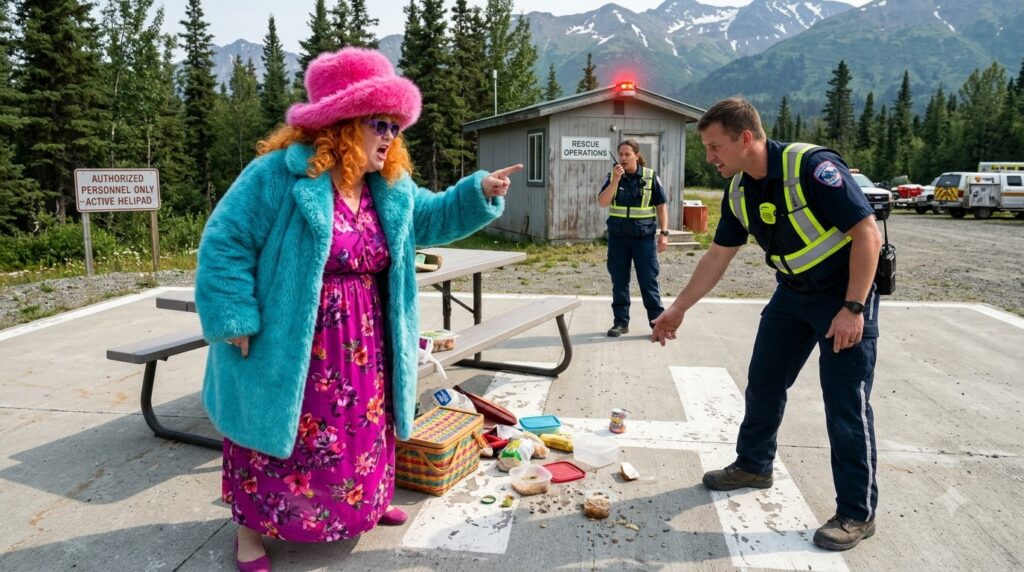
Daniel and another worker had already moved the picnic table.
Most of the containers were gone.
But Karen refused to move her rented SUV from the restricted service lane.
The vehicle was not sitting directly on the painted landing symbol. It was parked beside the equipment access route, where emergency vehicles needed room to maneuver.
When Daniel approached, Karen held up her phone.
She had begun broadcasting a video to a small social media audience.
Her commentary described the workers as aggressive government employees who were bullying an older woman enjoying a peaceful afternoon.
She carefully avoided filming the warning sign behind her.
She also failed to mention that she had been asked repeatedly to leave.
Daniel did not argue for the camera.
He explained that the vehicle had to be moved immediately.
Karen demanded written proof.
Sarah brought her a printed copy of the facility’s access restrictions.
Karen glanced at the document, declared it meaningless, and folded it into her handbag.
She then announced that she would be filing complaints with the governor, the federal government, and every television station in Alaska.
Sarah quietly notified station security and requested assistance from the federal law enforcement officer assigned to the surrounding public lands.
The officer was responding from another location.
Meanwhile, Daniel continued clearing the landing pad.
He was careful to remove every piece of plastic and loose paper.
Helicopter operations could be dangerous around unsecured debris. Even lightweight objects could become hazards in rotor wash.
The pilot would not land until the crew confirmed the area was safe.
Sarah checked the clock.
The rescue team had reached Thomas Hayes.
They were providing emergency care and preparing him for evacuation.
The helicopter crew had received the updated coordinates.
For a moment, Sarah allowed herself to believe that everything would proceed normally.
Then she looked through the operations building window.
Karen was standing beside her SUV.
She had opened the rear hatch.
And she was removing another folding chair.
Sarah closed her eyes briefly.
The woman wasn’t preparing to leave.
She was preparing to continue her picnic.
What Sarah did next would become one of the most important decisions of her career.