
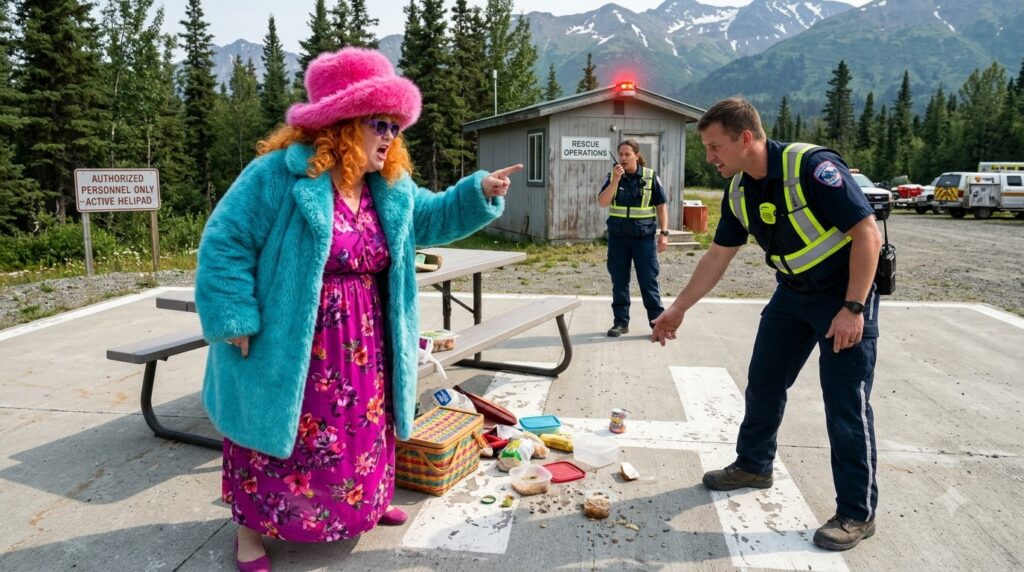
Chapter 10: A Different Kind of Landing
One year after the incident, Thomas Hayes returned to Alaska.
This time, he did not come to hike a remote trail.
He came with Eleanor and Rebecca to attend a small appreciation event recognizing regional rescue personnel and volunteers.
His health had improved.
He walked more slowly than before and carried a lightweight hiking pole on uneven ground.
But he was grateful to be walking at all.
The event took place at a community center several miles from Raven Creek Federal Rescue Station.
Daniel Mercer attended reluctantly.
Sarah Collins persuaded him that the recognition would help local residents understand the importance of emergency preparedness.
Officer Bennett was there too.
He stood near the back, speaking with several volunteers.
Thomas recognized Daniel from a photograph.
He approached and extended his hand.
Daniel shook it.
For a moment, neither man knew what to say.
Then Thomas thanked him.
Daniel explained that the rescue had involved many people.
Pilots.
Medical personnel.
Ground teams.
Dispatchers.
Operations staff.
No single person had made the rescue possible.
Thomas nodded.
He understood.
As a school principal, he had spent decades watching teachers, custodians, secretaries, bus drivers, and parents work together to keep children safe.
The best systems depended on people doing their jobs, even when nobody noticed.
Rebecca joined them.
She thanked Sarah for maintaining the station’s safety procedures during the obstruction.
Sarah told her that the helicopter crew had never been asked to land in unsafe conditions.
That fact mattered to Rebecca.
She was grateful that the workers had protected both the rescue mission and the people operating the aircraft.
Later, Helen Brooks introduced a group of volunteers who had contributed hundreds of hours to emergency preparedness programs.
Karen Whitcomb was among them.
She had completed her court-ordered service months earlier.
After returning to Arizona, she had begun volunteering with a local senior emergency preparedness organization.
She had also returned to Alaska for a scheduled volunteer project, paying her own travel expenses.
Her appearance was still colorful.
She wore a bright teal jacket, a floral scarf, and large gold earrings.
But there was no oversized hat.
No dramatic sunglasses.
And no attempt to dominate the room.
Karen noticed the Hayes family standing near Daniel.
Her expression changed.
For a moment, she considered leaving.
Then Helen gently encouraged her to stay.
Karen approached slowly.
She stopped several feet away.
Rebecca recognized her immediately.
So did Thomas.
Karen apologized in person.
She did not make a speech.
She did not explain the picnic.
She simply acknowledged that she had acted irresponsibly and that her behavior had no place at an emergency facility.
Thomas listened.
Then he told her that he was glad she had chosen to help other people.
He did not pretend that the incident had been harmless.
He did not excuse her actions.
But he accepted that people could learn from serious mistakes.
Rebecca remained reserved.
She thanked Karen for the apology and returned to her father’s side.
Karen understood.
She had not come to receive forgiveness.
She had come to take responsibility.
Across the room, Daniel watched the exchange.
Sarah stood beside him.
Neither of them expected Karen’s personality to change overnight.
People were more complicated than that.
But the woman who had once kicked a picnic basket onto an emergency landing pad was now spending her time helping older residents prepare for emergencies.
That was a meaningful difference.
After the event, Thomas and Eleanor drove to a scenic overlook along a paved road.
The mountains rose in the distance, their peaks catching the late afternoon sunlight.
Thomas stood beside his wife and looked across the valley.
He had once imagined Alaska as a place where he would prove he was still young enough for adventure.
Now he understood that the trip had given him something more valuable.
A reminder that life could change without warning.
A reminder that independence was precious but never absolute.
And a reminder that dignity was not measured by how loudly a person demanded respect.
It was measured by how that person treated others, especially when those others were vulnerable.
Eleanor slipped her hand into his.
They stood together for a long time.
Back at Raven Creek, the landing pad was empty.
The enormous white H was clean.
The warning signs stood beside the secured gate.
Inside the operations building, Daniel finished checking equipment while Sarah reviewed the next day’s schedule.
There were no reporters.
No angry visitors.
No flashing emergency beacon.
Just the quiet routine of people preparing to help strangers they had never met.
Then Daniel’s radio sounded.
A new call.
A different family.
Another emergency somewhere beyond the mountains.
Daniel picked up his equipment.
Sarah moved to her console.
Outside, the helicopter crew began preparing for departure.
And this time, nothing stood in their way.








