Chapter 4: The Price of Fifteen Minutes
The security recording showed the entire confrontation.
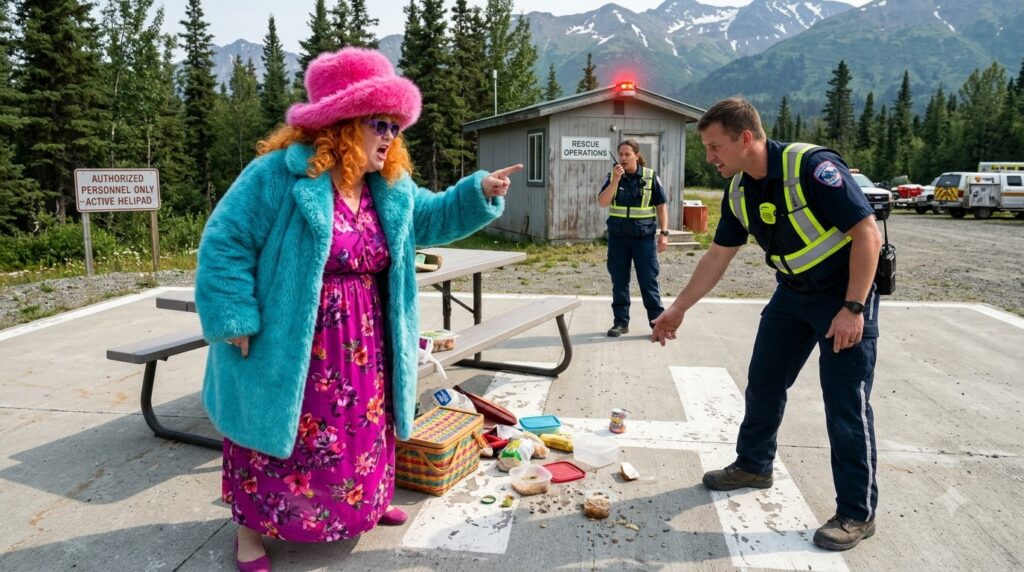
Karen’s arrival.
Her SUV passing the warning sign.
Her decision to place a picnic table on the landing pad.
Daniel’s initial request that she move.
Her refusal.
The deliberate collapse of the table.
And the moment she kicked the picnic basket back toward the center of the landing marking.
Officer Bennett watched the footage twice.
He did not raise his voice.
He did not lecture Karen.
He simply told her that the picnic was over and that she needed to move her vehicle immediately.
Karen protested.
Bennett explained that she was inside a restricted federal operational area during an active emergency.
She could leave voluntarily, or she could face detention while officers addressed the obstruction.
For the first time, Karen looked uncertain.
Her phone was still recording.
She glanced at the screen, perhaps expecting her viewers to encourage her.
Instead, several comments urged her to move.
One viewer wrote that their husband had worked in emergency aviation and that helicopter landing areas were not playgrounds.
Another asked whether Karen understood that someone might be dying.
She ended the livestream.
Then she demanded that Bennett help load her belongings.
He refused.
Daniel and another worker had already moved the picnic supplies to a safe collection area.
Karen could retrieve them later through the proper process.
Her immediate responsibility was to remove the vehicle.
She climbed into the SUV, slammed the door, and started the engine.
But instead of driving directly toward the exit, she stopped beside the equipment building and began making a phone call.
Bennett approached the driver’s window.
She ignored him.
Another minute passed.
Then another.
Finally, Bennett issued a direct instruction to proceed to the gate.
Karen drove away slowly, glaring through the windshield.
At 2:23 p.m., the service lane was clear.
Sarah confirmed the landing pad was free of debris.
Daniel completed a final visual inspection.
The helicopter crew received authorization to approach.
The delay had not lasted an hour.
It had not caused a crash or a dramatic mechanical failure.
It was something more ordinary and, in emergency work, more troubling.
A series of preventable interruptions had consumed valuable operational time.
Fifteen minutes had passed between the first urgent instruction to clear the area and the final confirmation that the facility was ready.
Those minutes could not be returned.
The helicopter descended against the backdrop of the mountains, its rotors sending waves of dust across the concrete.
Daniel stood beyond the marked safety boundary.
Sarah watched from the operations building.
The crew landed, completed the necessary staging procedures, and continued the mission.
The ground team had prepared Thomas Hayes for extraction.
The helicopter would rendezvous with the rescue personnel at a suitable pickup location before transferring him to advanced medical care.
By late afternoon, Thomas was aboard the aircraft.
Rebecca sat beside him, watching a medical crew member monitor his condition.
Eleanor had been transported separately with assistance from the ground team.
Thomas was frightened.
His breathing remained labored.
But he was conscious.
He squeezed Rebecca’s hand.
She leaned close enough to hear him over the aircraft noise.
He asked whether her mother was safe.
Rebecca assured him that she was.
Then he asked whether they would still make their flight home the following week.
Rebecca nearly laughed.
Instead, tears filled her eyes.
Even now, her father was thinking about ordinary things.
Plane tickets.
Family schedules.
The little details of a life he expected to continue.
She wanted desperately for him to be right.
At the regional hospital, doctors discovered that Thomas had suffered a serious cardiac event.
He required urgent treatment and several days of close observation.
The medical team stabilized him.
They could not determine that the delay at Raven Creek had changed his medical outcome.
But the incident had introduced an unnecessary obstacle into a time-sensitive rescue.
That distinction mattered.
It would matter later, when Karen’s behavior became public.
And it would matter most to Rebecca, who would soon learn why her father’s helicopter had encountered a delay.