
Chapter 7: When the Truth Became Official
The federal investigation proceeded without drama.
Officer Bennett submitted his report.
Sarah provided operational records.
Daniel documented the physical obstruction and the steps taken to clear the landing pad.
Investigators reviewed security footage, radio logs, photographs, and Karen’s own social media recordings.
The evidence established a clear sequence.
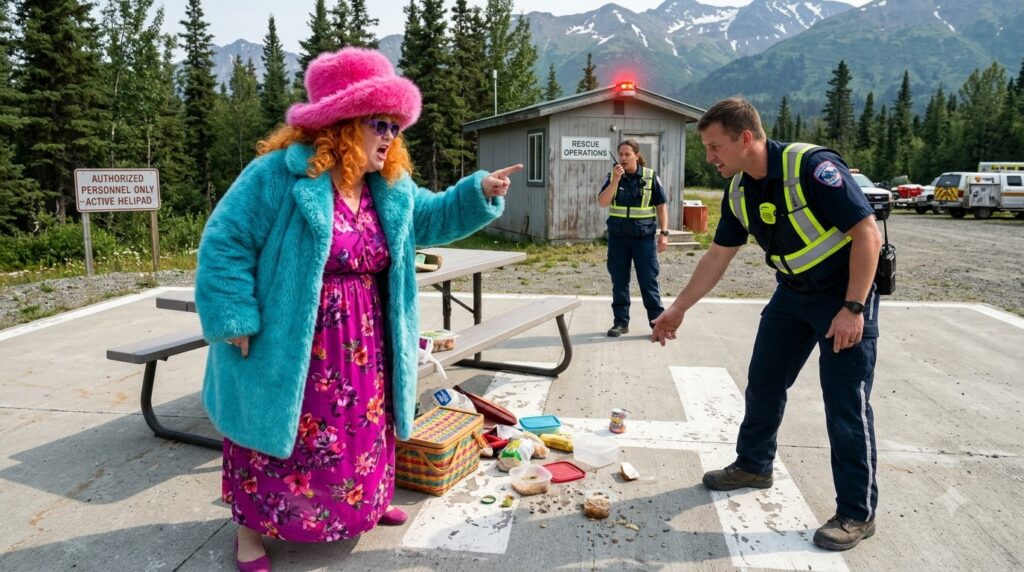
Karen had entered a restricted rescue facility without authorization.
She had ignored repeated instructions to leave.
She had placed picnic equipment on an active helicopter landing pad.
She had deliberately caused additional debris to scatter across the landing area.
And she had continued interfering after emergency personnel explained that a rescue operation was underway.
The investigation did not establish that Karen had caused Thomas Hayes’s cardiac event or worsened his medical condition.
Nor did investigators claim that the helicopter had attempted an unsafe landing.
The crew had followed safety procedures.
The problem was the unnecessary disruption of an emergency operation.
Several weeks later, Karen received formal notice of federal charges related to unauthorized entry and interference with facility operations.
She also received information about a proposed resolution that would require court approval.
The matter was no longer an argument she could end by demanding a manager.
She hired Margaret Ellis after all.
This time, she brought the complete recording.
Margaret watched it in silence.
Karen sat across from her, twisting a tissue between her fingers.
When the video reached the moment Karen kicked the picnic basket back onto the landing marking, Margaret paused.
She asked why Karen had done it.
Karen said she had been angry.
Margaret waited.
Karen added that Daniel had touched her belongings without permission.
Margaret explained that the worker had been attempting to clear a restricted emergency area.
Karen stared at the desk.
For years, she had treated anger as a justification.
If someone upset her, she believed she was entitled to retaliate.
But the recording showed something she could not explain away.
The worker had been trying to protect a rescue operation.
She had been trying to win an argument.
Margaret advised her to stop posting about the incident and to cooperate with the legal process.
She also explained that accepting responsibility could matter when the court considered an appropriate resolution.
Karen asked whether she could still sue the station.
Margaret told her there was no credible basis for the claims Karen had described.
The answer made Karen’s face redden.
But she did not storm out.
That small change surprised even her.
At the next hearing, Karen entered a plea under an agreement reviewed by the court.
The judge examined the evidence and the circumstances of the offense.
Karen was ordered to pay a financial penalty, complete community service, and comply with restrictions on entering designated federal operational areas without authorization.
She was also required to participate in a conflict-management program.
The court made clear that emergency facilities could not function if individuals treated safety instructions as optional.
Karen listened without interrupting.
Outside the courthouse, a reporter asked whether she regretted her behavior.
She had prepared a statement about being misunderstood.
The words were folded inside her handbag.
But when she opened her mouth, she remembered Thomas Hayes sitting in the hospital bed.
She remembered her son’s question.
What if she had been the one waiting?
Karen put the statement away.
She said only that she had made serious mistakes and intended to comply with the court’s orders.
It was not a complete transformation.
She still felt embarrassed.
She still resented being publicly criticized.
But for the first time, she had acknowledged wrongdoing without immediately blaming someone else.
And the consequences were only beginning.








