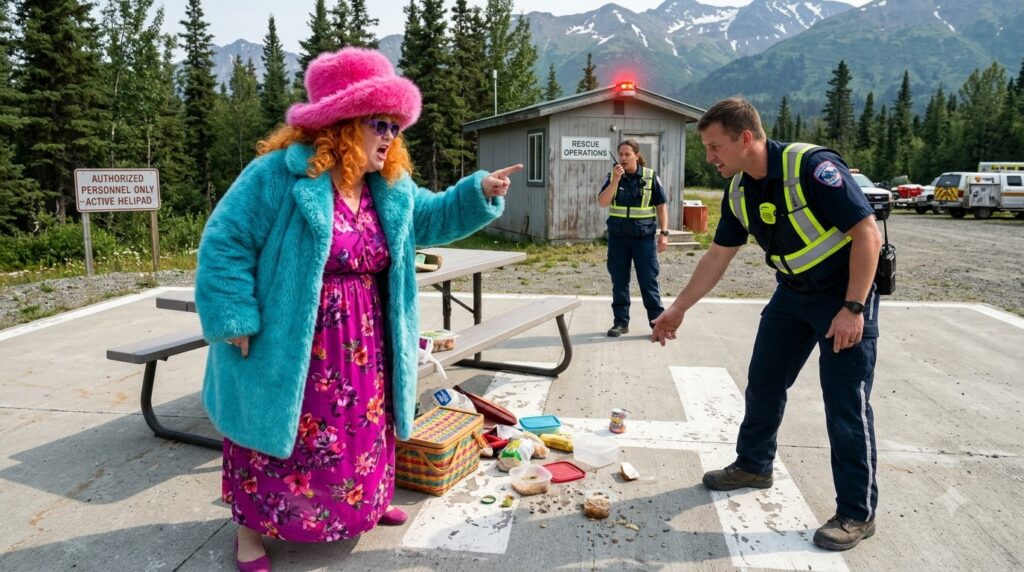
Chapter 3: The Evidence Karen Created Herself
Sarah Collins had spent nineteen years working in emergency management.
She knew that arguments could consume time faster than almost anything else.
She also knew that an angry person holding a camera could turn a straightforward safety intervention into a public spectacle.
So she stopped trying to persuade Karen.
Instead, she began documenting.
She instructed Daniel to continue operational preparations while she recorded the condition of the landing pad, the blocked service lane, and the remaining picnic equipment.
She photographed the warning signs.
She recorded the time of each request for Karen to leave.
She preserved the station’s security footage.
And she made sure that every instruction given to Karen was clear, calm, and limited to safety.
Karen interpreted the silence as weakness.
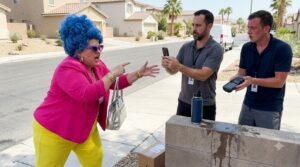
She strutted toward the operations building, her yellow sandals slapping against the concrete.
Her bright clothing looked almost surreal against the gray landing pad and distant mountains.
She demanded to enter the building and speak to whoever controlled the helicopter.
Sarah informed her that the building was restricted.
Karen attempted to push past her.
Sarah stepped into the doorway without touching her.
The two women faced each other.
Sarah was shorter and dressed in an ordinary navy uniform. Her dark hair was pulled into a practical ponytail, and there was nothing dramatic about her appearance.
But her expression was firm.
Karen had spent years getting her way by making other people uncomfortable.
She was accustomed to clerks giving refunds to end arguments, restaurant managers offering free meals to avoid complaints, and neighbors surrendering small disagreements because confronting her was exhausting.
Sarah was different.
She wasn’t protecting her pride.
She was protecting an emergency operation.
When Karen realized she would not be allowed inside, she turned her phone toward Sarah’s face.
She accused the rescue coordinator of discriminating against older citizens.
Sarah simply repeated the instruction to clear the restricted area.
Karen’s livestream audience began asking questions.
Why was there a helicopter pad?
Why was a warning beacon flashing?
Was someone actually in danger?
Karen ignored those comments.
Instead, she announced that the workers were staging an emergency to frighten her.
That statement would later prove especially damaging.
Inside the building, Sarah received another update.
Thomas Hayes was conscious but unstable.
The medical team wanted him transported without unnecessary delay.
The helicopter was approaching the region.
Sarah authorized a temporary alternate holding pattern until the landing area and access lane could be confirmed secure.
The crew was informed that the station was experiencing an unauthorized civilian obstruction.
No pilot would be pressured into an unsafe landing.
Daniel heard the radio exchange.
His jaw tightened.
He understood the operational consequence.
The helicopter could remain airborne, but it could not safely complete the planned staging operation until the facility was ready.
The rescue team was working against time.
Outside, Karen had placed the folding chair beside her SUV.
She sat down and began eating a sandwich.
The sight stunned Daniel more than her earlier shouting.
He walked past her carrying the last container of spilled food.
She watched him without moving.
Then she informed her viewers that the employees were stealing her belongings.
Daniel set the container beside the other recovered picnic supplies, well away from the landing area.
He said nothing.
At 2:17 p.m., a white government utility vehicle appeared at the service gate.
Federal law enforcement officer Michael Bennett stepped out.
He was fifty-four, broad-shouldered, with closely cropped gray hair and the patient expression of someone who had spent decades dealing with people who mistook volume for authority.
He surveyed the scene.
The overturned picnic table.
The scattered food.
The blocked service lane.
The flashing emergency beacon.
Then he looked at Karen.
She immediately stood, smiling as though reinforcements had arrived on her behalf.
She told Bennett that she was relieved someone in authority had finally come to arrest the rescue workers.
Bennett listened.
He asked one question.
Had she been instructed to leave the restricted facility?
Karen hesitated.
The hesitation lasted only a second.
But it was the first time that afternoon she seemed to understand that someone might not accept her version of events.
Bennett looked toward Sarah.
Then toward the security camera above the operations building.
He asked to see the footage.
Karen’s smile disappeared.