
Chapter 6: The Man Behind the Emergency
Thomas Hayes survived.
After undergoing treatment at the regional medical center, he began the slow process of recovery.
His doctors advised him to avoid strenuous activity and arrange follow-up care when he returned to Washington.
Eleanor spent long hours beside his hospital bed.
She brought him reading glasses, adjusted his blankets, and reminded him to drink water.
Their marriage had been built on thousands of ordinary acts like those.
They had weathered job losses, family disagreements, the deaths of parents, and the loneliness that followed when their children left home.
But seeing Thomas connected to medical equipment frightened Eleanor in a way she had not anticipated.
She had always known that one of them would eventually face a serious illness.
Knowing something intellectually was different from watching it happen.
Rebecca remained in Alaska until her father was stable enough to travel.
During a conversation with a hospital social worker, she learned that the rescue operation had experienced an access problem at the staging facility.
At first, she assumed it had been caused by weather.
Alaska’s mountains could create sudden changes in visibility and wind.
Then she learned that a civilian had obstructed the landing area.
Rebecca asked for more information.
The hospital could not provide details about a separate federal investigation.
But the social worker directed her toward publicly available reporting.
Rebecca found Karen’s video.
She watched it once.
Then again.
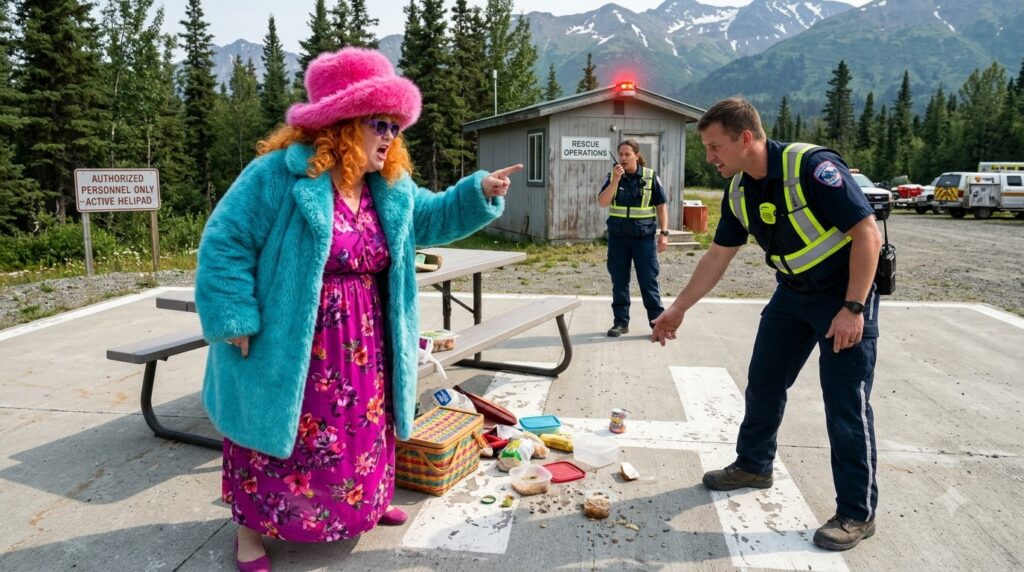
The bright turquoise coat.
The overturned picnic table.
The woman arguing about her lunch while rescue personnel tried to work.
Rebecca felt a cold anger settle in her chest.
She thought about her father’s pale face beneath the spruce trees.
She remembered Eleanor asking whether the helicopter was coming.
She remembered the helplessness of waiting while someone she loved struggled to breathe.
And she looked at a woman who had apparently decided that her picnic mattered more than an emergency landing area.
Rebecca wanted to write an angry public response.
She wanted Karen to understand what the delay had meant to a real family.
But Thomas discouraged her.
He had spent thirty-five years working in public education, including twenty as a principal.
He had seen countless disputes grow worse because people were more interested in winning than understanding.
He believed consequences were necessary.
He also believed public humiliation could become its own form of cruelty.
Rebecca argued that Karen deserved to be exposed.
Thomas did not disagree that the behavior needed to be addressed.
He simply asked his daughter to distinguish accountability from revenge.
That evening, Rebecca wrote a statement.
She did not identify Karen by name.
She described her father’s emergency, the rescue personnel who had helped him, and the fear her family experienced while waiting.
She explained that emergency facilities existed for people who had no other safe option.
Then she asked readers to respect rescue workers and restricted landing areas.
The statement was calm.
It contained no insults.
Perhaps because of that, it spread quickly.
Thousands of people shared it.
Many were older Americans who had experienced medical emergencies themselves.
Others had cared for spouses with heart disease, cancer, strokes, or serious injuries.
They understood the helplessness of waiting for help.
They also understood how fragile independence could become with age.
One day, a person could be hiking through the mountains.
The next, that same person might depend on strangers in uniforms to get home alive.
Karen saw Rebecca’s statement two days later.
She recognized the connection immediately.
For the first time, the emergency had a face.
Thomas Hayes was not an abstract patient on a dispatch sheet.
He was a husband, father, grandfather, and retired principal who had nearly lost his life during a family vacation.
Karen studied the photograph accompanying Rebecca’s statement.
Thomas was sitting in a hospital bed, smiling weakly beside Eleanor.
His face reminded Karen of her own father in the final years of his life.
She pushed the thought away.
Then she read the statement again.








