
Chapter 1: The Woman Who Wouldn’t Move
The picnic table struck the concrete with a metallic crash.
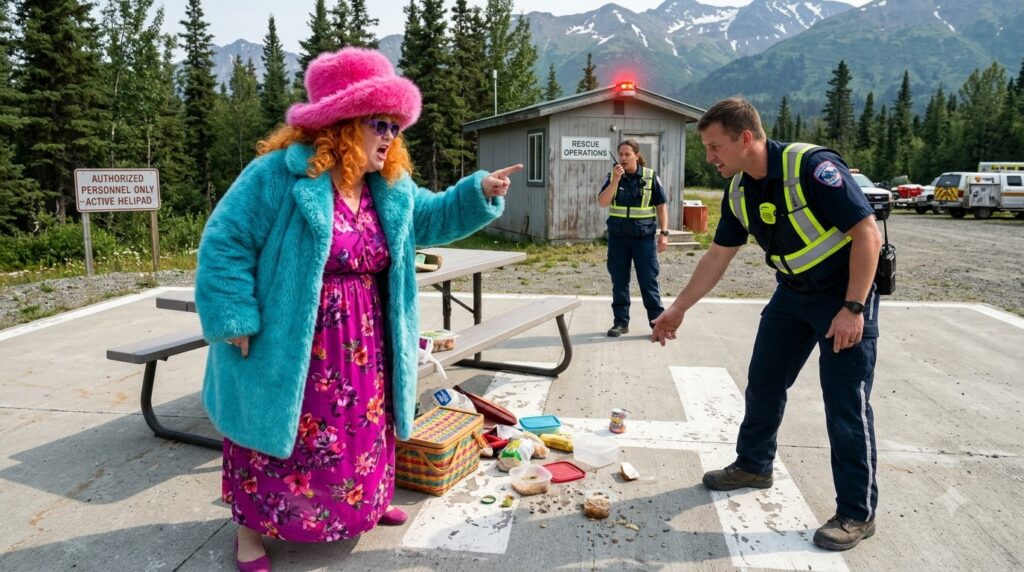
Plastic containers flew across the enormous white H painted on the helicopter landing pad. Potato salad spilled onto the pavement. A wicker basket rolled beneath the table, scattering paper plates and sandwiches across the yellow safety markings.
And standing in the middle of the destruction was a woman who seemed more offended by the interruption of her lunch than by the danger she had created.
“Touch my picnic again, and I’ll have you fired!”
Karen Whitcomb, sixty years old and dressed as though she were attending a garden party rather than trespassing at a federal rescue facility, pointed a thick finger inches from Daniel Mercer’s face.
Her oversized turquoise faux-fur coat fluttered in the mountain wind. Beneath it, a bright magenta floral dress stretched across her large frame. Her orange curls bounced beneath an enormous hot-pink hat, while purple sunglasses hung crookedly from her nose.
Daniel, thirty-six, wore a navy rescue operations uniform, reflective safety vest, and heavy work boots. His weathered face had the exhausted look of a man who had spent too many summers responding to emergencies in Alaska’s unforgiving wilderness.
He wasn’t interested in Karen’s outfit.
He was looking at the debris scattered across the only operational landing pad at Raven Creek Federal Rescue Station.
“Ma’am, you’re blocking an emergency landing.”
Karen planted both hands on her hips.
She had arrived forty minutes earlier in a rented SUV, ignored the warning signs, driven through an open service gate, and unloaded an elaborate picnic directly onto the helipad.
When Daniel first approached her, she had claimed that the concrete was public property because taxpayers had paid for it.
When he explained that it was a restricted federal rescue facility, she informed him that she was a taxpayer and therefore had every right to be there.
Then she had demanded his supervisor.
Now the picnic table lay partially collapsed because Karen had deliberately yanked its folding support while Daniel attempted to move it.
He had managed to catch the opposite edge before the heavy tabletop struck anyone.
That should have ended the argument.
Instead, Karen stepped over a spilled container and announced that she intended to finish her lunch.
Behind Daniel, the operations building suddenly emitted a sharp electronic alert.
A red beacon began flashing above the entrance.
Forty-two-year-old rescue coordinator Sarah Collins emerged carrying a handheld radio. Her expression immediately told Daniel that something serious had happened.
She raised two fingers, pointed toward the northern mountains, and motioned urgently toward the landing pad.
Daniel understood.
A helicopter had been dispatched.
He grabbed the damaged table and began dragging it toward the perimeter.
Karen moved to block him.
He stepped around her, concentrating on the table rather than the woman shouting behind him.
That only made her angrier.
She kicked the fallen picnic basket.
It skidded across the concrete and stopped directly in the middle of the white H. Two plastic containers bounced from its open lid.
“Stop!” Daniel shouted. “You’re delaying a rescue!”
For one brief moment, Karen appeared surprised by the force in his voice.
Then she lifted her chin.
The red beacon flashed across her purple sunglasses.
From inside the operations building came the muffled sound of a printer and the urgent movement of people preparing equipment.
Sarah approached Daniel and handed him the dispatch sheet.
A sixty-eight-year-old man had suffered a suspected cardiac emergency near a remote hiking trail approximately thirty miles north of the station. His adult daughter had called for help after he collapsed.
A ground rescue team was already heading toward him.
The helicopter was needed to retrieve the patient and transfer him to a regional medical center.
The estimated arrival window was less than twenty minutes.
Daniel looked from the dispatch sheet to the scattered picnic supplies.
Every minute mattered.
Karen watched him read the message.
She didn’t ask who needed help.
Instead, she demanded to know whether the rescue facility would reimburse her for the ruined potato salad.
Daniel stared at her.
For the first time in his twelve years of rescue work, he couldn’t immediately find an answer.
He had encountered frightened tourists, careless hikers, angry boat owners, and people who refused evacuation orders.
But he had never met someone who could look at a flashing emergency beacon and still believe her lunch was the most important thing happening.
Sarah touched his shoulder.
They had work to do.
As Daniel hurried to clear the landing area, Karen reached into her coat pocket and pulled out her phone.
She began recording.
She intended to prove that federal employees had mistreated her.
What she didn’t realize was that the station’s security cameras had already recorded everything.
And the emergency unfolding beyond the mountains was about to connect Karen’s selfish decision to a family whose lives would never be quite the same.








