
CHAPTER 8: THE FILES REVERSED
“You’re thirty minutes over your log window, McAllister,” Guard Miller said, his thumb tapping the plastic edge of a black proximity badge against the laminated desk rim. “Hand over the cart keys. The detail is being reassigned to a state transport crew.”
The intake desk was bathed in a sharp, blue-tinted glare from three flat-screen monitors that hummed with a persistent, high-frequency vibration. The air here was colder than the concrete throat of Tier 3, stripped of the organic smells of starch and cabbage, replaced entirely by the dry, recycled output of the administrative wing’s climate control units. On Miller’s secondary screen, a red flashing cursor hung over Frank’s digital personnel profile, the field marked Incident History – Pending Review open and ready for data entry.
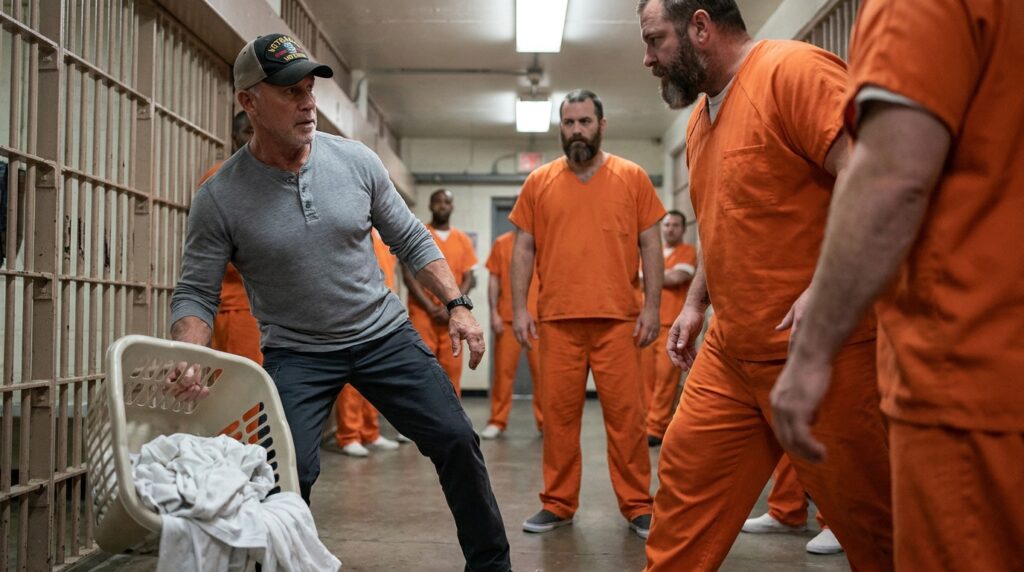
Frank didn’t release his grip on the three-wheeled utility cart’s iron handle. He let the frame settle against the front edge of the steel security counter, the cold metal clinking against the laminated wood with a dull, heavy resonance. He reached slowly into the inner pocket of his gray long-sleeve shirt, his fingers passing over the thick canvas stitching until they found the stiff, oilskin corner of the metal-bound logbook hidden against his ribs.
“The linen count is logged and verified,” Frank said. His voice was lower than Miller’s terminal hum, a flat, desaturated sound that seemed to pull the ambient noise out of the small office space. “The manifest matches the bags on the tier. If there’s a delay, you’ll find the bottleneck in your own ledger, Miller.”
The young guard’s fingers froze over the mechanical keyboard. He finally lifted his head, the blue light from the monitors reflecting off his clean-shaven jaw and the rigid, unearned lines of his corporate uniform shirt. He looked at Frank’s faded veteran cap, then down at the scuffed leather shoes that remained anchored exactly two inches behind the red intake line painted on the floor.
“I don’t need to look at my ledger,” Miller whispered, his eyes narrowing as he leaned forward, invading the clearance of the counter space. “The report’s already filed. Incident on Tier 3: contractor negligence leading to a physical disruption with an inmate population leader. That’s an automatic security pull, Mac. By Friday morning, your clearance code won’t even open the employee turnstile.”
Frank didn’t flinch. He didn’t drop into a tactical stance or shift his weight over his hips. Instead, he pulled the metal-bound logbook from his shirt flap and dropped it flat onto the center of the laminated desk, dead center over the plastic keyboard cord. The heavy oilskin cover hit the wood with a solid, unyielding thud that caused Miller’s proximity badge to slide two inches to the left.
“Open page fourteen,” Frank said softly.
Miller didn’t reach for the book immediately. He looked at the faded ink of the anchor tattoo on Frank’s wrist, then at the grayed, scuffed corners of the metal binding. The silence in the intake station grew thick, pressurized by the sudden drop in the young guard’s confident breathing. Outside the glass partition, the distant hum of the facility’s central ventilation system sounded like a dying engine grinding its gears against a rusted housing.
With a slow, slightly uneven movement of his hand, Miller flipped the oilskin cover back. His eyes tracked the clean, metronomic print of the facility’s administrative clerk—the rows of badge numbers, the specific retirement calculation codes, and the precise monetary figures marked next to his own family name. As his gaze crossed the final column where his digital signature password was cross-referenced with a private corporate ledger entry, the color drained from his face, leaving his skin looking as desaturated and gray as the concrete walls behind him.
“This doesn’t leave the block,” Miller muttered, his fingers tightening against the edge of the ledger page until the paper gave off a dry, crinkling hiss. He didn’t look up at Frank’s face; his eyes remained glued to the ink that systematically dismantled his administrative authority. “If the warden sees this out of the canvas lining, the whole tier goes into lockdown before the shift change.”
“The ledger stays right here,” Frank said, his hand descending onto the top of the oilskin cover, his thumb locking the page down against the desk. “And your report changes before the noon whistle clears. Write it up as a routine linen collection, Miller. No disruptions, no delays, and no file adjustments for Tier 3.”
Miller’s jaw worked silently, the thick muscle along his throat twisting as he looked at the flashing red cursor on his screen. For five long heartbeats, the digital clock on the monitor wall was the only active element in the room, its numbers shifting with a cold, plastic click that marked the steady collapse of the young guard’s corporate trap. He reached for the mouse, his hand visibly shaking as he cleared the pending incident field and re-locked Frank’s personnel profile into a green, compliant status.
“The warden’s still signing the privatization contract on Friday, McAllister,” Miller whispered, his voice stripped of its previous institutional arrogance. “You can’t hold a perimeter when they change the entire fence.”
“The fence isn’t my concern,” Frank said, pulling the logbook back into his shirt flap and buttoning the canvas cover down with a precise, unhurried click. “The watch is. Keep the lane clear, Miller.”
He turned on his heel, his polished boots hitting the scuffed linoleum with the same metronomic cadence he had used on the concrete tier, leaving the young guard alone in the blue, humming glare of his failing network.








