
CHAPTER 4: THE SHATTERED AXIS
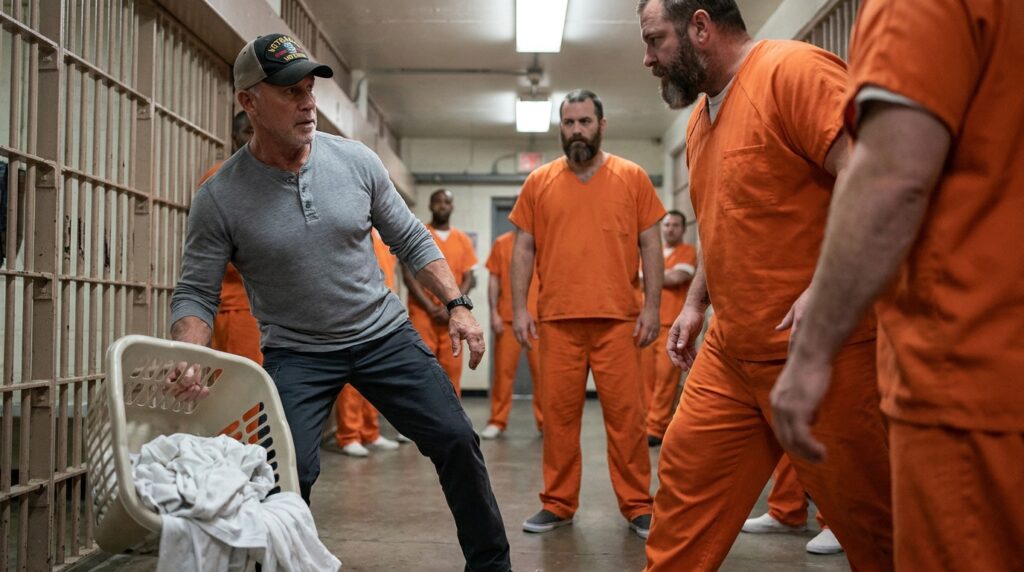
The mechanical click of the remote camera had barely cleared its housing when Big Vance moved. He didn’t drop his shoulder or raise his arms into a recognizable street-fighting posture. Instead, he simply dropped his mass forward, using the dead weight of his six-foot-four frame to crowd the remainder of the lane. It was a prison yard check, an old tactic designed to split an opponent’s balance over a fixed low obstacle before their muscle memory could account for the transition.
Frank’s lead boot caught the edge of the iron laundry cart as Vance’s chest collided with his left shoulder. The impact carried the heavy, unyielding physics of a moving flatcar. The scuffed concrete floor offered no friction; the layer of chemical floor stripper had left the surface slick, and Frank’s heel sheared across the gray linoleum joint. His fingers stripped away from the cold iron handle of the cart. The heavy canvas basket tipped instantly, its metal base plates screeching against the floor pins as twenty bags of institutional sheets slid out across the concrete lane.
The fall was slow, measured by the internal clock of a man who had dropped through tree lines under a heavy chute. Frank didn’t reach out his hands to break the descent—doing so would risk a fractured radius or an exposed throat. He folded his left elbow inward, tucking his chin tightly against the stiff collar of his gray shirt as his hip took the primary shock of the concrete. The scuffed surface bit into his skin through the dark tactical pants, a sharp, unvarnished heat that radiated into his lower vertebrae.
Vance stood over the scattered pile of white linens immediately, his massive boots pinning one of the stenciled canvas straps beneath his heel. The bright orange cotton of his prison trousers blotted out the desaturated light from the lower cells. He didn’t follow up with a boot to the ribs. He remained stationary, his broad chest rising and falling, a physical monolith establishing a territorial lockout in the blind spot of the tier’s security network.
“You’re in the wrong lane, old man,” Vance said. The words were low, targeted at the floor rather than the tier at large. “And you’re cleaning up my mess next.”
Around the perimeter, the silence deepened until the sixty-cycle vibration of the fluorescent tubes became the only audible layer of the tier. The inmate witness layer shifted closer to the rusted mesh of the cell fronts, their faces entirely unreadable in the yellow wash of the block. They weren’t cheering. In a federal facility, an escalation of this weight was viewed as a transactional shift; they were observing the structural damage to see how much territory would change hands before the afternoon shift change.
Frank lay motionless for two full heartbeats, his face less than three inches from a faded stencil on the spilled canvas that read US-DOC-PROPERTY. He could smell the sour starch of the sheets and the sharp, alkaline odor of the floor wash. His left shoulder throbbed where Vance’s mass had compressed the joint against the iron frame of the cart, but his breathing remained rhythmic, a metronomic four-count sequence that suppressed the adrenaline spike before it could compromise his motor control.
His fingers closed around the coarse, woven edge of the tipped laundry basket. He didn’t look up at Vance’s face. He looked at the larger man’s center of mass—the thick drawstring knot of his orange trousers, the slight tilt of his left hip that indicated his balance was forward, over-extended on the pinned strap. A younger man would have used the floor to launch an upward strike, an emotional response that would invite a counter-grapple from someone with Vance’s physical leverage. Frank didn’t seek a strike. He sought the alignment of his spine.
He pulled his knees toward his chest, his boots finding traction against the small metal lip of the utility locker’s bottom runner. The cold iron gave him a solid anchor point. With a single, explosive extension of his thighs, he drove his hips backward, sliding his torso out from beneath Vance’s immediate shadow and creating three feet of critical clearance along the scuffed concrete lane.
The movement was silent, devoid of the theatrical grunt of an aging worker in distress. As his boots cleared the spilled linen, Frank planted both palms flat against the gray floor plates, using the leverage to swing his torso up into a rigid, vertical axis. He didn’t stand all the way up yet; he remained in a low, deep crouch, his weight centered over his mid-foot, his hands rising instinctively to his chest level with the fingers curled into a loose, deceptive guard.
Vance’s expression didn’t change from its mask of bearded indifference, but his right boot slipped half an inch off the canvas strap as Frank re-established his spatial perimeter. The larger man’s eyes narrowed slightly, tracking the speed of the recovery. It wasn’t the scramble of a civilian civilian contractor who had lost his balance; it was the precise, weight-distributed repositioning of a tactical operator resetting an interior defensive perimeter after a structural breach.
The yellow light flickered once above the utility locker, casting long, fractured shadows across the white sheets that separated the two men. From the far corner of the tier, the automated camera began its slow, pneumatic rotation back toward the lane, its internal gears giving off a dry, high-pitched whistle that signaled the end of the five-second blind spot.








