
CHAPTER 10: THE MIDNIGHT DEFENSE
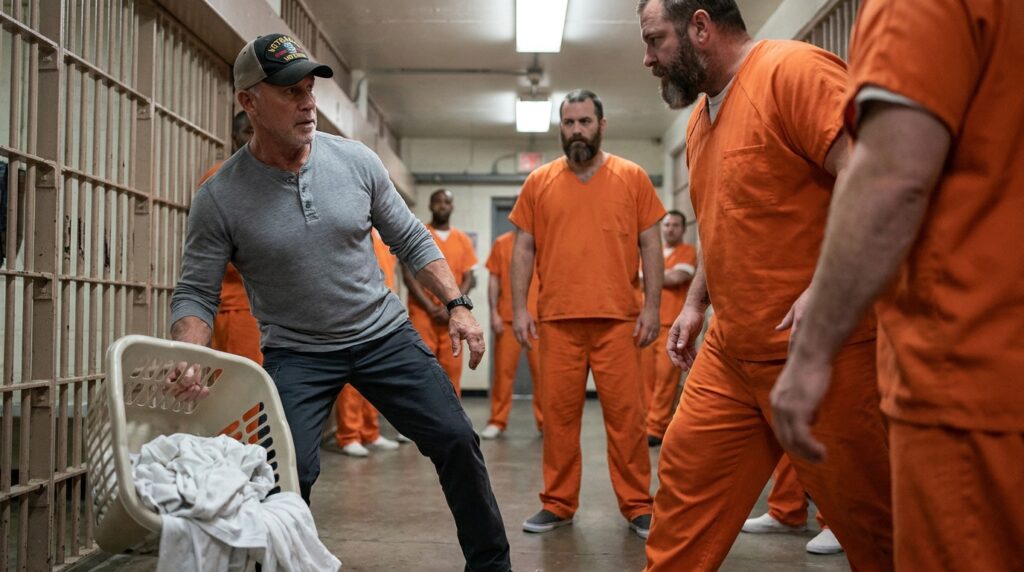
The cold iron pipe cut through the dim, amber-pulsing dark with a dry, hollow whistle. Big Vance threw the strike with the unvarnished momentum of a man who used a concrete tier as a private range, aiming a horizontal kill-stroke directly at the left temple of Frank’s veteran cap. It was an executioner’s angle, designed to use the full weight of his broad shoulders to crush the defensive perimeter before an older target could pivot away from the utility locker frame.
Frank didn’t duck, and he didn’t lean his torso backward into the narrow blind spot of the tier. He used the small steel lip of the drainage run behind his right heel as a fixed launching block. As the iron pipe cleared the shadow of Cell 312, Frank dropped his center of gravity three inches, shifting his mass onto his lead leg with a tight, sudden rotation of his hips that allowed the pipe to pass exactly two millimeters above his tucked chin. The displaced air smelled sharply of hot rust and the cheap grease coating Vance’s knuckles.
The counter-movement was a matter of basic physics, an old tactical formula drilled into his spine during deep-recon drops when an extra ounce of movement meant a blown perimeter. Frank kept his hands loose, palms open, his forearms acting as an unyielding wedge. Before Vance could reset his hips for a secondary back-swing, Frank stepped directly into the larger man’s shadow, closing the thirty-centimeter gap until his chest pressed against the wet orange cotton of the inmate’s uniform. His left hand locked onto Vance’s right wrist, his calloused thumb driving into the small, soft recess between the radius and the ulnar nerve.
The pipe hit the scuffed concrete floor with a heavy, metallic clank that echoed down the hollow throat of the corridor, the iron ringing like a dull bell through the dark.
Time dilated, slowing to the metronomic rhythm of Frank’s internal four-count breathing. In the amber wash of the emergency lights, every sensory anchor became hyper-magnified: the coarse, fraying stitches of the canvas sheets scattered beneath their boots, the sharp, acidic heat radiating off Vance’s bearded jawline, the damp, slick layer of chemical floor wash that made every foot adjustment a calculated risk against the linoleum. The surrounding circle of orange trousers stayed frozen, their arms folded, their silent witness layer paralyzed by the realization that the old man hadn’t scrambled or thrown a panic strike—he had absorbed the threat and dismantled the lever before the riot mandate could establish its trajectory.
Vance gasped, a sudden, wet rattle inside his neck as his center of gravity tipped backward over the laundry cart frame. He tried to drive his left forehead forward for a headbutt, his heavy teeth bared under his beard. Frank didn’t offer an axis for the collision. He pivoted on his lead heel, using Vance’s own forward momentum to swing the massive body forty-five degrees to the right, driving the inmate’s broad shoulder blades into the heavy iron mesh of the security cabinet with a crushing, structural thump.
The steel bars groaned under the impact, a cloud of dry concrete dust dropping from the ceiling joints like gray snow over Frank’s cap. Frank held him there, his open palm clamped over Vance’s throat, his thumb maintaining the exact necessary pressure against the carotid artery to suppress a secondary surge without rupturing the tissue. His weathered face remained perfectly flat, an unvarnished block of timber untouched by anger or tactical exhaustion.
“The clock is still ticking, Vance,” Frank whispered. His voice was a flat, desaturated drone that stayed beneath the roaring ambient chaos of the tier. “The ledger is in my pocket, and the report is locked on Miller’s desk. You’re fighting for a private board that cleared your faction’s transfer papers three hours ago.”
Vance’s eyes widened, his pupils expanding in the amber light as his breathing became shallow beneath Frank’s hand. The realization hit him not as a blow, but as a cold, structural calculation: the warden’s remote lock override wasn’t an escape route for his faction; it was a total containment protocol. The corporate privatization plan didn’t have room for a tier boss who knew the pipelines; the riot was designed to justify an automatic, high-lethalty sweep by the state tactical units, cleaning the entire human ledger—inmates and senior staff alike—before the private insurance companies signed the deed on Friday.
The heavy steel gate at the far end of the throat gave off a sharp, hydraulic hiss—the sound of the secondary emergency pins releasing as the state response squads finally hit the perimeter line.
Frank released his grip, stepping back two inches behind the red intake line of the lane. He reached down without looking, his fingers closing over the iron handle of his three-wheeled utility cart, pulling the heavy canvas frame back into its strict vertical axis. Vance didn’t reach for the dropped pipe on the floor. He stayed backed against the rusted security bars, his hands hanging loose, his chest rising and falling as the heavy, rhythmic boot falls of the approaching tactical line began to shake the concrete plates of Tier 3. Frank adjusted the low brim of his veteran cap, his posture locked, his perimeter absolute as he prepared to face the final clearance of the run.








