
CHAPTER 3: THE PRESSURIZED SILENCE
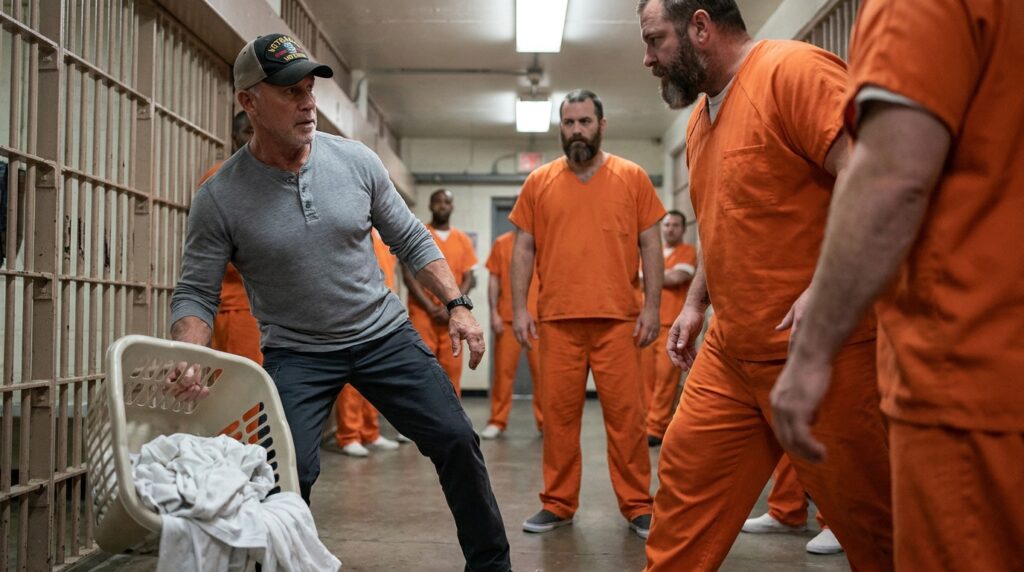
The low, industrial hum of Tier 3 shifted long before Big Vance made his second physical adjustment. To an untrained ear, the block always sounded the same—a baseline drone of extraction fans, rusted water lines knocking against reinforced masonry, and the distant, dry rattle of steel bunks. But Frank had spent three years listening to perimeter fences breathe in high-altitude crosswinds; he knew the exact density of a room’s atmosphere when the internal structure began to flex under structural stress.
The yellow-gray wash from the overhead fluorescent fixtures felt heavier now, catching the airborne lint and dry concrete dust that drifted from the utility run. The three-wheeled laundry cart sat dead locked, its rusted frame angled slightly against the masonry joint where the scuffed floor met the steel base plates of the cells. Vance had his left hand braced against the rusted locker jamb, his thumb resting less than an inch from the padlock staple where the fresh, translucent bead of machine oil gleamed. He wasn’t pushing yet. He was simply existing in the space, his broad chest rising and falling with a slow, heavy rhythm that smelled faintly of salt and state-issued starch.
“You’ve got a lot of miles on those boots, McAllister,” Vance said, his voice dropping into a flatter, more transactional tone that didn’t reach the control bubble thirty yards away. His eyes remained fixed on Frank’s collarbone, watching for the minor muscle twitches that betrayed an impending pivot. “But miles don’t buy you any track up here. This locker doesn’t need your fingers inside it.”
Frank left his right arm extended toward the iron latch, his knuckles precisely two inches from the rusted iron tongue. The blue ink of the anchor tattoo on his wrist looked faded under the sodium lighting, the edges of the ink frayed by years of manual labor and salt water. In his peripheral vision, the cell doors on the lower tier remained silent, but the shadows behind the rusted mesh were moving. Heads were low, bodies leaning against the bars to catch the angle of the run. None of them were shouting. The absence of noise on a high-security tier wasn’t a sign of compliance; it was a sign of organization. They were waiting for the friction point to declare its parameters.
“The inventory requires a baseline match,” Frank replied. His internal voice was counting the seconds between the control bubble’s automated sweep cycle. The rotating camera at the far end of the tier gave a rhythmic, pneumatic shhh-clack every eighteen seconds as its internal gears reversed. It had seven seconds left before its lens swung back toward the laundry blind spot. “The manifest was pulled from the main office an hour ago. If the count is short, the tier stays locked during the afternoon yard run.”
Vance’s bearded jaw tightened, the thick muscles along his neck hardening into solid cords under the orange cotton collar of his shirt. He didn’t drop his stance, but his fingers slipped off the locker jamb, his palm hitting the cold iron door with a hollow, metallic thunk that echoed through the concrete throat of the block. “The manifest is a piece of paper, old man. Papers get lost between the desk and the incinerator. Miller knows that. If you were as smart as your file says you are, you’d be down at the gate house smoking a stale cigarette instead of trying to look heavy in a gray shirt.”
The reference to his service record was the second indicator. Frank didn’t have his military history stamped on his civilian badge; his file was supposed to be restricted to the warden’s personnel cabinet in the administrative wing. The fact that a tier boss on a locked block could quote the contents of an off-limits ledger meant the information pipeline wasn’t just leaking—it was being directed. The fresh oil on the lock, Miller’s dismissive warning at the turnstile, and Vance’s spatial lock on the linen supply weren’t separate incidents. They were the mechanical linkages of a larger structural alignment designed to force an error.
Frank didn’t allow his eyes to wander toward the high windows where the dry noon sun hit the perimeter wire outside. He focused entirely on the distance between his lead boot and Vance’s forward heel. The space was forty-two centimeters. If Vance initiated a shoulder check or an intentional crowd, the physics of the concrete floor favored the larger man’s mass unless Frank adjusted his center of gravity before the impact point. He could feel the old, deep ache in his lumbar vertebrae—the physical price of three decades spent under the unyielding weight of combat gear and transport pallets—but his legs remained steady, his weight distributed fifty-fifty across the thick rubber soles of his tactical shoes.
“The lane belongs to the facility, Vance,” Frank said, his voice retaining its flat, measured cadence. He didn’t lift his hands into a defensive guard, but he let his shoulders square slightly, reducing the profile of his chest. “And the locker opens on my shift. Step back from the cart.”
Vance didn’t drop his head or pull his chin in for a charge. Instead, he let his right arm drop down, his fingers curling into a heavy, calloused fist that hung near the seam of his orange pants. The air between them grew thin, carrying the high, metallic vibration of the tier’s industrial fans. From the far end of the run, the pneumatic camera completed its rotation, its glass lens catching the yellow glare of the lights as it locked onto the dead space behind the utility locker. The five-second window was closing, and the silent perimeter of the block seemed to tighten around them like an ungreased winch.








