
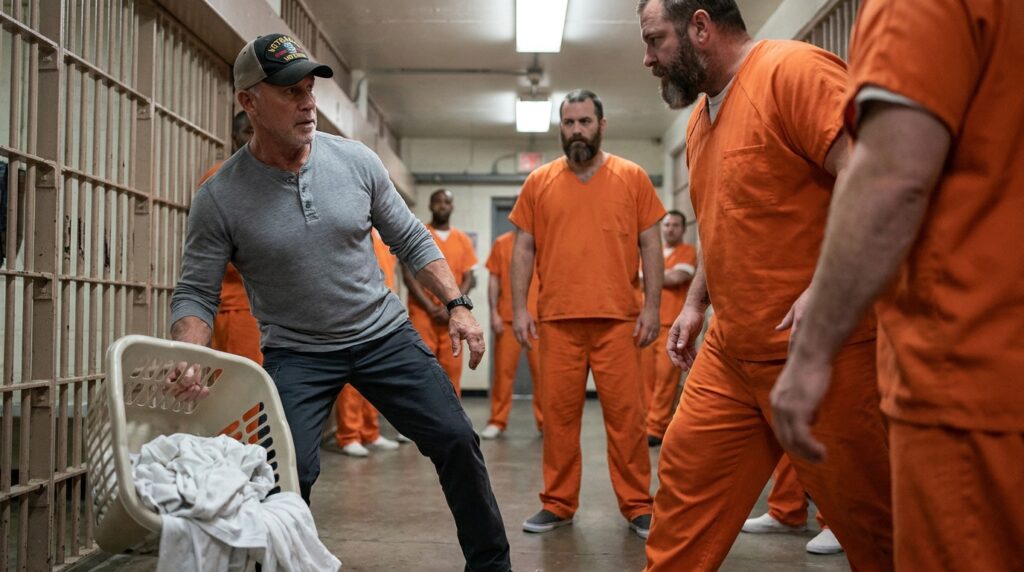
CHAPTER 5: THE GUARDED STANDOFF
“You shift weight fast for a civilian,” Big Vance said.
His shoulder didn’t drop, and his massive fingers remained loose, hanging an inch above the canvas laundry strap pinned under his boot. He didn’t rush into the clearance Frank had opened along the linoleum seam. He simply pivoted on his heel, his center of gravity remaining perfectly centered over his hips. The massive, hairless crown of his head gleamed under the yellow-gray wash of the tubes, casting a sharp, elongated wedge of shadow across the scattered, white institutional linens.
Frank didn’t rise to his full height. He kept his hips low, his boots dug into the small iron lip of the utility locker’s bottom runner to counter the slickness of the floor stripper. His forearms were up, fists unclinched but firm, tracking Vance’s collarbone with a steady, unblinking focus. His left shoulder socket throbbed where the initial impact had jammed the bone against the steel basket frame, a deep, grinding heat that reminded him of the mortar splinter he’d carried out of Mogadishu thirty-odd years ago. He ignored the pulse. In a narrow lane, pain was just noise; it didn’t change the coefficient of friction or the leverage required to stop an engine.
“The camera’s back on the run, Vance,” Frank said. His voice was a flat, unvarnished vibration that barely carried across the three feet of space separating their boots. “Stand down. You’re misreading the room.”
A low chuckle rattled inside Vance’s heavy, bearded jawline. He didn’t look back at the rotating lens whistling at the far end of the tier. “The camera’s got a dirty housing today, old man. Miller forgot to wipe the grease off the glass during the morning inspection. You’re the only one counting seconds on this line.”
The detail was a hard strike. Frank’s gaze narrowed by a fraction of a millimeter. A dirty camera lens meant the control bubble wasn’t seeing a clear perimeter; they were seeing an automated silhouette passing through a pre-set arc. The fresh machine oil on the intake cage lock, the rookie guard’s calculated cynicism, and the tactical blind spot weren’t random institutional failures. They were an invited vacuum. Vance wasn’t just testing a soft target for block status; he was executing a specific, timed contract designed to provoke an explosive physical intervention before the noon whistle could clear the tier.
From the dark cells lining the central corridor, the collective breathing of the witness layer grew shallow. A few younger inmates slid their hands through the rusted mesh, their fingers tapping a light, syncopated rhythm against the iron bars. They were waiting for Frank to break—to throw a desperate punch that would justify Vance using his entire two-hundred-and-fifty-pound mass to systematically dismantle him against the utility locker. If Frank committed to a strike, he was accepting their rules. If he used tactical violence, the report would read like an aging civilian losing control of a detail, providing the administrative justification Miller needed to pull his file from the personnel cabinet.
Frank shifted his lead heel backward by three centimeters, his sole grinding against a stray scrap of coarse, stenciled canvas. He didn’t offer an opening. His guard remained locked on his center of mass, his posture completely absorbing the physical exhaustion of the crouch without allowing his spine to bend.
“I don’t need a clear lens to know your balance is forward,” Frank said, his voice dropping into a colder, more precise cadence. “Go ahead and make your move. I’ve handled far worse than you in tighter spaces than this.”
Vance’s beard twitched as his teeth bared slightly, but his forward boot didn’t leave the floor. His eyes tracked the absolute stillness of Frank’s hands. In the yard, an old man who didn’t shake after hitting the concrete was a different kind of problem; it meant the muscle memory was too deep to be startled out of alignment. The massive inmate remained anchored, his weight testing the line, his massive shoulders blotting out the light from the utility latch as the high-pressure tension of the tier reached its absolute, vibrating limit.
The standoff didn’t break with a blow. Instead, a heavy, electronic rattle groaned through the deck plates from the far end of the run—the sound of the main tier gate pins grinding back into their tracks before the scheduled guard change.








