
CHAPTER 7: THE BALANCED LEDGER
The stiff nylon thread gave way with a dry, jagged rip that sounded like cold iron dragging across shale. Frank didn’t use a knife; his thumbnail, hardened by years of handling canvas transport bundles and field gear, forced the double-stitched seam of the utility cart’s bottom lining apart millimeter by millimeter. The desaturated yellow light of the utility corridor caught the white fluff of severed cotton batting as he reached into the dead space between the structural frame plates.
His fingers closed on something cold, flat, and bound in heavy oilskin. It wasn’t the dense, soft shape of smuggled narcotics or the sharp edge of a machined shank. It was a narrow, metal-bound logbook, its leather cover scuffed and grayed at the corners from constant contact with the damp canvas walls of the linen detail.
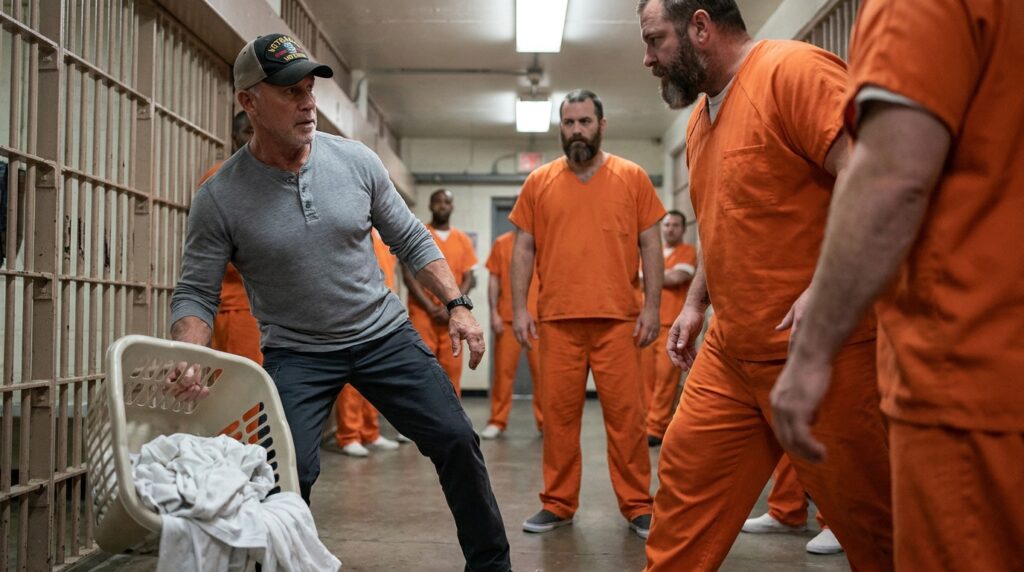
Frank pulled the ledger out into the light. He didn’t open it immediately. He stood motionless in the narrow corridor, his boots aligned precisely with the gray linoleum expansion joint, his weathered face shadowed by the low brim of his veteran cap. The ambient noise of Tier 3 had changed; the noon whistle had cleared the block, leaving behind a vast, hollow silence that smelled of floor stripper and stale cabbage. The iron cell doors stood open in uniform rows, their heavy mesh frames resembling the ribs of a pick-clean carcass under the flickering fluorescent tubes.
He flipped the first page with a slow, calloused thumb. The entries weren’t written in the crude, jagged hand of a tier boss managing a commissary racket. Every line was rendered in the clean, metronomic print of a high-level administrative clerk. There were dates, badge numbers, and specific retirement codes matching every older officer on the facility payroll, including his own. Next to each name was a dollar amount—a projected valuation of saved pension expenditures under the new private management contract—and a corresponding cross-reference to specific disciplinary files managed by Rookie Guard Miller.
Frank felt a cold, physical stillness settle behind his eyes. The decoy layout—the idea that Vance was using the linen carts to move contraband across the blind spots—was completely dismantled by the ink on the page. Vance wasn’t running an inmate enterprise against the system; he was the system’s operational instrument. The fresh oil on the lock hinges, the orchestrated confrontation in the lane, and Miller’s pre-written report about his failing reaction times weren’t separate tactical movements. They were the mechanical linkages of a deliberate corporate purge masquerading as an inmate security crisis. The warden wasn’t trying to clean up Tier 3; he was staging an artificial breakdown of older personnel to clear the legal ledger before the privatization signatures dried on Friday morning.
“You’ve got a steady hand for an old man,” a voice muttered from the threshold behind him.
Frank didn’t look up from the page. He knew the gait—the heavy, uneven drag of Henderson’s left heel against the concrete. The senior supervisor stopped two feet from the back wheel of the cart, his blue wool shirt looking desaturated and dark in the yellow wash of the corridor lights. The brass key block on his belt gave off a single, hollow click as he shifted his weight.
“You knew the alignment before I signed the intake sheet, Henderson,” Frank said. His voice was a flat, low vibration that didn’t bounce off the masonry. “The whole tier’s an empty perimeter.”
Henderson took a slow, heavy breath, his fingers resting passively near the top of his leather utility holster. “The facility’s already gone, Mac. The state closed the funding loop three months ago. The guys who built the lines—the guys who know how to stand a watch without an electronic bar-code—we’re just expensive ink on a state balance sheet. Miller’s faction gets a bonus for every senior folder they clear before the transition team arrives.”
Frank closed the ledger with a dull, heavy thud that echoed through the empty utility run. He didn’t drop it back into the canvas seam. He tucked the oilskin bundle securely into the inner pocket of his gray shirt, buttoning the stiff cotton flap down over the metal binding until the outline was flat against his ribs. The old anchor tattoo on his wrist looked sharp under the yellow tube light, the blue ink dark against his weathered skin.
“They want to test the perimeter,” Frank said, his eyes finally moving to meet the supervisor’s gray gaze. “Let them test it. But tell Miller I don’t move out of my lane until the shift is completed.”
Henderson looked at him for a long, silent three seconds, his jaw setting as the distant bells of the facility clock began to toll the midday change. “They won’t stop at a shoulder check next time, Mac. Vance has the run of the block until Friday.”
“Discipline doesn’t expire when you change the logo on the gate,” Frank said. He grabbed the iron handle of the three-wheeled cart, his knuckles white against the cold metal as he pushed the rattling frame forward into the central lane.
As the cart passed the threshold of Cell 312, Frank noticed a subtle change in the structure. Three middle-aged inmates who had stayed in the shadows during the standoff were standing exactly six inches behind their red cell lines. They didn’t shout, and they didn’t rattle their cups against the mesh. As Frank moved past them, his gray shirt crisp and his boots hitting the concrete with identical, metronomic precision, the lead inmate slowly lifted his right hand and adjusted the brim of a faded orange cap in a silent, rigid acknowledgment that looked exactly like a military salute. The power dynamic hadn’t just broken; it had realigned itself around the old man’s unyielding axis. Frank didn’t return the gesture, but he kept his head up, his gait steady, and his perimeter locked as he wheeled the cart toward the main gate run.








