Chapter 8: A Neighborhood Worth Coming Home To
Six months later, Willow Creek Estates looked much the same from the outside.
The brick houses stood beneath mature oak trees.
Lawns remained neatly maintained.
Neighbors walked their dogs in the early morning, and children rode bicycles along the sidewalks.
But the atmosphere had changed.
The association’s new leadership adopted clearer procedures for reviewing contracts, handling complaints, and documenting maintenance work.
Homeowners received more detailed financial summaries.
Board meetings included meaningful opportunities for residents to ask questions.
Conflicts of interest were required to be disclosed and managed appropriately.
No individual board member could simply declare a violation and impose a penalty without following established procedures.
The drainage repairs were completed by an independent qualified contractor.
Every identified problem was inspected, documented, and addressed according to the applicable requirements.
The old grate beside the Carter driveway was replaced.
Walter photographed the completed work.
This time, the financial records included supporting documentation.
The association also reached a negotiated resolution with Daniel’s company concerning the unfinished maintenance contract.
A portion of the disputed payment was recovered, and the company accepted responsibility for specific contractual deficiencies.
Daniel continued operating his business on a smaller scale.
He no longer performed work for the neighborhood association.
Karen’s injury claim was eventually resolved through the appropriate insurance and legal processes. She did not receive the sweeping compensation she had originally sought.
Her own conduct and knowledge of the maintenance concerns had complicated the matter considerably.
The resolution did not eliminate the association’s expenses, but it allowed the neighborhood to move forward.
Residents whose previous fines appeared unsupported were offered individual reviews.
Several penalties were withdrawn or refunded.
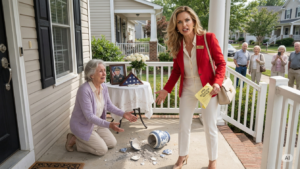
Margaret kept her flowerpots.
Frank kept his mailbox.
Walter’s seventeen-year-old porch bench remained exactly where it had always been.
Emily’s family received written confirmation that the lemonade stand violation had been canceled and that no outstanding balance remained.
Susan placed the letter inside a household records folder.
For the first time in months, she felt completely comfortable opening correspondence from the HOA.
Emily continued volunteering with the accessibility nonprofit.
She helped organize community events, reviewed fundraising materials, and spoke with families adjusting to mobility challenges.
She discovered that her experiences could help others navigate situations that once seemed overwhelming.
The money raised during the summer funded several practical improvements.
One elderly man received a ramp that allowed him to leave his home without depending on his son.
A woman recovering from surgery received bathroom accessibility equipment.
Another family obtained assistance purchasing a suitable mobility device for their teenage daughter.
Emily visited some of the completed projects.
Each visit reminded her that independence was not an abstract idea.
It was being able to reach the mailbox.
It was entering a home without being carried.
It was attending a family gathering without worrying about stairs.
It was making ordinary decisions without needing permission from someone else.
Those small freedoms were worth protecting.
Karen, meanwhile, lived more quietly.
Some neighbors remained unwilling to trust her.
Others gradually resumed greeting her during morning walks.
She understood that rebuilding relationships would take time, and that some relationships might never return to what they had been.
She stopped attending board meetings for several months.
When she finally returned, she sat among the other homeowners.
She listened.
She asked one question about landscaping expenses.
The board answered it.
Nobody was fined.
Nobody was threatened.
The meeting continued.
It was an ordinary exchange, but for Karen it represented a difficult lesson.
Being part of a community did not require being in charge of it.
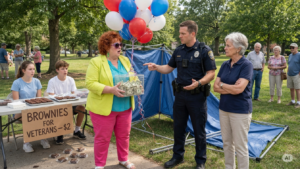
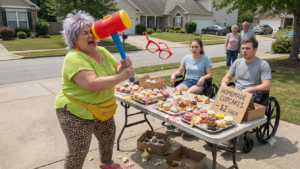
The following summer, Emily organized another lemonade fundraiser.
This time, the event became an annual neighborhood tradition.
Frank brought out the accessible serving table.
Margaret baked her famous pecan pies.
Walter arrived wearing his familiar beige baseball cap and carrying a clipboard for donation records.
Susan prepared sandwiches for the volunteers.
Children decorated cardboard signs.
Older residents brought lawn chairs and settled beneath the shade.
The new storm drain cover sat securely beside the curb.
As Emily poured lemonade into a paper cup, she noticed Karen approaching.
Karen carried a tray of homemade cookies.
She asked whether the volunteers could use them.
Emily smiled and pointed toward the baked goods table.
Karen placed the tray beside Margaret’s pies and began helping arrange the display.
There was no dramatic reconciliation.
No announcement that everything had been forgotten.
Some wounds healed slowly, and trust was something people earned through consistent behavior.
But the neighborhood had made room for improvement without abandoning accountability.
Walter watched the gathering from his chair.
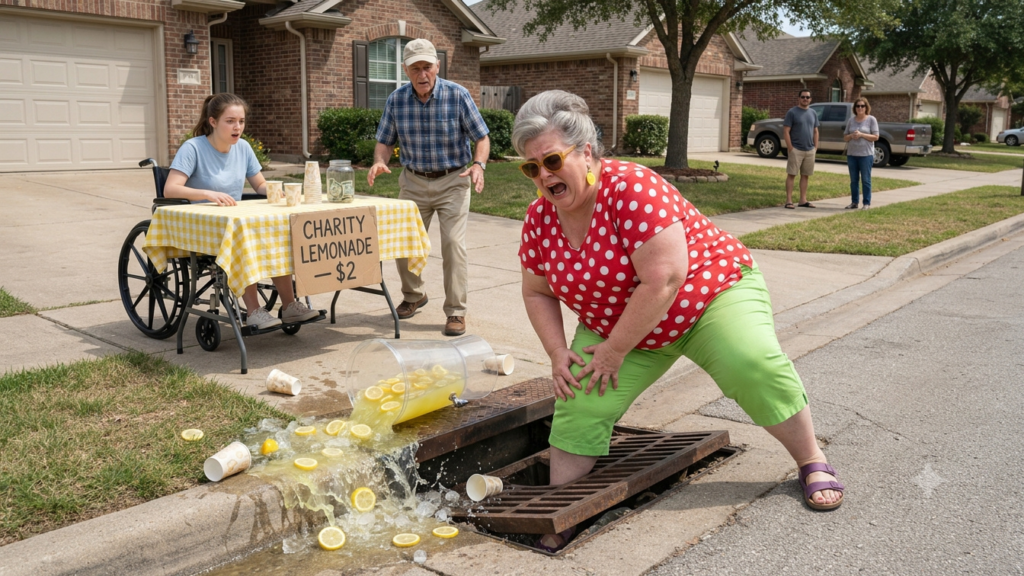
He remembered the moment Karen had fallen into the storm drain.
At the time, it had seemed like an extraordinary example of someone suffering the immediate consequences of her own behavior.
Looking back, he realized that the most important consequence had not been her injured leg.
It had been the neighborhood’s decision to stop accepting unfairness as the price of keeping the peace.
Residents had learned that silence could allow small abuses to become serious problems.
They had learned that kindness did not require surrendering their rights.
And they had learned that helping someone in distress did not mean excusing the harm that person had caused.
Near sunset, Emily poured Walter a final cup of lemonade.
He accepted it with a smile and placed five dollars into the donation jar.
The driveway was filled with conversation, laughter, and the familiar sounds of neighbors enjoying a summer evening.
Emily looked around.
A year earlier, someone had tried to convince her that she needed permission to do something good in her own community.
Now that same community was working beside her.
The lemonade stand had survived.
The neighborhood had changed.
And the people of Willow Creek Estates had finally remembered that a home was more than a piece of property governed by rules.
It was a place where dignity mattered, where fairness belonged to everyone, and where no title gave one person the right to take either away.