Chapter 1: The Woman in the Garage
The sound of a power drill coming from his garage was the first indication that something was terribly wrong.
Robert Mitchell had been standing in his kitchen, pouring himself a cup of coffee, when the unfamiliar mechanical noise interrupted the peaceful Texas afternoon.
Then came a loud hiss.
He abandoned his coffee and hurried toward the garage.
What he discovered made his stomach drop.
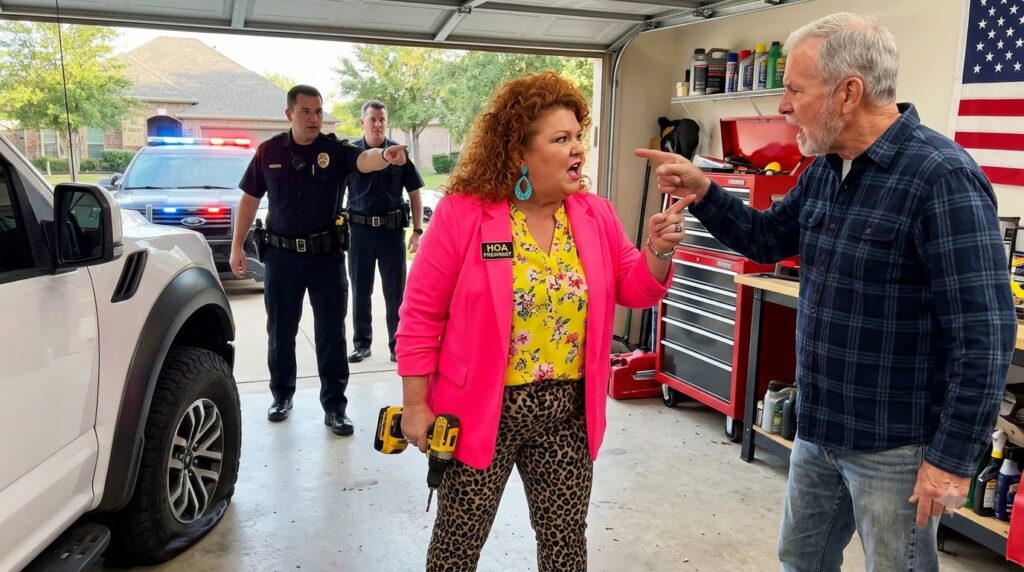
A woman wearing a neon-pink blazer and leopard-print trousers was crouching beside the front wheel of his white Ford F-150 Raptor. Her copper-red curls bounced as she pulled a cordless drill away from the tire.
Air escaped rapidly. The expensive pickup settled toward the damaged wheel.
The woman stood, examined her handiwork, and smiled.
Robert recognized her immediately.
Karen Whitmore, the fifty-eight-year-old president of the Willow Creek Estates Homeowners Association, had been making life difficult for residents for nearly three years.
But until that afternoon, Robert had never imagined she would enter his home and destroy his property.
“What the hell are you doing to my truck?!”
Karen turned without the slightest indication of embarrassment. Her oversized turquoise earrings swung as she raised her chin.
Robert approached the damaged tire, staring at the rubber collapsing beneath the weight of the vehicle.
He had purchased the truck shortly after retiring from thirty-six years of work as an electrical contractor. It was the first expensive thing he had ever bought entirely for himself.
He had spent decades driving aging work vehicles, repairing them whenever they broke down and postponing purchases so his children could attend college without overwhelming debt.
The truck represented years of sacrifice.
And now Karen stood beside it, holding the instrument she had used to damage it.
Robert reached toward the drill, but Karen jerked it away.
“You didn’t pay your HOA fine! I’ll destroy every tire if I have to!”
Her voice echoed through the garage.
She stepped closer, pointing a thick finger toward his face as though she were disciplining a disobedient child.
Robert was sixty-two years old. He had raised two children, supervised construction crews, paid his taxes, and maintained his property without assistance from anyone.
He had never been spoken to like that inside his own home.
Especially not by someone whose supposed authority came from a neighborhood association.
The fine Karen was referring to involved a dispute over his truck being parked in his driveway overnight.
Robert had challenged the violation because the association’s governing documents contained no restriction applicable to his vehicle.
He had requested written clarification.
Instead of providing it, Karen had increased the amount of the fine.
Now she had apparently decided that damaging his truck was an acceptable method of collecting it.
Robert demanded that she leave.
Karen refused.
She insisted that homeowners surrendered certain property rights when they purchased homes in Willow Creek Estates. According to her interpretation, the association could take whatever enforcement measures it considered necessary.
Robert could scarcely believe what he was hearing.
Before he could respond, red and blue lights began flashing across the garage walls.
A police cruiser stopped outside.
Two uniformed officers approached through the open garage door.
Karen’s expression changed immediately.
The lead officer noticed the drill, the deflated tire, and Robert’s furious expression.
“Ma’am! Put the drill down!”
Karen clutched the tool against her chest.
Then she pointed at Robert.
“He owes the HOA! His property is mine!”
For several seconds, nobody spoke.
The officer looked at Karen as though he were waiting for her to explain that she had made a joke.
She did not.
Instead, she repeated that Robert owed money and that she was exercising her authority as association president.
The second officer separated them while his partner instructed Karen to place the drill on the workbench.
This time, she complied.
Robert explained that he had never given Karen permission to enter his garage. He showed the officers the damaged tire and described what he had witnessed.
Karen interrupted repeatedly.
She claimed the garage door had been open. She claimed the truck violated community standards. She claimed that her position gave her permission to enter.
None of those explanations appeared to impress the officers.
A neighbor named Margaret Ellis stood near the driveway, holding her cellphone.
Margaret had seen Karen enter the garage and had heard the confrontation. Concerned that someone might be injured, she had called the police.
Robert silently thanked her.
After documenting the scene and speaking with both parties, the officers placed Karen in handcuffs while they continued their investigation.
Her indignation turned into disbelief.
She demanded that someone contact the HOA’s attorney.
As she was escorted toward the cruiser, several neighbors emerged from their homes.
For the first time in years, Karen Whitmore was leaving a confrontation without having the final word.
Robert remained beside his truck, feeling an unfamiliar mixture of anger and humiliation.
He looked around the garage.
The workbench, the American flag, the red tool cabinets, and the shelves he had built himself suddenly seemed different.
Someone had entered his private space and behaved as though his ownership meant nothing.
That was when he remembered something.
Above the garage workbench, partially concealed beside a storage shelf, was a small security camera.
His daughter had installed it six months earlier.
Robert opened the camera application on his phone.
He expected to find a recording of Karen damaging his tire.
What he discovered instead suggested that the incident had been planned long before she arrived.