Chapter 1: The Woman Who Tried to Buy a Trail That Wasn’t Hers
The first thing Karen Whitmore did that Saturday afternoon was tear down a sign that had stood beside the community’s equestrian trail for nearly twenty years.
The second thing she did was replace it with a demand for money.
“This trail belongs to my son’s company now!” she announced, pressing a new wooden sign onto the metal hooks beside the entrance gate.
The words were painted in thick black letters:
PRIVATE TRAIL — $300 ENTRY.
Karen stepped back to admire her work.
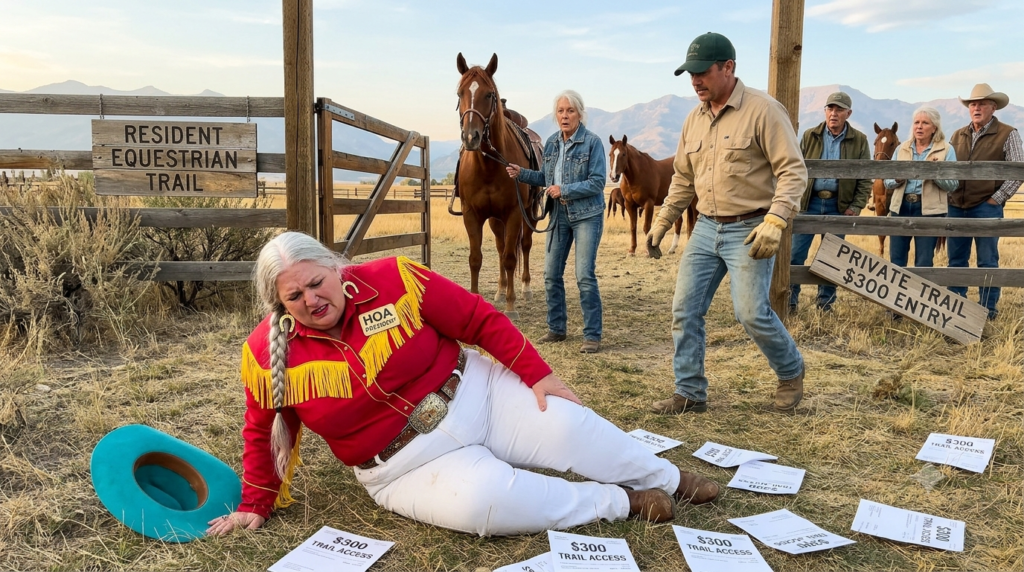
At sixty-one, she was an unmistakable presence in the rural Montana equestrian community. Her enormous frame strained against a flamboyant cherry-red Western jacket decorated with bright yellow fringe. A long silver braid hung down her back beneath an oversized turquoise cowboy hat. Enormous gold horseshoe earrings swung beside her broad cheeks, and a decorative belt buckle stretched across her waist.
A shiny HOA PRESIDENT badge was pinned to her jacket.
Under her left arm, she carried a thick stack of invoices, each demanding $300 for access to the trail.
She looked less like someone maintaining a neighborhood association and more like someone who had arrived to collect tribute from an entire town.
Unfortunately, Karen had no authority to do what she had just done.
The trail was a shared community amenity. Residents had paid for its construction and maintenance through their homeowners’ association dues for years. It crossed several acres of open land, followed a small creek, and connected the neighborhood’s horse properties to a longer public riding route.
For many residents, it was more than a recreational facility.
It was part of the reason they had chosen to live there.
Margaret Ellis, a sixty-five-year-old horse owner, was approaching the gate with her chestnut gelding, Copper. She had ridden the trail countless times since moving into the community.
She stopped when she saw the new sign.
Her weathered face tightened.
“What is this supposed to mean?”
Karen turned toward her, looking irritated that anyone had interrupted her announcement.
“Exactly what it says. Private access. Three hundred dollars per horse.”
Margaret glanced at the discarded sign lying in the dry grass.
It read RESIDENT EQUESTRIAN TRAIL.
“We already pay for this trail,” she said. “It’s included in our HOA dues.”
Karen raised her chin.
“Those dues cover basic community maintenance. Premium access is different.”
“Premium access?” Margaret repeated. “We’ve been riding here for years.”
Karen pulled one of the invoices from her stack and waved it in Margaret’s direction.
“Then you should have no problem paying.”
Behind Margaret, several residents had gathered. Two were holding their horses, while others had come out after hearing Karen’s raised voice.
Nobody seemed to understand what was happening.
A maintenance employee named Daniel Brooks stood beside the fence, holding a pair of work gloves. He had been repairing a loose hinge when Karen arrived with her replacement sign.
He had already told her that he needed written authorization before changing anything.
She had ignored him.
Margaret pointed toward the discarded sign.
“Who approved this?”
Karen’s expression hardened.
“I don’t need to explain every board decision to every resident.”
Daniel looked up.
“Actually, nobody approved it.”
The words landed harder than he intended.
Karen slowly turned toward him.
“Excuse me?”
“I checked with the property manager this morning. The trail is still listed as a shared community amenity. There’s been no vote to change access.”
Karen’s cheeks flushed.
She stepped closer to Daniel and jabbed a finger toward the new sign.
“I’m the HOA president. I decide what happens here.”
Daniel didn’t argue. He simply walked over, lifted the unauthorized sign from its hooks, and placed it against the fence.
Then he retrieved the original sign from the grass.
He brushed off the dirt, reattached it, and opened the wooden gate.
Margaret gave him a grateful nod and began leading Copper toward the entrance.
Karen stared as her carefully staged announcement disappeared in less than a minute.
“You cannot do that!” she shouted.
Daniel continued holding the gate open.
“It’s a shared trail, ma’am. Residents are allowed to use it.”
Karen grabbed her stack of invoices.
“Then I’ll charge you for leaving!”
She rushed toward Margaret, waving the papers and stepping dangerously close to Copper’s hindquarters.
Margaret immediately shortened the lead rope.
“Karen, back away from the horse!”
But Karen was too angry to listen.
Copper pinned his ears back.
His muscles tightened.
Then, in one sudden defensive movement, he delivered a single backward kick.
The impact caught Karen in the upper thigh.
She screamed, lost her balance, and fell heavily onto the dry grass.
Her oversized turquoise cowboy hat flew off. The invoices scattered around her like oversized white leaves.
For a moment, nobody moved.
Karen lay on her back, grimacing and clutching her thigh.
Margaret immediately stopped Copper and looked over her shoulder.
“Is she hurt?”
Daniel hurried toward Karen while another resident reached for a phone.
Karen’s face had changed completely. The anger was gone, replaced by shock and genuine pain.
“My leg!” she cried.
Daniel knelt beside her.
“Don’t try to get up. We’re calling for help.”
Karen looked past him toward the open gate.
The original sign was hanging where it belonged.
Margaret was still holding Copper, and the residents were watching.
Her unauthorized invoices lay scattered across the ground.
Even as the emergency call was placed, Karen managed to glare at Margaret.
“This isn’t over,” she muttered.
But for the first time that afternoon, nobody appeared frightened by her threats.
And the most important question had not yet been answered.
Why had Karen been so determined to turn a community trail into a private business?
The answer was sitting in the stack of invoices Daniel had just picked up.
Each one carried the same company name.
Whitmore Outdoor Services.
Karen’s son’s business.