Chapter 3: The Meeting That Exposed Everything
The emergency HOA meeting was scheduled for Thursday evening in the community recreation hall.
By six o’clock, nearly every chair was occupied.
Residents who rarely attended association meetings had arrived early. Some brought folders containing old maintenance bills. Others carried printed copies of Karen’s emails. Margaret came with Daniel, while Tyler sat near the back of the room, looking uncomfortable.
Karen arrived fifteen minutes late.
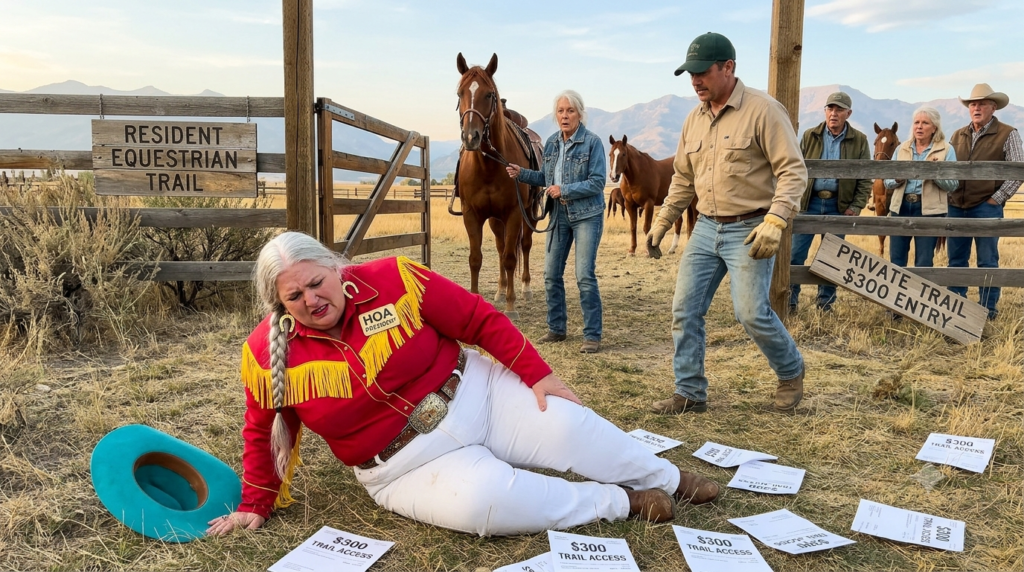
She had traded her Western jacket for a bright purple blouse and a long black skirt. Her silver braid was neatly arranged, and her turquoise cowboy hat was tucked under one arm. She walked with a slight limp but refused assistance.
Her HOA PRESIDENT badge was still pinned to her blouse.
She expected the room to become quiet when she entered.
It didn’t.
Conversations continued until Linda Foster, the property manager, called the meeting to order.
Karen immediately demanded to speak.
She claimed that the entire controversy had been caused by a misunderstanding between herself and a handful of residents who refused to support improvements.
She described the proposed access fee as a reasonable way to generate additional revenue.
She also argued that the community needed a more professional approach to trail management.
Then she turned toward Margaret.
“And perhaps residents who bring large animals onto shared property should be more careful about how they handle them.”
Margaret’s expression tightened.
She had no intention of allowing the meeting to become another argument about Copper.
But before she could respond, Linda placed a document on the table.
It was the association’s approved trail maintenance budget.
The document showed that the community had already allocated funds for fence repairs, drainage improvements, and regular trail inspections.
The budget had been approved unanimously.
Karen’s signature appeared beneath the other board members’ names.
Linda then displayed a photograph of the unauthorized invoices.
Each demanded $300 and listed Whitmore Outdoor Services as the payment recipient.
Finally, she presented Tyler’s written statement.
The room became unusually quiet as Linda read it aloud.
Tyler confirmed that his company had never entered into a contract with the HOA, had never agreed to manage trail access, and had never authorized the invoices.
Karen shifted in her chair.
“That statement doesn’t tell the whole story,” she interrupted.
Linda looked at her.
“Then perhaps you can explain which part is incorrect.”
Karen began discussing preliminary conversations, potential maintenance agreements, and possible future revenue arrangements.
But the questions became increasingly specific.
Who had authorized the $300 amount?
Who had approved the replacement sign?
Who had told Daniel to prepare for a locked entrance?
Where was the board resolution?
Where was the signed contract?
Karen had no documents to produce.
She insisted that she had been acting in the association’s best interests.
A retired accountant named Robert Hayes raised his hand.
Robert had served on the HOA finance committee for eight years. He was known for being patient, meticulous, and almost impossible to distract with emotional arguments.
He had examined the invoices before the meeting.
“Karen,” he said, “you weren’t proposing a fee for future consideration. You were demanding payment from residents. That’s a very different thing.”
Karen glared at him.
Robert continued.
“The money was supposed to go to your son’s company. Was the board aware of that arrangement?”
Nobody answered for her.
Tyler slowly stood.
“I want to make something clear,” he said. “My company never agreed to receive those payments. I didn’t know invoices had been printed using our name. I would never ask people to pay for something they already own access to.”
He looked toward his mother.
“I told you we needed an approved contract.”
Karen’s face reddened.
“You’re making me look like a criminal in front of everyone.”
“I’m telling them what happened,” Tyler replied.
That was the moment the room changed.
Until then, Karen had been able to portray the controversy as a disagreement between herself and difficult residents.
Now her own son was confirming that she had acted without his authorization.
Linda moved to the next item on the agenda.
She presented a formal motion to suspend Karen’s authority to make independent decisions involving shared amenities, vendor contracts, access restrictions, and community payments pending a full review.
The motion passed.
Karen objected immediately.
She accused the board of betraying her and threatened to contact the association’s attorney.
But the other board members remained firm.
The board then voted to require a complete accounting of any money collected or promised in connection with the proposed trail fees.
So far, no payments had been received.
That was fortunate.
However, the board still needed to establish whether Karen had used HOA resources to prepare the invoices and whether any residents had been threatened with penalties for refusing to pay.
Robert requested that all related emails, financial documents, and communications be preserved.
Daniel provided his written account of the gate incident.
Margaret submitted photographs of the discarded sign, the unauthorized replacement, and the scattered invoices.
For the first time, the community was discussing the situation in terms of records, responsibilities, and accountability rather than personalities.
Karen sat silently for several minutes.
Then she made one final attempt to regain control.
“This association would be falling apart without me,” she said.
Robert closed his folder.
“An association isn’t supposed to belong to its president.”
Nobody applauded.
Nobody shouted.
But several residents nodded.
The meeting ended with the original trail access policy formally reaffirmed. The unauthorized invoices were declared invalid, and the board scheduled a special membership vote to determine Karen’s future as president.
As residents began leaving, Tyler approached his mother.
“I tried to tell you this would happen,” he said quietly.
Karen refused to look at him.
“You have no idea what I’ve sacrificed for this family.”
Tyler stood there for a moment.
Then he walked away.
Outside, the evening air was cool, and the distant mountains were beginning to disappear into darkness.
Margaret looked toward the trail entrance.
The old wooden sign was still hanging beside the gate.
But something else had changed.
For the first time, the residents were no longer waiting for Karen to tell them what they were allowed to do.
They were beginning to understand that the authority she had claimed was never hers to give.